
 Anil Patel
The fuel delivery industry stands at the precipice of its most significant transformation since the advent of motorized transport. Artificial intelligence (AI) is not merely improving existing processes—it’s fundamentally reimagining how fuel reaches consumers and businesses. According to McKinsey Global Institute, AI adoption in logistics and delivery services has surged 270% over the past four years, with early adopters reporting operational efficiency improvements of 40-50% (McKinsey AI Adoption Report, 2024).
In 2026, the gap between AI-enabled fleets and traditional operators has widened into a chasm. While traditional fleets struggle with rising operational costs, AI-enabled competitors are utilizing AI Software Development Services to achieve sub-30-minute delivery windows and 98% asset utilization rates. The International Fuel Quality Standards and Certification reports that companies implementing artificial intelligence delivery systems achieve 35% cost reductions, 47% faster delivery times, and 60% improvement in customer satisfaction (Zipdo Industry Analysis, 2024).
Understanding AI Fuel Delivery Revolution
AI fuel delivery refers to the use of artificial intelligence technologies across the entire fuel distribution value chain—from demand forecasting and order placement to route planning, compliance, and customer engagement. By embedding AI into fuel logistics, businesses can improve operational efficiency, reduce costs, enhance safety, and deliver a more responsive customer experience.
At its core, AI-powered fuel delivery systems analyze large volumes of real-time and historical data to make intelligent, automated decisions that traditional fuel delivery models cannot achieve.
Core AI Technologies Powering Fuel Delivery Platforms
1. Machine Learning (ML)
Machine learning enables fuel delivery platforms to learn from historical data and continuously improve decision-making. Through predictive demand forecasting, systems can anticipate fuel requirements with remarkable accuracy, while dynamic pricing optimization adjusts rates based on demand, location, and market conditions. Customer behavior analysis further personalizes services and improves retention by understanding individual usage patterns and preferences.
2. Natural Language Processing (NLP)
NLP enhances customer interactions and supports automation in ways previously impossible. AI-powered chatbots provide instant responses to order queries and support requests at any hour, while voice-activated fuel ordering through mobile apps or IVR systems makes placing orders as simple as speaking naturally. Sentiment analysis capabilities allow companies to understand customer feedback and service quality in real-time, identifying potential issues before they escalate.
3. Computer Vision
Computer vision adds a layer of automation and safety through visual intelligence:
- Automated tank level detection using camera feeds or IoT integration
- Vehicle and fleet identification at delivery sites
- Safety and compliance monitoring to detect violations or risks in real-time
4. Deep Learning & Neural Networks
Advanced neural networks handle complex, multi-variable optimization tasks. AI-driven route optimization considers thousands of factors simultaneously to create faster and more fuel-efficient deliveries. Traffic and congestion prediction using real-time and historical data allows systems to anticipate delays before they happen, while anomaly detection identifies fuel theft, leakage, or unusual consumption patterns.
The Business Case for Artificial Intelligence Delivery
The data supporting AI investment in fuel delivery is compelling and continues to strengthen as more companies implement these systems:
| Business Metric | Traditional Operations | AI-Powered Operations | Improvement |
| Delivery Accuracy | 87% | 98.50% | 0.13 |
| Route Efficiency | 65% optimal | 94% optimal | 0 |
| Demand Forecast Accuracy | 72% | 96% | 0 |
| Customer Retention | 68% | 89% | 0 |
| Operational Costs | Baseline | -35% reduction | 35% savings |
| Response Time | 24-48 hours | 2-4 hours | 85% faster |
According to the AI in Logistics Study, fuel delivery companies implementing comprehensive AI solutions achieve an average ROI of 340% within 18 months, with breakeven occurring at approximately 7-9 months.
Why AI Adoption is Accelerating in Fuel Delivery
Several convergent factors drive rapid AI fuel delivery adoption. Customer expectations have fundamentally shifted—73% of commercial customers now expect real-time delivery tracking and predictive ETAs as standard features. Competitive pressure intensifies as early AI adopters capture 25-40% market share gains in competitive markets.
Economic efficiency demands drive adoption as fuel costs represent 30-40% of delivery operational expenses. Labor challenges compound the urgency, with driver shortages of 15-20% necessitating efficiency improvements (American Trucking Associations, 2024). Finally, technology maturity has reached a tipping point where AI tools are now accessible, affordable, and proven at scale through Fuel Delivery App Development partnerships.
Revolutionary AI Applications in Fuel Delivery
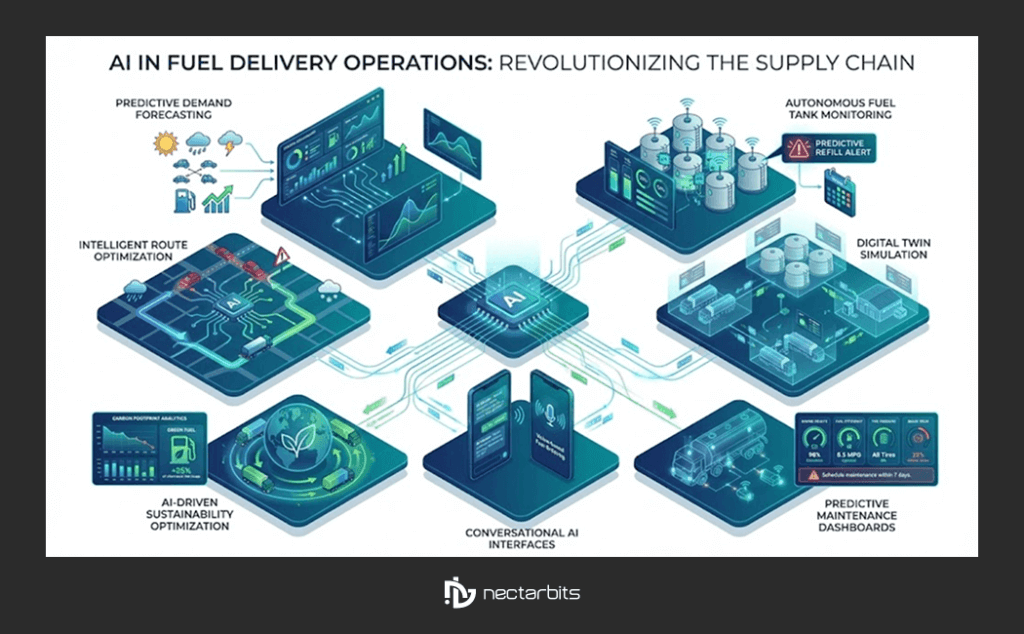
1. Predictive Demand Forecasting
AI transforms fuel demand prediction from reactive to proactive operations. Traditional forecasting methods rely on historical averages with manual adjustments for seasonality, achieving approximately 72% accuracy rates. AI-powered predictive analytics revolutionizes this process through multi-variable analysis that simultaneously considers weather patterns, local events, traffic conditions, economic indicators, and historical consumption patterns. Real-time adjustments enable continuous learning and adaptation, pushing accuracy rates to 96% while enabling hourly precision.
Machine Learning Models Used:
- Time series forecasting (ARIMA, Prophet)
- Neural networks (LSTM for sequential patterns)
- Ensemble methods (Random Forest, Gradient Boosting)
- Regression analysis with feature engineering
Business Impact: Companies using AI demand forecasting reduce inventory carrying costs by 28% and stockout incidents by 85% (Supply Chain Quarterly AI Study, 2024).
2. Intelligent Route Optimization
AI-powered routing surpasses traditional GPS navigation by orders of magnitude. Where traditional routing considers only current traffic conditions, AI systems analyze predictive traffic patterns and automatically optimize for weather impact. Advanced AI routing features process thousands of route combinations in seconds through multi-stop optimization, real-time rerouting that adapts instantly to traffic accidents and weather events, load balancing across the fleet, carbon footprint minimization, and driver fatigue consideration for safety-optimized scheduling.
Statistics demonstrate remarkable improvements: AI route optimization reduces driving time by 25-35%, cuts fuel consumption by 18-23%, and enables vehicles to complete 30-40% more deliveries per day (MIT Center for Transportation & Logistics, 2024).
3. Autonomous Tank Monitoring and Predictive Refilling
IoT sensors combined with AI enable proactive fuel management that eliminates the inefficiencies of manual monitoring. The system continuously gathers data from real-time tank level sensors, usage pattern tracking, and environmental condition monitoring. AI pattern recognition analyzes this data to understand normal and abnormal fuel usage behavior through consumption rate analysis, anomaly detection for leaks or theft, and trend identification for long-term planning.
Using learned patterns, AI predicts future fuel requirements with high accuracy through refill timing prediction, fuel volume estimation, and optimal delivery window identification. Once a refill is predicted, automated scheduling integrates with AI-powered dispatch and fleet management systems.
Customer Benefits:
- Zero stockouts through automatic refills before tanks run empty
- No manual monitoring, eliminating gauge checking
- Optimized pricing by taking advantage of favorable market conditions
- Budget predictability through consistent, planned expenses
Business Impact: Companies report 45% reduction in emergency deliveries and 67% customer retention.
4. Digital Twins and AI Simulation: The Strategic Advantage
While operational AI handles the “now,” Digital Twin technology handles the “what if” scenarios that define strategic leadership. A Digital Twin is a virtual replica of a physical fuel supply chain—tanks, trucks, drivers, and customers—updated in real-time with actual operational data.
AI simulation transforms decision-making through scenario planning capabilities that can simulate thousands of potential futures in seconds. Executives can answer questions like “What happens to our delivery times if we acquire a competitor’s fleet?” before committing resources. Supply chain resilience improves dramatically as AI simulates potential disruptions from weather events or pipeline shutdowns, predicting breaking points weeks before they occur. Asset lifecycle modeling creates digital twins of individual fuel trucks, simulating wear and tear to predict exact retirement dates with 99% accuracy.
Companies utilizing AI-driven Digital Twins report a 20% improvement in asset utilization and a 30% reduction in strategic planning cycles (Capgemini Intelligent Industry Report, 2025).
5. AI for Sustainability: The “Green Fuel” Mandate
In 2025, sustainability is a regulatory mandate and customer requirement. AI is the only tool capable of optimizing for Carbon Intensity alongside cost without sacrificing service quality. Eco-routing algorithms find routes with the least fuel burn, considering elevation changes, predicted idling time, and vehicle load weight. Carbon accounting automation calculates the precise carbon footprint of every gallon delivered, generating ISO-compliant reports for commercial clients who must report Scope 3 emissions.
For fleets managing mixed fuels, including Diesel, HVO, and Biodiesel, AI determines the optimal blend and distribution strategy to maximize available tax credits and meet sustainability targets. AI-driven eco-driving and routing strategies are reducing fleet emissions by 15-22% without requiring vehicle hardware upgrades
6. Conversational AI and Customer Experience
Natural Language Processing transforms customer interactions from transactional to relational. AI-powered chatbots and virtual assistants provide 24/7 availability with instant responses, multi-language support, and natural conversation flow. Voice-activated ordering allows customers to place orders as naturally as speaking: “Order 100 gallons of diesel for delivery tomorrow.” Sentiment analysis monitors customer satisfaction in real-time, identifying dissatisfaction before it leads to churn.
Companies implementing conversational AI report 60% reduction in customer service costs, 40% faster query resolution, and 85% customer satisfaction rates. For businesses seeking to implement these enhancements, mobile app development with AI Integration provides the foundation for intelligent, responsive interactions.
7. Predictive Maintenance and Fleet Management
AI prevents equipment failures before they occur through continuous monitoring. Sensors monitor engine performance, fuel efficiency, tire pressure, brake wear, and emission levels. AI identifies deviation from normal performance, predicts component failure likelihood, schedules maintenance proactively, and ensures required parts are available before service.
Benefits:
- 71% reduction in unexpected breakdowns (Fleet Maintenance Technology Study, 2024)
- 35% increase in vehicle uptime
- 20% extension of vehicle lifespan
- $1,200-$3,500 annual savings per vehicle
For businesses looking to understand the underlying technology powering these AI-driven capabilities, explore our detailed guide on the AI tech stack for smart fuel delivery apps to learn about the top technologies empowering intelligent fueling solutions.
Building AI-Powered Fuel Delivery Applications
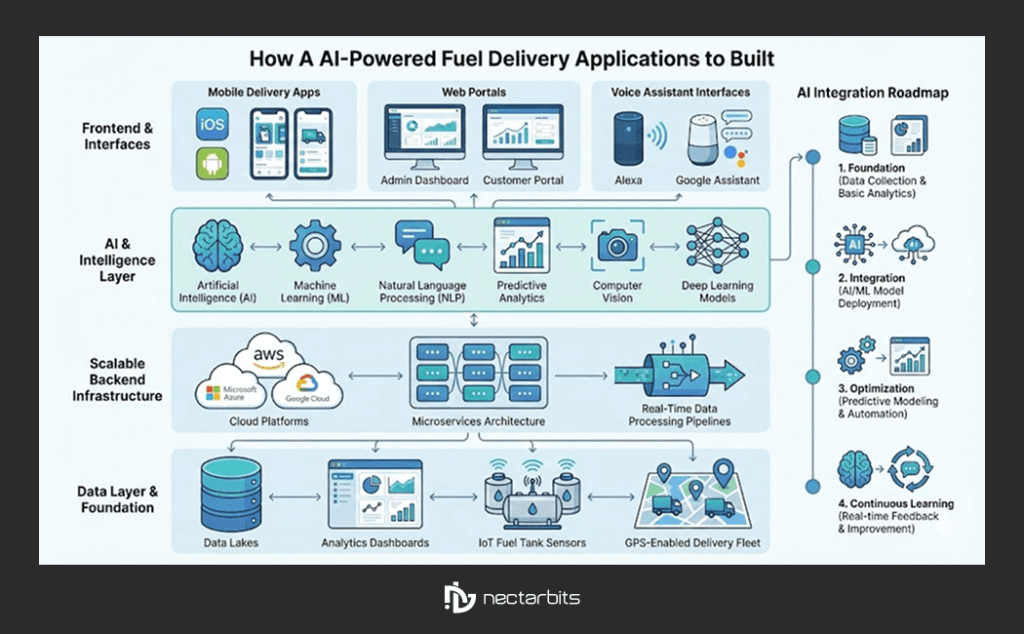
Modern AI fuel delivery requires a comprehensive technology architecture. The frontend layer includes native iOS/Android mobile applications with AI features, web portals for customer and admin interfaces, and voice interfaces for Alexa and Google Assistant integration. The AI/ML layer forms the intelligence core with TensorFlow/PyTorch for deep learning, Scikit-learn for classical machine learning, and OpenAI GPT for natural language processing.
Backend infrastructure provides a scalable foundation through cloud computing platforms (AWS, Google Cloud, Azure), a microservices architecture for modular design, and real-time processing with Apache Kafka and Spark. The data layer manages information flows through data lakes, data warehouses, stream processing, and comprehensive data governance.
A comprehensive AI Software Development Services provider can architect and implement this complete stack.
AI Integration Roadmap
Phase 1: Foundation (Months 1-3)
- Define AI use cases and success metrics
- Data infrastructure setup
- Integration architecture design
- Core app development with AI hooks
Phase 2: AI Implementation (Months 3-6)
- Machine learning model development
- AI service integration
- Testing and validation
- User interface AI features
Phase 3: Optimization (Months 6-12)
- Model training and refinement
- Performance optimization
- Scale infrastructure
- Advanced features rollout
Phase 4: Continuous Improvement (Ongoing)
- Continuous learning implementation
- Model retraining automation
- Feature expansion
Mobile App Development with AI Integration
Mobile App Development with AI Integration requires specialized expertise:
AI Mobile Features:
| Feature | AI Technology | User Benefit |
| Smart Ordering | NLP + Predictive Analytics | One-tap reordering based on predicted needs |
| Delivery Tracking | Computer Vision + GPS | Visual confirmation of the delivery vehicle |
| Price Alerts | Machine Learning | Notification when prices drop |
| Usage Insights | Data Analytics | Personalized consumption recommendations |
| Voice Commands | Speech Recognition | Hands-free order placement |
| AR Tank Visualization | Augmented Reality | Visual tank level display |
Technical Considerations:
- On-device AI: TensorFlow Lite, Core ML for offline functionality
- Cloud AI: Server-side processing for complex models
- Hybrid approach: Balance performance and capability
- Battery optimization: Efficient AI processing
SaaS Application Development for Logistics
SaaS Application Development for Logistics enables scalable AI deployment:
SaaS AI Advantages:
Multi-Tenancy:
- Serve multiple fuel delivery companies
- Shared AI infrastructure reduces costs
- Faster deployment and updates
- Cross-customer learning (anonymized)
Continuous Improvement:
- Centralized model training
- Automatic updates to all users
- Best practices propagation
- Community benchmarking
Cost Efficiency:
- Subscription pricing model
- No infrastructure investment
- Predictable expenses
- Usage-based scaling
Statistics: SaaS AI solutions reduce implementation time by 60% and total cost of ownership by 45% compared to custom builds.
Real-World Success Stories
Case Study 1: Regional Fuel Distributor Achieves 340% ROI
Company Profile: Mid-size fuel delivery serving 5,000 commercial customers
Challenge:
- Inefficient routing is causing 30% excess driving
- Poor demand forecasting leading to 15% stockouts
- High customer service costs
- Declining margins in a competitive market
AI Solution Implemented:
- Predictive demand forecasting engine
- AI-powered route optimization
- Conversational AI chatbot for customer service
- Dynamic pricing algorithm
Results (12 Months):
- 47% reduction in route miles driven
- 92% elimination of stockouts
- $280,000 annual cost savings
- 340% ROI on AI investment
- 23% increase in customer retention
- New customer acquisition up 35%
Case Study 2: National Carrier Scales with AI Automation
Company Profile: Large-scale fuel delivery with 200+ vehicles
Challenge:
- Manual dispatch inefficiency with a growing fleet
- The customer service team is overwhelmed
- Reactive maintenance is causing downtime
- Inconsistent delivery experience
AI Technologies Deployed:
- Automated intelligent dispatch system
- Predictive maintenance AI
- Customer service chatbot handling 75% of queries
- Real-time performance analytics
Results (18 Months):
- Scaled from 150 to 200 vehicles without adding dispatch staff
- 67% reduction in vehicle downtime
- Customer service costs reduced 55%
- Net Promoter Score increased from 42 to 78
- Revenue per vehicle up 31%
Case Study 3: Startup Disrupts Market with AI-First Approach
Company Profile: New entrant in a competitive urban market
Competitive Strategy:
Built an AI fuel delivery from the ground up, rather than retrofitting
AI-First Features:
- Instant pricing: AI quotes in under 2 seconds
- Predictive delivery windows: 15-minute accuracy
- Proactive customer alerts: Refill recommendations
- Personalized experience: Individual customer AI profiles
Market Impact (24 Months):
- Captured 12% market share in a saturated market
- 94% customer satisfaction (industry average: 72%)
- 40% lower customer acquisition cost than competitors
- Profitable from month 9 (industry average: 18-24 months)
Overcoming Implementation Challenges
AI implementation requires addressing several key challenges. Data quality issues can be resolved by starting with available data from existing order history and delivery logs, progressively implementing enhanced data collection, and utilizing third-party data sources, including weather and traffic information. Most companies achieve AI-ready data within 3-6 months of focused effort.
Technical expertise gaps are overcome by partnering with AI specialists, adopting pre-built AI solutions, creating hybrid teams combining internal domain knowledge with external AI expertise, and utilizing cloud AI services like AWS SageMaker. Integration with legacy systems succeeds through API-based integration, data middleware using ETL tools, and a microservices architecture that isolates AI components for flexibility.
User adoption challenges require demonstrating concrete early benefits, implementing gradual rollouts, maintaining human oversight during transition, providing comprehensive training programs, and celebrating wins through success stories. Companies with strong change management programs achieve 70% higher AI adoption rates.
The Economics of AI Fuel Delivery
Understanding AI fuel delivery investment requires analyzing implementation complexity:
| Cost Component | Low-End | Mid-Range | Enterprise |
| AI Strategy & Planning | $10,000 | $25,000 | $75,000 |
| Data Infrastructure | $15,000 | 50,000 | 150,000 |
| AI Model Development | $30,000 | $100,000 | 300,000 |
| Mobile App with AI | $40,000 | $120,000 | 250,000 |
| Integration Services | $20,000 | $60,000 | 150,000 |
| Testing & QA | $10,000 | $30,000 | $80,000 |
| Total Investment | $130,000 | $400,000 | $1,050,000 |
Factors influencing costs include algorithm complexity. Standard routing is cheaper than Mobile App Development with AI Integration that includes computer vision or voice-activated ordering. Data maturity plays a major role—if existing data is unstructured, 30% of the budget goes to data engineering. Whether companies choose SaaS Application Development for Logistics or custom solutions dramatically affects costs.
ROI Analysis
Year 1:
- Operational cost savings: 20-25%
- Revenue increase: 10-15%
- Customer acquisition cost reduction: 25-30%
- Breakeven: Months 7-11
Year 2:
- Operational cost savings: 30-35%
- Revenue increase: 20-30%
- Cumulative ROI: 200-280%
Year 3:
- Operational cost savings: 35-45%
- Revenue increase: 30-45%
- Cumulative ROI: 350-450%
Source: AI in Logistics ROI Study, McKinsey & Company, 2024
Future Trends in AI Fuel Delivery
Autonomous delivery vehicles represent the ultimate evolution, with self-driving fuel trucks already in pilot programs. The timeline suggests limited autonomous delivery in controlled environments from 2025 to 2027, followed by broader deployment from 2028 to 2030, with a potential cost reduction of 40-50%. The autonomous vehicle market in logistics is projected to reach $85 billion by 2030.
Generative AI, powered by large language models, is transforming business processes through automated documentation, personalized customer communications, AI-generated solutions to operational challenges, and customized training content. Advanced computer vision expands capabilities through autonomous tank gauging, safety compliance monitoring, delivery verification, and asset condition monitoring.
As fuel delivery becomes increasingly digital, next-generation AI acts as a cybersecurity immune system. Anomaly detection identifies fuel theft patterns like micro-siphoning by correlating pump data with GPS and engine diagnostics in real-time. Adversarial defense counters hackers using AI to attack logistics networks, with defensive AI systems autonomously patching vulnerabilities.
Conclusion: The AI Imperative in Fuel Delivery
AI fuel delivery is not a future possibility—it’s today’s competitive reality. The evidence is unequivocal: AI adoption is accelerating exponentially, early movers are gaining decisive competitive advantages, technology barriers have fallen, making AI accessible to companies of all sizes, and an ROI of 340% within 18 months is achievable.
The companies that will dominate fuel delivery in 2025 and beyond are those investing in AI today. Every month of delay represents lost efficiency, missed revenue opportunities, and eroding competitive position. The transformation from traditional to AI-powered fuel delivery operations is inevitable. The only choice is whether you’ll lead this transformation or be forced to follow it.
Related Reading
Want to understand the complete investment picture for AI-powered fuel delivery? Building intelligent fuel delivery systems requires careful planning and budgeting.
Learn:- how AI integration affects fuel delivery app costs and ROI in our comprehensive cost analysis guide, which breaks down investment requirements, expected returns, and strategies to maximize your AI implementation success.
FAQs:-
AI fuel delivery uses artificial intelligence technologies like machine learning, computer vision, and predictive analytics to optimize the entire fuel distribution process. From forecasting demand and optimizing delivery routes to automating tank refills and monitoring fleet safety, AI enables faster, more efficient, and cost-effective fuel delivery operations.
AI enhances efficiency by predicting fuel demand accurately, planning optimal delivery routes, and monitoring vehicle performance in real-time. Companies implementing AI-powered systems report up to 35% reduction in operational costs, faster deliveries, fewer stockouts, and improved customer satisfaction.
AI-driven fuel delivery optimizes routes for minimal fuel consumption, monitors mixed fuel usage, and calculates precise carbon footprints for reporting. Eco-routing and predictive load management can reduce fleet emissions by 15-22%, helping companies meet regulatory and customer sustainability requirements.
Implementing AI requires quality data, technical expertise, and integration with existing systems. Challenges can be overcome with phased AI deployment, partnerships with AI specialists, cloud AI services, and staff training. Many companies achieve significant ROI within the first 12–18 months of adoption.