
 Anil Patel
In today’s competitive business landscape, fleet managers and operations directors are constantly seeking ways to reduce operational costs while improving efficiency. One solution that’s gaining significant traction is on-site fuel delivery programs. But how do you determine if this investment makes financial sense for your operation? The answer lies in using a fuel delivery ROI calculator to estimate your potential savings accurately.
The mobile fuel delivery market reached $4.42 billion in 2025 and is projected to grow at a 7.1% CAGR through 2033, signaling a massive shift in how businesses manage their fuel logistics. This growth isn’t just a trend; it’s driven by measurable cost savings and operational improvements that forward-thinking companies are already capturing.
Understanding the True Cost of Traditional Fueling
Before diving into ROI calculations, it’s essential to understand what traditional fueling really costs your business. Most fleet managers focus solely on the price per gallon at the pump, but the hidden costs often dwarf the fuel price itself.
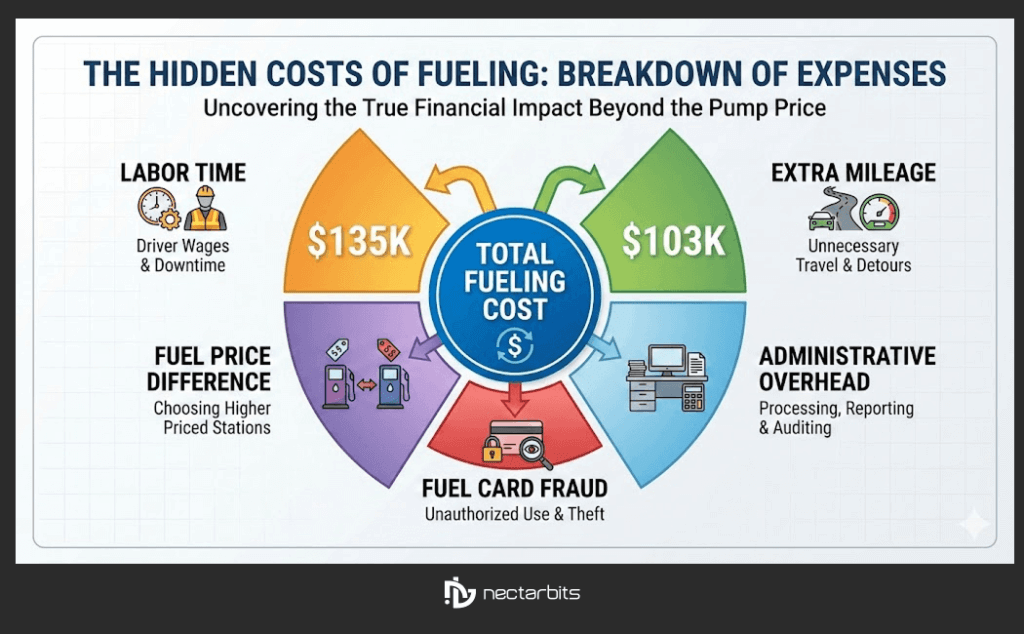
When drivers make fueling stops during work hours, you’re paying for unproductive time. Each fueling stop typically consumes 20-30 minutes per trip, and when multiplied across an entire fleet, the lost hours become substantial. Consider a fleet of 50 vehicles where each driver makes one fueling stop per day. That’s 25 minutes per stop, resulting in 1,250 minutes or roughly 21 hours of lost productivity daily. Over a year, this translates to 5,408 hours of paid time spent on fueling activities alone.
If your average driver cost, including wages and benefits, is $25 per hour, that’s $135,200 annually in labor costs just for fueling stops. This doesn’t even account for the opportunity cost of what those drivers could have accomplished during that time.
The Hidden Costs Include:
- Labor waste: Drivers spending valuable work hours at fuel stations instead of completing deliveries
- Mileage costs: Extra miles driven to and from fuel stations add up quickly across your fleet
- Vehicle wear: Additional trips accelerate depreciation and increase maintenance needs
- Price volatility: Retail fuel stations have unpredictable daily price fluctuations
- Administrative burden: Time spent managing fuel cards, reconciling receipts, and handling disputes
Beyond labor costs, there’s the issue of mileage waste. The loaded cost per mile ranges from $2.50-3.00 per mile, including vehicle, labor, fuel, and other expenses. When drivers travel an extra 3 miles round-trip to reach a fuel station, you’re adding 750 miles per vehicle annually. For a 50-vehicle fleet, that’s 37,500 wasted miles, costing approximately $103,125 per year.
Key Components of a Fuel Delivery ROI Calculator
An effective on-site fuel delivery savings calculator should account for multiple variables to provide accurate projections. Understanding these inputs helps you build a comprehensive picture of your potential savings.
The essential components you need to track include fleet size and consumption patterns, current fuel costs at retail stations, labor rates with benefits included, fueling frequency and schedules, travel distance to fuel stations, operational hours, vehicle types, and annual mileage per vehicle. Each of these factors contributes to your overall cost structure and potential savings opportunity.
| Input Category | What to Measure | Why It Matters |
| Fleet Size & Consumption | Number of vehicles, gallons per vehicle monthly | Determines scale and bulk pricing advantages |
| Current Fuel Costs | Average retail price per gallon over 90 days | Your baseline for comparison |
| Labor Rates | Hourly wage + benefits + overhead | Calculates time savings value |
| Fueling Frequency | How often do drivers stop for fuel | Projects’ total labor hours recovered |
| Travel Distance | Miles to nearest fuel station | Quantifies mileage waste |
| Operational Hours | 24/7 or business hours | Determines optimal delivery scheduling |
Step-by-Step: Calculating Your ROI from On-Site Refueling
The first step in calculating your fuel delivery ROI is establishing your baseline costs. Document your current fuel-related expenses over 90 days to capture realistic averages. Track total gallons purchased, total fuel expenditure, average price per gallon, time spent on fueling activities, and mileage logs showing detours to fuel stations.
Let’s walk through a real-world example. Consider a fleet of 50 vehicles consuming 15,000 gallons monthly at an average retail price of $3.50 per gallon. Your monthly fuel cost is $52,500, or $630,000 annually. But this is just the beginning of your true costs.
Step 1: Calculate Your Total Current Costs
Add up all fuel-related expenses, including direct fuel purchases, labor costs for fueling time, mileage waste, and administrative overhead. For our 50-vehicle example, the annual baseline comes to $868,325 when you include the $630,000 in fuel, plus $135,200 in labor costs and $103,125 in extra mileage expenses.
Step 2: Project On-Site Delivery Costs
Now, calculate what on-site delivery would cost. Using our example, 180,000 gallons annually at a bulk wholesale price of $3.26 per gallon equals $586,800. Add a typical delivery service fee of $0.20 per gallon, which is $36,000 annually. Your total on-site delivery cost would be $622,800.
Step 3: Calculate Net Savings and ROI
Subtract your projected on-site costs from your current total costs to find your net savings. In our example, $868,325 minus $622,800 equals $245,525 in annual savings. With implementation costs of approximately $13,000 for setup and software, your first-year ROI is 1,889% with a payback period of just 19 days.
| Cost Category | Current (Traditional) | On-Site Delivery | Annual Savings |
| Fuel Purchases | $630,000 | $586,800 | $43,200 |
| Labor Time | $135,200 | $0 | $135,200 |
| Extra Mileage | $103,125 | $0 | $103,125 |
| Delivery Service Fee | $0 | $36,000 | -$36,000 |
| Total Annual Cost | $868,325 | $622,800 | $245,525 |
Fuel represents up to 39% of the total operating cost of a truck fleet according to industry research, with individual trucks consuming up to $70,000 in fuel annually. This makes fuel management one of the most impactful areas for cost reduction in fleet operations.
ROI gains depend not only on fuel pricing but also on how efficiently deliveries are scheduled and executed. Fuel Delivery Dispatch Software ensures optimized routing, accurate delivery windows, and consistent service, protecting the savings calculated above.
Read our full guide on fuel delivery dispatch software
Leveraging Technology for Maximum ROI
Modern on-site fuel delivery programs integrate with advanced technologies that multiply your returns. Real-time monitoring, automated scheduling, and data analytics transform fuel management from a reactive task into a strategic advantage.
Reducing fuel waste through real-time monitoring directly increases your ROI from on-site refueling. IoT-enabled fuel monitoring provides instant tank level alerts to prevent unexpected shortages, detects theft to identify anomalies in consumption patterns, and tracks driver behavior to improve fuel efficiency by 30-60%. These systems also deliver historical efficiency data, enabling continuous improvement.
Technology Benefits Include:
- Automated fuel scheduling reduces manual coordination time and ensures optimal delivery timing
- Consumption analytics identify inefficiencies and opportunities for improvement
- Predictive maintenance alerts reduce unexpected breakdowns by 25%
- Driver coaching dashboards improve fuel economy by 12% on average
- Integration with fleet management provides comprehensive operational visibility
Want to go deeper into dispatch technologies that improve fuel delivery ROI? Partnering with a mobile app development Company can help you build custom solutions that integrate seamlessly with your existing operations. Almost 88% of fuel delivery operators now use delivery software in some capacity, with adoption accelerating significantly in 2025.
For businesses looking to develop comprehensive fuel management solutions, fuel delivery app development services can create platforms with automated scheduling, real-time tracking, digital documentation, and integration capabilities that maximize your ROI.

Industry-Specific ROI Scenarios
Different industries experience unique benefits from on-site fuel delivery programs. Understanding how your specific sector can benefit helps you build a more accurate business case.
Construction and Heavy Equipment
Construction fleets face unique challenges with equipment spread across multiple job sites. A typical construction operation with 75 pieces of equipment consuming 1,500 gallons daily across 8-12 active sites can realize substantial benefits. Equipment stays productive on-site rather than traveling for fuel, and idle time is reduced by 30-45 minutes per day, allowing earlier job starts. Bulk delivery to on-site storage tanks provides a guaranteed supply. Construction companies typically see annual savings of $380,000-$450,000 for a 75-unit fleet.
Delivery and Logistics Companies
Last-mile delivery operations prioritize route efficiency above all else. A fleet of 100 delivery vans running 15-20 stops per vehicle daily benefits enormously from overnight fueling that ensures 100% fleet availability at shift start. Drivers avoid the hassle of lost receipts and manual tracking errors, streamlined operations enable earlier departure times, and reduced fuel card management cuts administrative burden. These companies typically achieve annual savings of $420,000-$510,000 for a 100-vehicle fleet.
Municipal and Government Fleets
Government operations face strict compliance and budget requirements that make predictable costs essential. A mixed fleet of 200+ vehicles, including police, fire, public works, and transit vehicles,s benefits from predictable budgeting with fixed-price contracts, enhanced security with controlled access fueling, comprehensive reporting for accountability, and emergency fuel availability for critical services. Municipal fleets typically realize annual savings of $550,000-$680,000.
Related Insight
Reducing fuel loss and idle time is essential to maximizing ROI from on-site fueling across all fleet types. Real-time IoT fuel monitoring provides visibility into consumption patterns, detects anomalies, and prevents pilferage, directly protecting the savings outlined above.
Learn how IoT helps monitor fuel levels and reduce losses
Real-World Case Study: Mid-Size Delivery Company
Let’s examine how a regional delivery company with 80 vehicles implemented on-site fueling and the results they achieved. Before implementation, they consumed 24,000 gallons monthly at $3.42 per gallon for a monthly fuel expense of $82,080. They lost 2,000 driver hours monthly to fueling stops and wasted 4,800 miles on extra trips to fuel stations.
After six months of implementation, their results were remarkable. While their fuel consumption remained at 24,000 gallons monthly, their wholesale delivery price dropped to $3.18 per gallon. Even after adding a $4,800 monthly delivery service fee, their net fuel cost was only $81,120. More importantly, they eliminated all lost driver time and extra mileage.
The financial impact was substantial, with $5,760 monthly savings from fuel price differences, $50,000 monthly from recovered labor time, and $13,200 monthly from eliminated mileage. Their gross monthly savings totaled $68,960, or $827,520 annually. After subtracting the $57,600 annual delivery service fee, their net annual savings reached $769,920. With an implementation investment of just $22,000, their actual ROI was 3,499% with a payback period of only 10 days.
Beyond the impressive financial returns, the company reported unexpected benefits, including improved customer satisfaction from earlier delivery times, increased driver retention as drivers appreciated eliminating the fueling task, decreased safety incidents from fewer miles driven, andthe complete elimination of fuel theft through controlled access fueling.

Common ROI Calculator Mistakes to Avoid
Many businesses underestimate their potential savings by making critical errors in their calculations. Understanding these pitfalls helps you build a more accurate and compelling business case.
Ignoring Soft Costs
Many calculators focus exclusively on fuel price per gallon and miss significant factors like administrative overhead spent managing fuel cards and reconciling receipts, potential insurance premium reductions from decreased accident exposure, extended vehicle service life from reduced wear and tear, and improved employee satisfaction when drivers don’t have fueling responsibilities.
Using Incomplete Data
Base your calculations on actual data rather than estimates. Pull 6-12 months of fuel purchase records to capture seasonal variations, document actual time drivers spend fueling using GPS tracking data, calculate loaded labor costs, including all benefits and overhead, and track mileage waste with telematics data for precision.
Underestimating Delivery Service Value
The delivery fee might seem like an added cost, but consider what it includes, such as guaranteed delivery on your schedule, no storage liability for mobile delivery, avoiding tank ownership costs, professional service with certified drivers and proper insurance, access to fuel management technology, and compliance support with environmental and safety documentation.
Failing to Account for Scalability
Your cost-benefit analysis should consider growth scenarios and how ROI improves with scale. Smaller fleets see solid returns, but larger operations benefit from fixed implementation costs spread across more vehicles, increasing purchasing power that enhances bulk pricing advantages, and operational efficiencies that multiply across the fleet.
Creating a Compelling Business Case for Leadership
When presenting to decision-makers, structure your proposal clearly with a problem statement, proposed solution, financial impact, strategic benefits, and implementation timeline. Your executive summary should concisely present the current fuel operation costs, the proposed on-site delivery program details, total investment requirements, projected annual net savings, ROI percentage, and payback period.
The strategic benefits extend beyond pure financials and include increased vehicle availability and utilization, enhanced driver satisfaction and retention, reduced environmental impact with quantified CO2 reduction, improved safety and risk management, and better budget predictability through fixed pricing contracts.
Support your business case with detailed ROI calculations showing all assumptions, competitive vendor proposals from 3+ providers, industry benchmarks from similar organizations, reference customers with testimonials, and visual aids, including charts showing cost comparisons and savings trajectory.
Conclusion: Transforming Fuel Costs into Strategic Advantage
Understanding and calculating ROI from on-site fuel delivery programs is no longer a luxury; it’s a competitive necessity. With the on-demand fuel delivery market experiencing rapid growth, businesses that delay adoption risk falling behind competitors who are already capturing these efficiency gains.
The numbers speak clearly as companies implementing on-site delivery typically see a 20-35% reduction in total fuel-related costs, a 15-25% increase in fleet productivity, payback periods under 6 months, and sustained ROI exceeding 500% annually. Beyond the impressive financial returns, on-site fueling represents a strategic transformation of how you manage one of your largest operating expenses.
It converts fuel from a reactive cost center into a proactive competitive advantage through predictable budgeting with fixed pricing contracts, enhanced sustainability with quantifiable environmental benefits, improved operations with guaranteed vehicle availability, better data for continuous optimization, and reduced risk through professional service providers.
The key to success lies in thorough analysis using a comprehensive fuel delivery ROI calculator tailored to your specific operation. Don’t rely on generic estimates; use your actual data to project realistic savings and build a compelling business case. Whether you operate a 20-vehicle delivery fleet or a 200-vehicle municipal operation, the fundamental economics of on-site fuel delivery favor adoption.
For businesses seeking additional expertise in optimizing their fleet operations, Software Consulting Service providers can offer strategic guidance on technology integration, process improvement, and custom solution development that maximizes your fuel delivery ROI. The question isn’t whether on-site delivery delivers ROI, but how quickly you can implement it to start capturing value.
See On-Demand Fuel Delivery in Action
Now that you understand the ROI impact of on-site fuel delivery, explore how real-world, on-demand fueling models are transforming daily fleet operations. Learn how doorstep fuel delivery platforms enable fleets to eliminate refueling downtime, improve vehicle availability at shift start, and maintain consistent service levels across distributed locations.
Discover how companies using FuelBuddy-style doorstep fuel delivery apps streamline fueling coordination, reduce manual tracking, and scale operations efficiently, while keeping vehicles running, routes on schedule, and operational costs under control.
FAQs:-
A fuel delivery ROI calculator estimates potential savings from switching to on-site fuel delivery. It accounts for hidden costs like labor, mileage, and administrative overhead, helping you make data-driven decisions for your fleet.
Include fuel purchase costs, labor hours lost to fueling stops, extra mileage, administrative overhead, and delivery service fees. Ignoring these can drastically underestimate your true savings.
Accuracy depends on the data you provide. Using real fuel consumption records, driver hours, vehicle mileage, and labor rates ensures the most reliable projections.
Yes. Even smaller fleets save time and money by reducing refueling downtime, minimizing mileage waste, and improving operational efficiency. ROI scales with fleet size and frequency of fueling.
IoT monitoring, automated scheduling, and fuel delivery software optimize routes, prevent theft, reduce waste, and provide actionable insights, boosting savings and efficiency.