
 Anil Patel
Why Enterprise Fuel Delivery Platforms Need a Purpose-Built Architecture
In my experience working with logistics and on-demand platforms, one thing is clear: basic fuel delivery apps don’t survive enterprise scale. They’re usually built to launch fast, handle limited orders, and support simple workflows. That works early on, but it quickly breaks when large fleets, strict SLAs, and compliance requirements enter the picture.
Fuel delivery is operationally complex. You’re dealing with high-value inventory, real-time dispatch, multiple user roles, and zero room for errors or downtime. This is why custom fuel delivery app development with a purpose-built architecture becomes critical as businesses grow. Without it, performance issues, data gaps, and security risks begin to accumulate.
The difference between consumer apps and an enterprise fuel delivery system lies in control and scalability. Enterprise platforms must support audits, integrations, and long-term growth, not just quick transactions.
In this guide, we’ll focus on how the right architecture enables scalable operations, strong security, and enterprise-ready performance from day one.
Architectural Challenges Unique to Enterprise Fuel Delivery Operations
When fuel delivery platforms grow beyond small-scale operations, architectural complexity increases significantly. An enterprise fuel delivery system must be designed to handle operational risks that don’t exist in basic applications.
1. High-Value Fuel Inventory Management
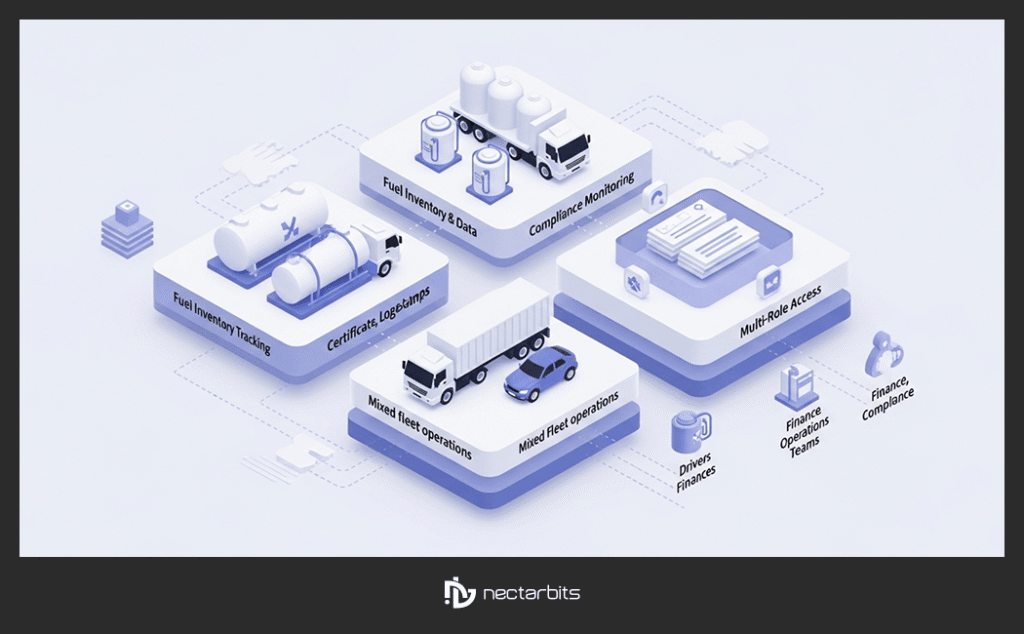
Fuel is a measurable, high-cost asset. At enterprise scale, platforms must track fuel across multiple stages: loading, transit, delivery, and billing. A reliable fuel delivery app architecture requires accurate quantity tracking, seamless reconciliation workflows, and effective exception handling to identify discrepancies promptly. Without this, small variances can quietly grow into significant financial losses over time.
2. Compliance-Driven System Design
Enterprise fuel delivery operates under strict safety, tax, and environmental regulations that vary by location. Architecture must support configurable compliance rules rather than hardcoded logic. In a mature enterprise fuel delivery system, compliance data—such as delivery logs, certifications, and timestamps—is automatically captured and stored for audits, not manually assembled later.
3. Mixed Fleet Operations (Owned and Third-Party)
Most enterprises use a combination of owned vehicles and third-party fleets. Each fleet type has different cost models, service levels, and access permissions. Architecture must clearly separate fleet data and workflows while still allowing centralized visibility. Without this separation, dispatch efficiency and cost reporting quickly break down.
4. Multi-Role Access Across Teams
Enterprise platforms are used by more than just drivers and dispatchers. Finance teams require billing accuracy, operations teams need real-time visibility, and compliance teams need audit-ready records. Role-based access control must be embedded into the core architecture to ensure each team sees only what they need—without compromising security or performance.
These challenges define the foundation of a scalable and reliable enterprise fuel delivery platform. When architecture is designed around them from the start, growth becomes manageable instead of disruptive.
To see how CAFU tackled complex enterprise fuel delivery challenges in real-time, read the CAFU Case Study
Core Layers of a Scalable Fuel Delivery Platform
When teams ask me how to future-proof their product, I always bring the conversation back to structure. A solid fuel delivery platform architecture isn’t about choosing the trendiest tech stack; it’s about clearly separating responsibilities so the system can grow without breaking. Over the years, I’ve seen platforms struggle simply because everything lived in one tightly coupled backend.
Let’s break this down layer by layer.
1. User Interfaces (Driver, Admin, Enterprise Dashboards)
Each user interacts with the platform differently. Drivers need a lightweight, distraction-free app focused on routes, delivery confirmation, and safety. Admin and enterprise dashboards, on the other hand, prioritize visibility—order status, fleet performance, compliance data, and financial summaries. Mixing these concerns leads to cluttered experiences and slower workflows.
2. Application Services Layer
This layer handles core business logic—orders, customers, pricing rules, and permissions. In a scalable fuel delivery platform, this logic must be modular. I’ve worked with platforms that couldn’t add new pricing models without touching half the codebase. Proper service separation avoids that trap.
3. Dispatch & Orchestration Layer
This is the operational heart of the system. It coordinates orders, vehicles, drivers, and time windows. At scale, dispatch becomes a decision engine, not just a routing tool. Rules, constraints, and priorities must be handled independently from the UI and core services.
4. Data, Analytics & Reporting Layer
Operational data should not compete with analytics workloads. Mature platforms separate real-time transactions from reporting systems to avoid performance bottlenecks. This is where insights like cost per delivery or fuel utilization live.
5. Integration Layer (ERP, IoT, Payments)
Enterprise platforms rarely operate in isolation. Clean integration layers allow the system to connect with ERP software, fuel sensors, and payment gateways without disrupting core operations.
When these layers are clearly defined, scaling becomes predictable instead of painful.
How Dispatch Engines Power Enterprise Fuel Delivery Systems
In enterprise fuel operations, dispatch is not just a routing feature—it’s the operational brain of the entire platform. In a well-designed enterprise fuel delivery system, dispatch continuously evaluates changing conditions and makes real-time decisions that keep deliveries on track. I’ve seen platforms with strong front-end experiences struggle simply because their dispatch logic wasn’t built for this level of complexity. Intelligent route optimization can reduce transportation costs by up to 20% for fuel marketers, as highlighted by FleetPanda, lowering miles driven, reducing fuel consumption, and ensuring timely deliveries
- Dispatch as a decision engine, not just routing
At scale, dispatch must decide which order should be fulfilled first, which vehicle is best suited, and how priorities shift when conditions change. A mature fuel delivery app architecture treats dispatch as a live orchestration layer that responds to real-time inputs like driver availability, order changes, and operational constraints. - SLA-driven prioritization
Enterprise customers often operate under strict service-level agreements. Dispatch logic needs to factor in delivery deadlines, customer importance, and penalty risks. When SLA priorities are built into the dispatch engine, platforms can meet enterprise expectations without overloading the fleet. - Vehicle, fuel type, and compliance constraints
Not every vehicle can carry every fuel type, and not every driver is certified for every delivery. Dispatch engines must automatically enforce these rules to prevent unsafe or non-compliant assignments. This removes manual checks and significantly reduces operational risk. - Rule-based versus AI-powered dispatch logic
Rule-based dispatch ensures predictability and compliance, which is critical in regulated fuel operations. As delivery volume grows, AI-driven optimization can be layered in to improve efficiency and adapt to complex patterns. In practice, the strongest systems combine both approaches.
When designed as an intelligent decision layer, Fuel Delivery Dispatch Software makes enterprise fuel delivery platforms more reliable, scalable, and easier to manage under real-world pressure.
Why Event-Driven Systems Are Critical for Real-Time Fuel Operations
As fuel delivery platforms grow, one of the first architectural pain points I see is over-reliance on traditional request-based APIs. They work fine at low volume, but at enterprise scale they quickly become a bottleneck. In a scalable on-demand fuel delivery app Business, thousands of events are happening at the same time: orders are created or modified, drivers update their status, and fuel sensors stream data continuously. Expecting everything to be handled through synchronous API calls simply doesn’t scale.
This is where event-driven design becomes essential to a modern fuel delivery platform architecture.
With request-based systems, every component waits for a response before moving forward. If one service slows down, others are forced to wait. I’ve seen this cause cascading delays, dispatch waits on inventory, inventory waits on sensors, and suddenly the entire operation feels sluggish. Event-driven systems solve this by allowing services to react independently to events as they occur.
In practical terms, event-driven workflows power key real-time operations:
- Orders: When an order is placed, updated, or canceled, events trigger downstream actions such as dispatch recalculation, customer notifications, and billing updates, without blocking the main flow.
- Driver updates: Status changes like “en route,” “on site,” or “delivery completed” are published as events, keeping dispatch and dashboards in sync instantly.
- Fuel sensor data: IoT sensors can stream readings as events, enabling real-time validation and automated alerts when anomalies appear.
A common concern I hear is consistency. Real-time consistency means all systems update instantly, which is expensive and fragile at scale. Event-driven platforms use eventual consistency, where systems sync within seconds instead of milliseconds. For fuel operations, this trade-off improves reliability without affecting decision-making.
Done right, event-driven architecture keeps enterprise fuel platforms responsive, resilient, and ready to scale.
Preventing Fuel Loss with Intelligent Platform Architecture
In enterprise fuel operations, fuel loss rarely happens in one big incident. It usually happens quietly, small mismatches across hundreds or thousands of deliveries. Over time, these gaps turn into serious financial leakage. A strong enterprise fuel delivery system is designed to detect and prevent this early, not after audits raise red flags.
At the core of this problem is the delivered vs billed fuel mismatch. Differences can occur due to meter calibration issues, manual data entry, delayed sensor readings, or operational overrides. Without a well-structured fuel delivery app architecture, these discrepancies are hard to trace and even harder to resolve.
Modern platforms address this using IoT-integrated reconciliation. Fuel meters, vehicle sensors, and depot systems stream data directly into the backend. Instead of relying on human confirmation, the platform compares readings automatically across each delivery stage.
Below is how intelligent reconciliation architecture typically works in enterprise environments:
| Architecture Component | What It Does | Why It Matters |
| Fuel Meter & IoT Sensors | Capture real-time fuel quantity during loading and delivery | Reduces reliance on manual input and improves accuracy |
| Backend Data Ingestion | Collects sensor data and delivery records in real time | Ensures consistent data flow across systems |
| Automated Reconciliation Engine | Matches loaded, delivered, and invoiced fuel quantities | Detects discrepancies early |
| Exception Handling Workflow | Flags mismatches beyond allowed thresholds | Prevents silent financial loss |
| Audit-Ready Logs | Stores immutable, timestamped delivery records | Simplifies audits and compliance reviews |
In one enterprise rollout I worked on, introducing automated reconciliation reduced unexplained fuel variance within the first quarter. Just as importantly, finance and compliance teams gained confidence in the data.
When fuel reconciliation is built into the platform, not layered on later, loss prevention becomes a natural part of daily operations, not a reactive process.
Securing Fuel Delivery Platforms Beyond Authentication
In enterprise fuel delivery, security issues rarely come from hackers alone. In my experience, they usually stem from over-permissioned systems and weak internal controls. That’s why security must be designed into the platform architecture, not treated as a login feature.
- Role-based access control
Different teams need different levels of access. Drivers, dispatchers, finance teams, and compliance officers should only see and act on what’s relevant to their role. This reduces mistakes and limits damage if credentials are misused.
- Insider threat prevention
Most risks come from inside, shared accounts, excessive permissions, or manual overrides. Limiting access by role, location, and operation type helps prevent both accidental and intentional misuse. Insider threats account for a significant share of security incidents, about 20% according to Verizon’s Data Breach Investigations Report. Read the report for more details.
- Immutable delivery records
Once a delivery is completed, critical data like fuel quantity, timestamps, and approvals should be locked. Tamper-resistant records protect the business during audits, disputes, and compliance reviews.
- Zero-trust security principles
Enterprise platforms increasingly verify every action, even from internal users. Each request is validated based on identity, role, and context, reducing risk without slowing operations.
Strong security architecture doesn’t just protect data—it protects trust across the entire fuel delivery operation.
Turning Fuel Delivery Data into Enterprise Intelligence
After working with fuel delivery platforms for over a decade, I’ve learned that data only becomes powerful when it’s structured and actionable. Many scalable fuel delivery platforms fail not because they lack data, but because they mix operational and analytical workloads, slowing everything down during critical delivery periods.
1. Operational vs Analytical Data Separation
In a robust fuel delivery app architecture, operational data (orders, driver updates, sensor readings) is separated from analytical data. This ensures real-time operations run smoothly while reports and analytics process historical or aggregated data without affecting performance. Effective IoT integration in fuel delivery apps plays a key role here, as sensor data can flow continuously into operational systems while also feeding analytics pipelines.
2. Data Lakes and Reporting Pipelines
Enterprise platforms stream raw delivery data into centralized data lakes. Reporting pipelines then transform this into structured insights for operations, finance, and management. I’ve worked with clients who were able to analyze years of delivery history without impacting live fleet operations thanks to this separation.
3. Cost-Per-Delivery Analytics
By combining fuel usage, labor, vehicle wear, and route efficiency, enterprises can calculate accurate cost-per-delivery metrics. In practice, this helps identify high-cost routes or scheduling inefficiencies, directly improving profitability.
4. Vendor and Driver Performance Insights
Analytics track vendor reliability, driver efficiency, and recurring delays. Platforms that surface these insights enable managers to make data-backed decisions rather than relying on intuition alone, improving accountability and operational efficiency.
A strong data architecture doesn’t just store information; it turns fuel delivery operations into actionable enterprise intelligence, enabling smarter decisions and sustainable growth.
Multi-Region & Compliance-Ready Architecture
When I first worked on an enterprise fuel delivery system that operated across multiple states, I quickly realized that scaling beyond a single region is far more than just adding more drivers or vehicles. A global or multi-region operation introduces complex regulatory, financial, and operational challenges that must be addressed in the fuel delivery platform architecture from day one.
One of the core requirements is city, state, and country-level configuration layers. Rules around delivery times, hazardous material handling, and environmental restrictions vary significantly. A platform that allows regional rules to be configured separately—without affecting other regions, avoids operational errors and compliance violations.
Another critical layer is the tax and regulatory engine. Fuel is heavily regulated, and taxes differ by region and fuel type. I’ve seen platforms struggle with manual tax calculations, leading to billing errors and compliance penalties. A robust engine calculates taxes automatically based on location, fuel type, and customer type, ensuring accurate invoicing and reporting.
Multi-currency billing support is also essential for enterprises operating internationally. Some platforms overlook this until expansion, creating delays and manual reconciliation headaches. A flexible architecture that supports different currencies, exchange rates, and payment gateways prevents these issues and streamlines finance operations.
Finally, compliance adaptability must be built into the platform. Regulations change frequently, and enterprises need the ability to update workflows, reporting, and user permissions without major system overhauls. In practice, platforms with this adaptability reduce operational risk, protect the business from fines, and maintain client trust.
A well-designed multi-region, compliance-ready architecture doesn’t just ensure legal adherence; it enables enterprise fuel delivery systems to scale globally with confidence.
Ensuring Reliability in Enterprise Fuel Delivery Operations
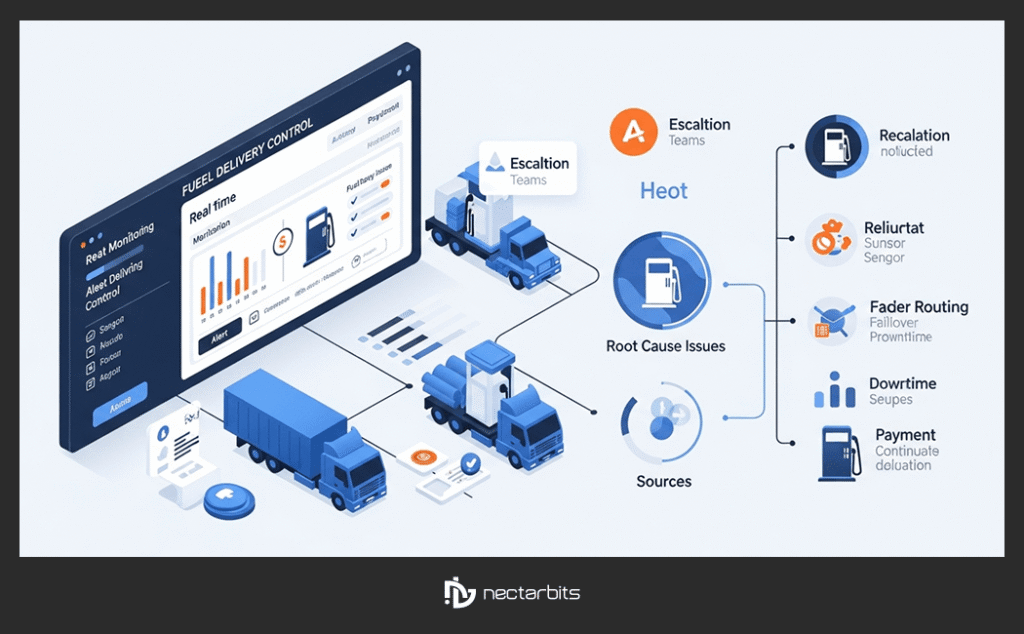
Reliability is critical for enterprise fuel operations. In a scalable Fleet Fueling Solutions platform, even short downtime can cascade into delayed deliveries, frustrated clients, and financial losses. A robust fuel delivery platform architecture builds observability and incident response into the core system.
- Real-time monitoring
Continuously track all system components, orders, dispatch, sensors, and payments. Early detection of anomalies, like unusual delivery times or sensor errors, prevents small issues from becoming operational failures. - Alerting and escalation workflows
Automated alerts notify the right teams immediately based on severity, location, or SLA impact. Multi-level escalation ensures critical issues are addressed quickly, reducing downtime. - Root cause analysis
Detailed logging and traceability allow teams to pinpoint the origin of issues, whether it’s network failures, dispatch logic, or sensor anomalies, and prevent recurrence. - Downtime prevention strategies
Redundant services, failover routing, and load balancing ensure continuous platform operation even under high load or partial system failures.
Integrating observability and incident response into the architecture transforms enterprise fuel delivery platforms from reactive systems into resilient, reliable operations that scale with confidence.
Build vs Buy Decisions in Fuel Delivery Platform Architecture
In enterprise fuel delivery, deciding what to build in-house versus what to buy or integrate is critical for long-term scalability, cost control, and reliability. Here’s a practical approach based on my experience with scalable fuel delivery platforms:
Key Considerations
- Dispatch Engines: Best built in-house for enterprise operations. Handles SLA prioritization, mixed fleet management, and compliance rules.
- Payment Processing: Safer to integrate with trusted third-party gateways for PCI compliance and security.
- IoT & Telematics: Core ingestion and validation logic should be built; sensors and SDKs can be integrated from reliable vendors.
- White-Label vs Custom Platforms: White-label solutions speed up launch but limit flexibility. Custom architecture ensures long-term scalability and control.
Build vs Buy Decision Table
| Component | Recommended Approach | Why it Matters | Example/Insight |
| Dispatch Engine | Build | Handles SLA, fleet, and compliance rules | Custom engine reduced late deliveries by 30% in 6 months |
| Payment Processing | Buy/Integrate | Ensures PCI compliance and security | Integrating Stripe or PayPal saves months of development |
| IoT & Telematics | Hybrid | Sensor data from vendors, validation built in-house | Real-time fuel tracking with automated reconciliation |
| White-Label Platform | Buy (short-term) | Fast deployment but limited flexibility | Suitable for testing markets before scaling |
| Custom Platform | Build | Long-term scalability, security, and compliance | Full control over enterprise-grade operations |
Making thoughtful build vs buy decisions ensures your enterprise fuel delivery system is robust, compliant, and scalable, building trust with both clients and internal stakeholders.
A Practical Reference Architecture for Enterprise Fuel Delivery Platforms
A strong fuel delivery platform architecture connects multiple components into a seamless, scalable system. In my experience, enterprise-grade platforms succeed when modularity and clear boundaries are built into the design from day one.
At the core, user interfaces, driver apps, admin portals, and enterprise dashboards communicate with the application services layer, which handles business logic, permissions, and workflows. The dispatch engine orchestrates deliveries while event-driven pipelines process real-time updates from IoT sensors, driver statuses, and fuel inventory. Analytical and reporting layers draw data from operational systems, providing cost-per-delivery insights, vendor performance metrics, and compliance logs. Integration layers ensure ERP, payment, and telematics systems work without friction.
This modular approach allows platforms to evolve without major overhauls, supporting new regions, compliance rules, or fleet types. A reference diagram here (ideal for visualization) would show how each layer interacts, making it easy for technical teams to align on implementation.
For enterprises exploring scalable fuel delivery systems, platforms like NectarBits showcase how architecture, observability, and compliance work together for long-term success. For a practical example of how enterprise fuel delivery platforms implement these architectural principles, read the Filld App Case Study
Conclusion & Key Takeaways
Building an enterprise fuel delivery platform is more than a fast app—it’s about creating a scalable, secure, and reliable system. Over my 10 years in logistics tech, I’ve seen success hinge on smart architecture.
- Purpose-built for enterprise: Handles mixed fleets, high-value fuel, and SLA-driven deliveries.
- Modular design: Separate layers for UI, dispatch, analytics, and integrations ensure scalability.
- Automation reduces risk: Reconciliation, compliance, and intelligent dispatch minimize errors.
- Security & observability: Role-based access, zero-trust principles, and real-time monitoring protect operations.
- Data-driven decisions: Analytics on cost, vendors, and performance drive efficiency and growth.
A well-architected fuel delivery platform isn’t just technical, it’s strategic. Platforms like NectarBits deliver operational excellence, regulatory compliance, and long-term scalability.
FAQs:
Enterprise platforms must handle high-volume operations, compliance requirements, mixed fleet management, and multi-role access control. Unlike consumer apps, they need robust dispatch engines, real-time telemetry, and detailed analytics to optimize efficiency and reduce operational costs.
Route optimization algorithms reduce miles driven, fuel consumption, and vehicle wear. By considering SLA priorities, vehicle type, fuel type, and compliance rules, an intelligent dispatch engine ensures deliveries are done efficiently. Statistics show enterprise fleets can cut up to 20% in transport costs with optimized routing.
Event-driven systems decouple services, allowing the platform to handle real-time updates independently. This ensures that order processing, driver updates, and fuel sensor data flow seamlessly, without delays. Unlike request-response systems, it improves responsiveness and fault tolerance.
Enterprises use IoT-enabled tank monitoring, automated reconciliation workflows, and audit-ready immutable logs. This allows real-time tracking of delivered vs billed fuel, preventing mismatches and fraud. Platforms that implement these measures can reduce losses by up to 78%.
Role-Based Access Control (RBAC) ensures that drivers, dispatchers, and finance teams access only what they need. Zero-trust principles continuously verify every action, internal or external, reducing the risk and impact of data breaches. Immutable delivery logs further protect against insider misuse.