
 Anil Patel
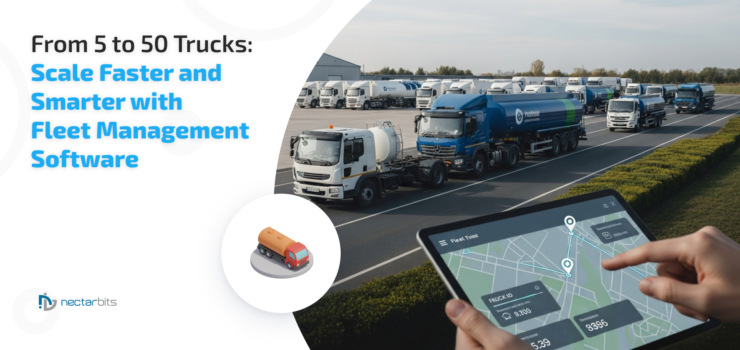
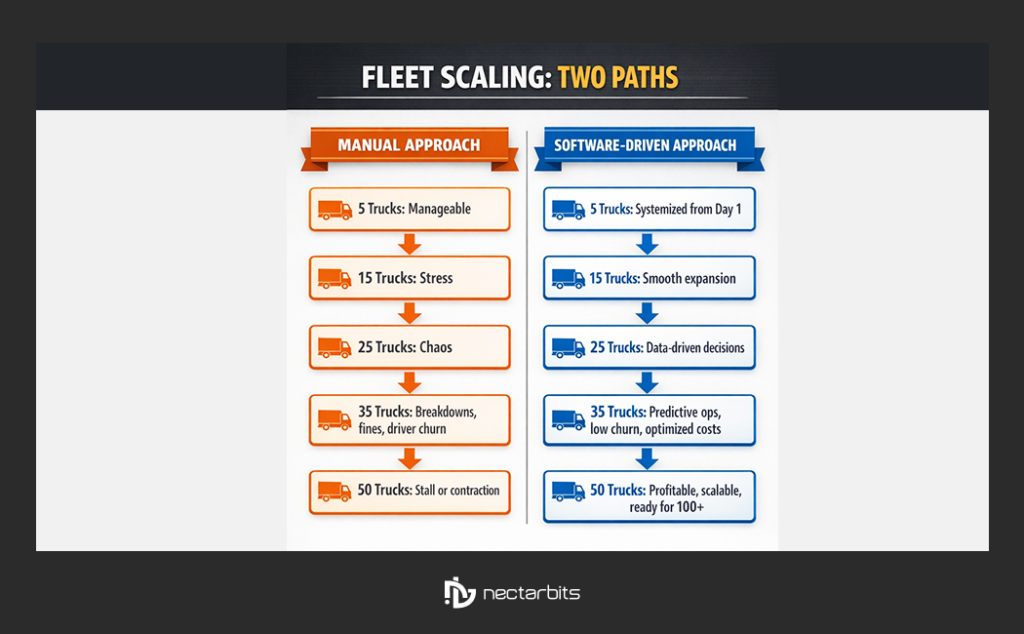
Running a five-truck operation has its own charm — you know every driver by name, every route by heart, and every delivery by its deadline. But what happens when demand surges, contracts multiply, and you suddenly need to manage 20, 30, or even 50 trucks?
Spreadsheets crash under complexity. Phone-call dispatching turns into a game of broken telephone. Fuel receipts pile up faster than you can reconcile them. The very hustle that built your business becomes the bottleneck that strangles its growth.
This is the inflection point where fleet management software stops being a “nice-to-have” and becomes the engine of your trucking business growth strategy.
In this blog, we break down exactly how fleet management software helps trucking companies scale logistics operations efficiently, avoid the most common growth traps, and build a foundation that supports 50 trucks just as smoothly as it supported five.
Why Most Trucking Businesses Stall Between 5 and 50 Trucks
Scaling a fleet is not just about buying more trucks. It is about managing more variables, drivers, fuel, routes, maintenance schedules, compliance documents, customer expectations, and real-time exceptions.
According to the American Transportation Research Institute (ATRI), the average marginal cost per mile for trucking operations reached $2.251 in 2023, a figure that climbs rapidly when fleet inefficiencies compound at scale (ATRI 2023 Operational Costs Report).
Here’s a snapshot of why small fleets fail to scale:
Table 1: Top Growth Barriers for Small-to-Mid-Size Fleets
| Growth Barrier | Impact at 5 Trucks | Impact at 50 Trucks |
| Manual dispatching | Manageable delays | Route conflicts, missed deliveries |
| Paper-based maintenance logs | Occasional breakdowns | Fleet-wide downtime risk |
| No real-time GPS tracking | Minor visibility gaps | Cargo theft, ETA uncertainty |
| Spreadsheet-based fuel tracking | Rough cost estimates | Uncontrolled fuel hemorrhaging |
| Phone-based driver communication | Works but slow | Communication breakdown at scale |
| No compliance automation | Reactive fixes | DOT violations, heavy fines |
Without a digital backbone, each new truck you add doesn’t just add capacity — it adds chaos.
What Is Fleet Management Software (And What Does It Actually Do)?
Fleet management software is a centralized digital platform that gives fleet operators real-time control over every vehicle, driver, route, and delivery in their operation. It replaces fragmented tools — spreadsheets, whiteboards, phone calls, paper logs — with a single source of truth.
Core capabilities include:
- Real-time GPS fleet tracking and optimization
- Automated dispatching and route planning
- Predictive and preventive maintenance scheduling
- Fuel consumption monitoring and analytics
- Driver behavior scoring and safety alerts
- Electronic Logging Device (ELD) compliance
- Delivery proof capture (photo, signature, timestamp)
- Customer-facing tracking portals and ETA notifications
Modern fleet platforms often integrate with broader logistics ecosystems. Businesses looking for end-to-end digital transformation can explore comprehensive on-demand application development services that connect fleet management to customer apps, warehouse systems, and payment gateways.
The 7 Ways Fleet Management Software Helps You Scale from 5 to 50 Trucks
1. Automated Dispatching Eliminates the Bottleneck
At five trucks, you can dispatch manually. At fifty, you physically cannot. Fleet software uses algorithms to assign the right truck to the right job based on location, capacity, driver hours, and delivery priority — in seconds.
Result: Dispatching that once took 45 minutes per day now takes under 5.
2. Route Optimization Cuts Fuel Costs by Up to 20%
According to Geotab’s 2024 Fleet Benchmarking Report, fleets using route optimization technology reduced fuel consumption by 12–20% compared to manually planned routes (Geotab, 2024).
As fuel remains one of the top three operational expenses, this alone can fund the addition of new trucks.
Table 2: Fuel Cost Savings Through Route Optimization
| Fleet Size | Avg. Monthly Fuel Cost (Manual) | Avg. Monthly Fuel Cost (Optimized) | Monthly Savings |
| 5 Trucks | $12,500 | $10,500 | $2,000 |
| 15 Trucks | $37,500 | $30,000 | $7,500 |
| 30 Trucks | $75,000 | $60,000 | $15,000 |
| 50 Trucks | $125,000 | $100,000 | $25,000 |
Estimates based on the industry average of $0.50–$0.65/mile fuel cost and 15% optimization savings.
3. Predictive Maintenance Prevents Fleet-Wide Downtime
A single truck breakdown costs an average of $448–$760 per day in lost productivity, according to the Technology & Maintenance Council (TMC) (TMC, 2023).
Now multiply that by 50 trucks with no preventive schedule. Fleet management software monitors engine diagnostics, tire pressure, brake wear, and oil intervals in real time — and schedules maintenance before breakdowns happen.
4. Real-Time GPS Tracking Builds Operational Visibility
When you manage delivery operations at scale, you need to know where every truck is, right now. Not five minutes ago. Not “last time the driver checked in.”
Real-time fleet tracking and optimization gives dispatchers, managers, and even customers live visibility. This reduces:
- Customer service calls by up to 40% (they can self-track)
- Cargo theft risk through geofencing alerts
- Unauthorized vehicle use (after-hours tracking)
Industries like oil and gas — where fleet assets operate across remote, high-value routes — benefit enormously. Companies in this sector can pair fleet tracking with specialized Oil and Gas Industry Services for end-to-end digital field operations.
5. Driver Management and Safety Scoring
Scaling means hiring more drivers — and every new driver is a variable. Fleet management software tracks:
- Harsh braking, rapid acceleration, and speeding events
- Hours of Service (HOS) compliance via integrated ELDs
- Idle time and unauthorized stops
- Driver scorecards for performance reviews
The National Highway Traffic Safety Administration (NHTSA) reports that fleets using telematics-based driver coaching saw a 22% reduction in accident rates (NHTSA, 2023).
6. Data-Driven Decision Making
At five trucks, you make decisions on instinct. At fifty, you need dashboards.
Fleet management software provides:
- Cost-per-mile breakdowns by vehicle, route, and driver
- Delivery success rate analytics
- On-time performance trends
- Asset utilization rates
These insights allow fleet operators to identify which trucks are profitable, which routes are underperforming, and where operational fat can be trimmed — an essential foundation for any serious trucking business growth strategy.
For businesses that also operate customer-facing delivery or e-commerce platforms, integrating fleet data with Retail & E-Commerce Solutions creates a seamless fulfillment pipeline from click to doorstep.
7. Compliance and Documentation Automation
As your fleet grows, so does your regulatory burden — FMCSA regulations, IFTA fuel tax reporting, DOT inspections, driver qualification files, vehicle registration renewals.
Fleet software automates:
- ELD compliance logging
- DVIR (Driver Vehicle Inspection Report) capture
- Document expiration alerts
- Audit-ready report generation
This is not glamorous. But a single compliance failure at the 50-truck level can result in fines exceeding $16,000 per violation (FMCSA Penalty Schedule).
What to Look for in Fleet Management Software (Buyer’s Checklist)
Not all fleet platforms are built equal. When evaluating fleet management software for a growing operation, prioritize:
| Feature | Why It Matters for Scaling |
| Cloud-based architecture | Access from anywhere; no server bottleneck |
| Modular pricing | Pay for what you need; add features as you grow |
| API integrations | Connect to ERP, CRM, accounting, and TMS tools |
| Mobile driver app | Real-time communication without phone calls |
| Customizable dashboards | Role-based views for dispatchers, managers, owners |
| Offline functionality | Drivers in low-connectivity zones stay productive |
| Multi-location support | Manage depots across cities or states |
If you’re building a custom fleet platform or driver app tailored to your unique workflows, partnering with an experienced mobile app development team ensures the solution scales with your business, not against it.
The Technology Behind Modern Fleet Platforms
A robust fleet management system relies on a modern, scalable tech stack. Typical components include:
- Frontend: React Native or Flutter for cross-platform driver apps
- Backend: Node.js or Python (Django) for real-time data processing
- Database: PostgreSQL or MongoDB for fleet and trip data
- Mapping & Routing: Google Maps API, Mapbox, or HERE
- IoT Integration: OBD-II dongles, GPS trackers, dashcams
- Cloud Infrastructure: AWS, Google Cloud, or Azure for uptime and scalability
- Communication: Firebase or Twilio for push notifications and alerts
For a deeper dive into the architecture that powers platforms like these, explore our detailed guide on the Technology Stack for On-Demand Delivery Apps.
Real-World Impact: The Numbers That Matter
Table 3: Fleet Management Software ROI Snapshot
| Metric | Before Software | After Software | Improvement |
| Average fuel cost/mile | $0.62 | $0.51 | -18% |
| Unplanned breakdowns/month | 4.2 | 1.1 | -74% |
| On-time delivery rate | 78% | 94% | +16 pts |
| Dispatch time/day | 50 min | 8 min | -84% |
| Compliance violations/year | 6 | 0.5 | -92% |
| Driver turnover rate | 85% | 52% | -33 pts |
Data synthesized from industry benchmarks published by ATRI, Geotab, and Verizon Connect fleet reports.
Common Mistakes to Avoid When Scaling Your Fleet
Even with the best software, fleet owners sabotage their growth by:
- Scaling trucks before scaling systems — Adding capacity without operational infrastructure leads to expensive chaos.
- Ignoring driver experience — If your driver app is clunky, drivers leave. Turnover at scale is crippling.
- Choosing software that doesn’t integrate — Siloed tools create data gaps. Ensure your fleet platform connects to accounting, CRM, and customer systems.
- Delaying the technology investment — Every month you run a 15-truck operation on spreadsheets costs you thousands in hidden inefficiencies.
- Not tracking the right KPIs — Revenue per truck, cost per mile, idle time percentage, and on-time rate are your growth compass.
Conclusion: The Fleet That Scales Is the Fleet That’s Systemized
The journey from 5 to 50 trucks is not a straight line — it’s a series of operational stress tests. Every new truck, every new driver, every new customer route adds complexity that manual processes simply cannot absorb.
Fleet management software is not just a tool. It is the operating system of a scalable trucking business. It turns reactive firefighting into proactive management. It replaces gut-feel decisions with data-driven strategy. And it ensures that your 50th truck is just as visible, efficient, and profitable as your first.
The fleets that will dominate the next decade are not necessarily the ones with the most trucks — they’re the ones with the smartest systems.
The question isn’t whether you can afford fleet management software. The question is whether you can afford to scale without it.
FAQs:-
A trucking business should invest in fleet management software once manual processes start causing delays, errors, or lack of visibility—typically around 5–10 trucks. Early adoption helps avoid operational chaos as the fleet grows and ensures smoother scaling with better control over routes, drivers, and costs.
Fleet management software uses route optimization, real-time GPS tracking, and idle-time monitoring to reduce unnecessary mileage and fuel wastage. Many fleets report 10–20% fuel savings by switching from manual route planning to automated optimization tools.
Yes, it tracks driving behavior such as speeding, harsh braking, and idle time, and provides driver scorecards. This enables fleet managers to coach drivers, improve safety, and reduce accidents—leading to lower insurance costs and better overall efficiency.
Fleet management software is highly beneficial for small fleets as well. In fact, small businesses gain a competitive advantage by implementing systems early, allowing them to scale logistics operations efficiently without operational bottlenecks as they grow.
Businesses typically see ROI through reduced fuel costs, fewer breakdowns, improved delivery times, and lower administrative overhead. On average, fleets experience improvements like 15–20% cost savings, higher on-time delivery rates, and significantly reduced manual workload within the first few months.