
 Anil Patel
While the basic implementation of GPS tracking provides a snapshot of “where,” the next generation of delivery management systems is answering the much more complex question of “why.” In this advanced deep-dive, we explore the algorithmic intelligence, technical architecture, and strategic frameworks that allow modern enterprises to never lose sight of a delivery again.
The Architecture of Precision: Beyond Simple GPS
To achieve true real-time delivery tracking, a system must process millions of data points per second. It is no longer enough to “ping” a driver’s phone every few minutes.
1. High-Frequency Data Ingestion via WebSockets
Traditional tracking relied on HTTP polling, which created a lag between the driver’s actual position and the customer’s screen. Advanced Delivery Tracking Software utilizes WebSocket protocols and MQTT (Message Queuing Telemetry Transport). This allows for a persistent, bi-directional connection that pushes location updates with sub-second latency.
2. Edge Computing and Latency Reduction
In high-density urban environments or remote areas where a fuel delivery app Dubai might operate, connectivity is inconsistent. Advanced systems utilize Edge Computing. By processing data locally on the driver’s device before syncing it to the cloud, the system can maintain “dead reckoning” paths. This ensures that the customer’s map visualization remains smooth and predictive even if the signal drops for 10 seconds.
The Behavioral Economics of “Operational Transparency”
Why does customer delivery tracking actually increase satisfaction? It is rooted in a psychological concept known as “Operational Transparency.”
Studies from Harvard Business School show that when customers see the effort going into their service (e.g., seeing the driver navigate traffic), they value the service more highly.
Reducing the “Anxiety Gap”
The “Anxiety Gap” is the period between placing an order and receiving it. By providing customer delivery notifications at every milestone (Order Picked -> Route Optimized -> 5 Minutes Away), the software removes the cognitive load from the customer. They no longer have to “remember” to check their delivery; the delivery “checks in” with them.
Table 2: The Psychological Impact of Tracking Features
| Feature | Psychological Trigger | Business Outcome |
| Live Map View | Operational Transparency | Increased Brand Trust |
| Automated ETA Alerts | Uncertainty Reduction | Lower Support Ticket Volume |
| Driver Profile/Bio | Humanization of Service | Higher Driver Ratings/Tips |
| Photo POD | Closure/Security | Reduced Fraud/Claims |
Algorithmic Routing: The Brain Behind the Map
The true power of delivery route optimization software lies in its ability to solve the “Traveling Salesman Problem” in real-time.
Dynamic Constraint Mapping
Unlike basic maps, advanced software manages hundreds of “soft” and “hard” constraints simultaneously:
- Time Windows: Ensuring a premium customer gets their package between 10:00 and 10:15 AM.
- Vehicle Capacity: Accounting for both weight and volume (cubing out vs. weighing out).
- Driver Skill Sets: Matching a heavy-machinery delivery with a certified driver.
- Regulatory Zones: Essential for a fuel delivery app Dubai, where certain tankers cannot enter specific districts during peak hours.
Machine Learning and “Learning Loops”
The most advanced delivery management systems use machine learning to refine their estimates. If a driver consistently takes 4 minutes longer at a specific loading dock in a skyscraper, the AI learns this “dwell time” and adjusts all future automated ETA alerts for that location.
Specialized Vertical: High-Stakes Cold Chain and Pharma
While we have discussed the fuel delivery app Dubai model, another advanced application is the Pharmaceutical Cold Chain.
In these scenarios, losing sight of a delivery could mean the spoilage of life-saving medicine. Advanced tracking integrates with IoT sensors to provide:
- Real-Time Thermals: Live temperature and humidity data overlayed on the GPS path.
- Shock Detection: Alerts if a package is dropped or tilted beyond a specific angle.
- Light Sensors: Instant alerts if a package is opened before it reaches the destination.
This level of last-mile delivery visibility transforms a delivery service into a high-compliance logistics partner.
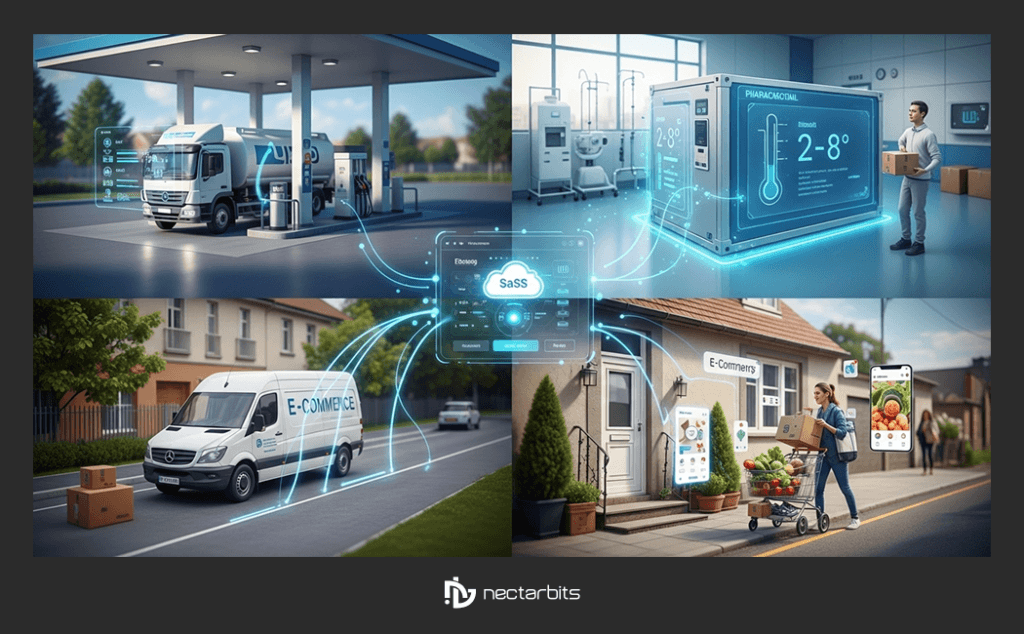
From temperature-sensitive pharma to everyday deliveries, real-time visibility powers smarter logistics across industries.
Table 3: Statistical ROI of Advanced Feature Adoption
| Technology | Efficiency Gain | Cost Impact |
| AI-Route Optimization | 25% Increase in drops/day | 15% Reduction in fleet size |
| Dynamic ETA Alerts | 70% Drop in WISMO calls | 20% Increase in CSAT scores |
| IoT Sensor Integration | 98% Compliance Rate | 40% Reduction in Spoilage |
| Automated Dispatching | 90% Faster Planning | 30% Lower Admin Overhead |
Strategic Business Intelligence: Turning Pings into Profits
When you never lose sight of a delivery, you gain a massive dataset that can be used for strategic decision-making. A modern delivery management system provides “Heat Maps” of your operations.
Identifying Profitability Leaks
By analyzing tracking data, executives can identify:
- Cost-per-Stop Analysis: Which neighborhoods are actually losing the company money?
- Driver Performance Benchmarking: Identifying your top 10% of drivers to replicate their habits across the fleet.
- Territory Planning: Using historical tracking data to decide where to open your next micro-fulfillment center.
Security and the Blockchain: The Future of Verified Delivery
As we look toward 2026 and beyond, the integration of Blockchain technology into Delivery Tracking Software is becoming a reality.
Why Blockchain for Tracking?
- Immutable Proof of Delivery: A signature can be forged; a hash on a blockchain cannot. This creates an unalterable record of the time, place, and condition of a delivery.
- Smart Contracts: Imagine a system where the driver’s payment is automatically released the moment the real-time delivery tracking confirms the package entered the customer’s geofence and the photo POD was uploaded.
- Chain of Custody: For high-value goods (luxury items, fuel, pharmaceuticals), the blockchain provides a “Trustless” history of every hand that touched the package.
Final Thoughts: The Cost of the “Visibility Gap”
The “Visibility Gap”—the space between what you think is happening in your fleet and what is actually happening—is where profit goes to die. Businesses that fail to invest in an intelligent delivery management system will find themselves unable to compete with the efficiency of AI-driven logistics.
Whether you are optimizing a fuel delivery app in Dubai or a global e-commerce giant, the goal is the same: absolute transparency. When you never lose sight of a delivery, you gain the trust of your customers, the loyalty of your drivers, and the clarity to scale your business.
Learn More:
To understand the specific challenges facing the modern delivery entrepreneur, read our comprehensive guide on Top 10 Delivery Business Pain Points and How to Fix Them.
FAQs:
Intelligent delivery tracking software is a next-generation solution that goes far beyond basic GPS tracking. Instead of simply showing the location of a delivery, it leverages advanced technologies like artificial intelligence, machine learning, IoT sensors, and real-time data streaming to provide deeper insights. These systems can predict delays, optimize routes dynamically, and even explain the reasons behind disruptions, helping logistics businesses operate more efficiently and proactively.
Real-time tracking plays a crucial role in improving customer satisfaction by reducing uncertainty and increasing transparency. By offering live map views, accurate ETAs, and automated delivery notifications, customers stay informed throughout the delivery journey. This significantly reduces the “anxiety gap” between placing an order and receiving it, while also minimizing support queries like “Where is my order?” As a result, businesses experience higher trust, better engagement, and improved customer retention.
Advanced delivery tracking systems are powered by a combination of cutting-edge technologies working together seamlessly. WebSockets and MQTT enable instant, real-time data communication, while edge computing ensures low-latency performance even in areas with poor connectivity. Additionally, AI and machine learning enhance predictive capabilities, and IoT sensors provide real-time monitoring of conditions such as temperature, humidity, and package handling. Together, these technologies create a highly responsive and reliable tracking ecosystem.
AI-based route optimization significantly enhances logistics efficiency by solving complex routing challenges in real time. It takes into account multiple dynamic factors such as traffic conditions, delivery time windows, vehicle capacity, driver expertise, and regulatory restrictions. By continuously learning from past data, the system improves route accuracy over time. This leads to faster deliveries, reduced fuel consumption, better fleet utilization, and the ability to complete more deliveries per day.
End-to-end visibility is essential in modern logistics because it eliminates the “visibility gap” between planned operations and actual execution. With complete real-time insights into every stage of the delivery lifecycle, businesses can quickly identify inefficiencies, track performance, and make data-driven decisions. This level of transparency is especially critical in high-stakes industries like fuel delivery and pharmaceuticals, where compliance, safety, and timing are crucial. Ultimately, it helps companies reduce costs, improve service quality, and scale operations with confidence.