

 Anil Patel
A high-value customer calls your support line for the fifth time today. They are frustrated, demanding to know, “Where is my package?” Your dispatcher is frantically scrolling through spreadsheets, the driver isn’t answering their phone, and your customer’s loyalty is evaporating in real-time.
This isn’t just a minor headache. According to McKinsey, 76% of consumers now consider real-time delivery tracking a non-negotiable requirement. In fact, businesses lacking transparency are part of a global “$178 Billion Problem”, the cost of lost revenue, failed deliveries, and churned customers due to poor logistics visibility.
To survive in the modern on-demand economy, you need more than just a map with dots on it. You need an intelligent delivery management system.
Why Basic GPS is No Longer Enough in 2026
Historically, tracking meant knowing where a truck was. Today, Delivery Tracking Software has evolved into a predictive AI ecosystem. It doesn’t just show you where the package is; it predicts where it will be and alerts you if something goes wrong before the customer even notices.
The Shift from Information to Intelligence
Modern systems combine 5G-enabled GPS, IoT sensors, and machine learning. This provides last-mile delivery visibility, covering everything from cargo temperature to the exact second a digital signature is captured on the doorstep.

Key Pillars of Intelligent Delivery Tracking Software
To truly “never lose sight” of your operations, your software must master three critical areas:
1. Automated ETA Alerts and Communication
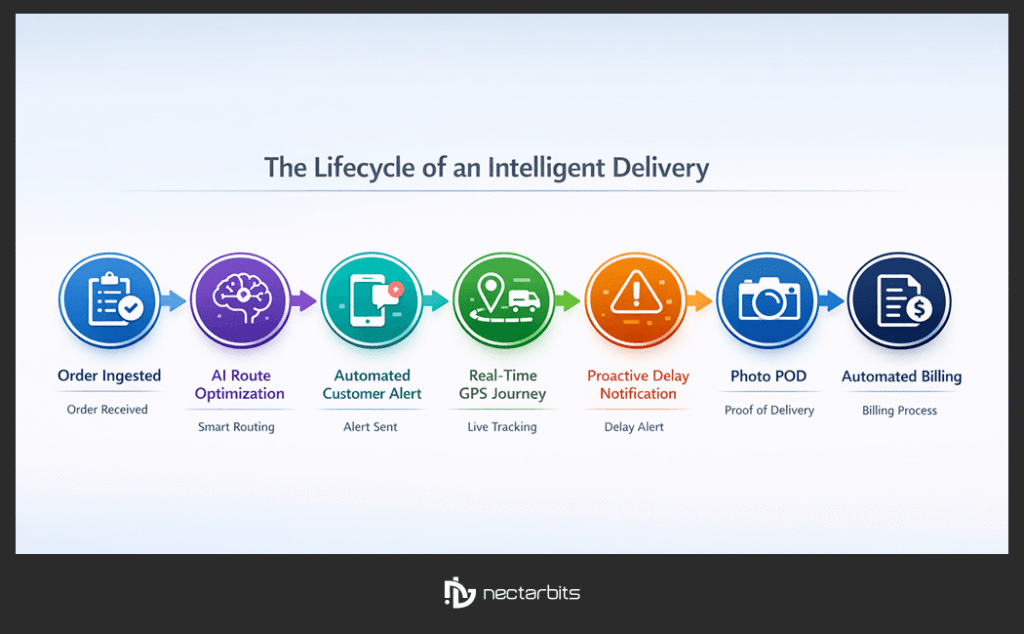
The “delivery window” (e.g., 8 AM – 5 PM) is dead. Customers now demand precision. Automated ETA alerts use live traffic data and driver behavior to provide arrival times accurate within minutes. By sending proactive customer delivery notifications, you reduce “Where is my order?” (WISMO) calls by up to 80%.
2. Delivery Route Optimization Software
Visibility is useless if the route is inefficient. Delivery route optimization software does more than find the shortest path; it balances vehicle capacity, driver shifts, and priority delivery windows to ensure the fleet is always moving profitably.
3. Integrated Delivery Management System
A standalone tracking tool is a data silo. The best results come when tracking is integrated into a total delivery management system. This connects your warehouse, your drivers, and your back-office accounting into a single source of truth.
The Financial Impact of Intelligent Tracking (50-Vehicle Fleet)
| Performance Metric | Traditional Tracking | Intelligent Software | Annual Savings (Est.) |
| On-Time Rate | 70% – 75% | 95% – 98% | $150,000+ (Retention) |
| Fuel Consumption | Unoptimized | 25% Reduction | $80,000 – $110,000 |
| Failed Deliveries | 15% average | < 4% average | $60,000 (Redelivery) |
| Customer Support | High Volume | 80% Reduction | $45,000 (Staffing) |
Deep Dive: Specialized Tracking for Fuel Delivery App Dubai
Certain industries face higher stakes. For a fuel delivery app Dubai, visibility isn’t just about convenience; it’s about safety and high-stakes compliance.
In the UAE’s fast-paced energy sector, tracking software must handle:
- Hazmat Compliance: Ensuring vehicles avoid prohibited residential zones.
- Theft Prevention: Using IoT sensors to monitor fuel levels in real-time, preventing unauthorized siphoning.
- Geofenced Delivery: The system only allows the “Start Pumping” command when the GPS confirms the truck is within 5 meters of the designated tank.
By implementing these specialized features, Dubai-based fuel distributors have reported a 93% reduction in fuel theft and a complete elimination of regulatory fines
Overcoming the “Last-Mile” Challenge
The last mile is the most expensive and complex part of the journey, often accounting for 53% of total shipping costs. Customer delivery tracking portals are the primary tool to fix this.
Features that customers love in 2026:
- Live Map View: Watching the driver move in real-time.
- Driver Identification: Seeing a photo and the name of the driver for safety.
- Dynamic Rescheduling: Allowing the customer to change the drop-off point while the driver is still en route.
- Proof of Delivery (POD): Receiving an instant notification with a photo of the package at the door.

5 Common Mistakes When Choosing Tracking Software
Many businesses waste thousands on the wrong tech. Avoid these pitfalls:
- Choosing “GPS-Only” Tools: If it doesn’t offer route optimization or automated notifications, it’s not a complete solution.
- Ignoring Integration: Your tracking software must “talk” to your ERP and Shopify/WooCommerce store.
- Complex Driver Interfaces: If the app is hard to use, drivers will find ways to bypass it.
- Poor Data Frequency: Some systems only update every 5 minutes. In a city like Dubai or New York, a driver can go a long way in 5 minutes. Demand 10-30 second refresh rates.
- Lack of Proof of Delivery: Without photo and signature capture, you are still vulnerable to “item not received” fraud.
The Future: AI and Predictive Logistics
As we look toward the end of the decade, Delivery Tracking Software will move from reactive to proactive.
- Predictive Maintenance: The software will analyze engine data and tell you a truck will break down next week, allowing you to fix it before it ruins a delivery day.
- Machine Learning Routes: The system will learn that a specific street is always blocked on Friday afternoons and will automatically reroute drivers without human intervention.
Conclusion: Visibility is Your Greatest Asset
The data is clear: visibility is no longer a luxury. Whether you are running a boutique courier service or a specialized fuel delivery app in Dubai, the right delivery tracking software is the difference between a scaling business and one that is bleeding cash.
By prioritizing real-time delivery tracking, optimizing your paths with delivery route optimization software, and keeping the customer at the center with automated ETA alerts, you ensure that your business never loses sight of a delivery—or its profit margins—again.
Learn More:
Want to solve the most common hurdles in your logistics chain? Read our expert breakdown: Top 10 Delivery Business Pain Points and How to Fix Them.
FAQs:
Delivery tracking software is a digital solution that allows businesses and customers to monitor the real-time location and status of deliveries. It uses GPS, mobile networks, and cloud platforms to track vehicles, update order progress, provide automated ETA alerts, and send customer delivery notifications throughout the delivery journey.
Yes, modern delivery tracking systems allow real-time package tracking. Using GPS-enabled driver apps and cloud-based delivery management systems, businesses can provide live map tracking, dynamic ETA updates, and instant status notifications to customers.
The best delivery tracking software typically includes:
– Real-time delivery tracking
– Automated ETA alerts
– Customer delivery notifications
– Proof of delivery (photo or digital signature)
– Delivery route optimisation software
– Driver tracking and fleet monitoring
– Integration with a delivery management system
These features improve last-mile delivery visibility and reduce failed deliveries.
Businesses use automated systems that send customer delivery notifications via SMS, push notifications, or email. These updates can include order confirmation, dispatch alerts, live delivery tracking links, ETA updates, and proof of delivery once the package is delivered.
Real-time delivery tracking improves customer experience, reduces support calls about order status, increases delivery efficiency, and helps businesses manage fleets more effectively. It also provides transparency in the last-mile delivery process, which is critical for modern logistics operations.