
 Anil Patel
In the world of B2B fuel logistics, a delivery is never just a delivery. For a construction manager in Nairobi, it’s the diesel that keeps million-dollar excavators running. For a fleet operator in Dubai, it’s the gasoline that ensures a thousand vehicles start their routes on time. In these high-stakes environments, a delayed, missing, or short-delivered fuel shipment isn’t a minor hiccup; it’s a catastrophic failure that can halt operations, incur massive financial penalties, and shatter a business relationship in an instant.
Across the rapidly growing economies of Africa and the hyper-competitive landscape of the UAE, fuel suppliers are no longer competing on price alone. They are competing on a far more valuable commodity: Trust.
The old way of doing business—a phone call, a vague delivery window, and a paper receipt—is dead. Today, B2B clients demand transparency, accountability, and irrefutable proof. This is where technology becomes the ultimate differentiator. A sophisticated Fuel Delivery App in Kenya, Africa, and the UAE, powered by real-time tracking, is no longer a luxury; it is the single most powerful tool for building trust, preventing loss, and winning the most valuable long-term contracts.
The Trust Deficit: Why Fuel Logistics is a High-Stakes Game
The challenges in the fuel supply chain are unique and pronounced in regions like Africa and the UAE. Understanding these specific pain points is key to grasping why technology is so transformative.
In Africa (e.g., Kenya):
The Challenge of Distance and Diversion
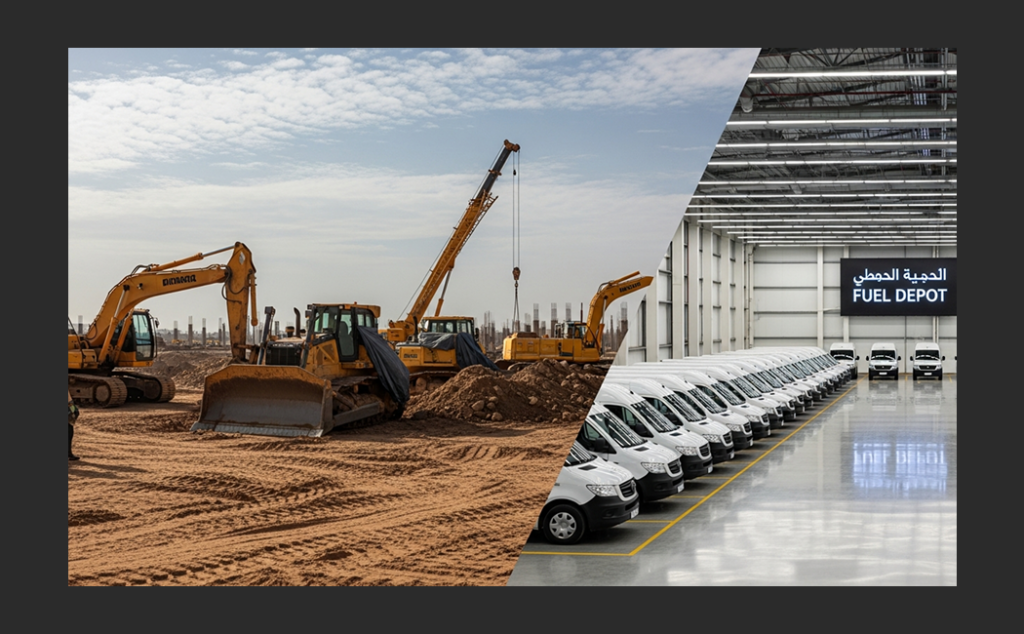
Africa’s economic boom is powered by massive infrastructure, mining, and agricultural projects—often located in remote areas with complex logistics. Here, the “trust deficit” is driven by structural challenges on the ground:
- Theft and Adulteration:
Fuel theft and adulteration during transit is a documented and severe problem across sub-Saharan Africa. Industry reports and on-ground operators consistently describe siphoning losses during long-haul transit as one of the most significant margin destroyers in the sector — in some documented corridor routes, operators report double-digit percentage losses before fuel reaches its destination. - Logistical Black Holes:
Long distances and unpredictable road conditions turn ETAs into guesswork. Clients often have no reliable way to verify whether a delay is genuine—or the result of route diversion or unauthorized stops. - Quantity Disputes:
Without verified, tamper-proof metering systems, disagreements over delivered fuel quantities are common. These disputes slow down invoicing, strain partnerships, and create ongoing operational friction.
A Fuel Delivery Management System for Africa must be purpose-built to solve these rugged, high-risk challenges—where visibility and control are not optional, but essential.
In the UAE:
The Demand for Absolute Precision and Efficiency
In contrast, the UAE market is defined by its demand for world-class operational precision and seamless service delivery. For an On-Demand Fuel Delivery Software UAE provider, the stakes are equally high—but fundamentally different:
- Zero Tolerance for Downtime:
The pace of business in Dubai and Abu Dhabi is relentless. Fleets—from luxury rentals to 24/7 logistics operators—cannot afford idle time. Reliability isn’t a feature; it’s a contractual requirement. - Hyper-Competition:
The market is saturated with capable providers. The differentiator is no longer just delivery—it’s the digital experience: live tracking, precise ETAs, automated reporting, and instant digital receipts. - Brand Reputation:
For companies serving premium clients, every operational touchpoint reflects on their brand. A seamless, tech-enabled fuel delivery experience is now part of delivering a high-end service promise.
The Old Way vs. The New Digital Handshake
The traditional fuel delivery process is riddled with blind spots that create friction and destroy trust. The new way, powered by a fuel delivery tracking system, replaces those blind spots with clarity and proof.
The Old Way (Based on Blind Trust):
- Client calls for fuel.
- Dispatch radios a driver with an address.
- Client waits, anxious about ETA.
- The driver arrives, fills a paper log.
- Client signs the paper, hopes the quantity is correct.
- Disputes arise later over billing or delivery time.
Result: Low Trust, High Friction, Potential for Loss.
The New Way (Based on Verifiable Proof):
- Client requests fuel via an app or portal.
- Dispatch assigns the job digitally; the optimal route is sent to the driver’s app.
- Client receives an automated ETA and a live tracking link. They watch the tanker approach on a map.
- Driver arrives, scans a QR code on-site to verify location.
- The driver’s app captures photos of the meter before and after dispensing.
- The client provides a digital signature in the real-time delivery proof app.
- An instant, indisputable digital receipt with GPS, time, and photo proof is sent to both parties.
Result: High Trust, Zero Friction, Full Accountability.
How a Modern Fuel App Wins Contracts: From Features to Trust
Let’s break down exactly how the features of a modern on-demand fuel delivery software translate directly into the trust that secures long-term B2B contracts.
1. Radical Transparency with Real-Time Fuel Dispatch Tracking Kenya
The Feature: A customer-facing portal or app screen showing the fuel tanker’s live location on a map, with a constantly updated, AI-powered ETA.
How it Builds Trust: This single feature eradicates the biggest source of client anxiety: uncertainty. When a site manager in rural Kenya can see that his fuel is just 30 minutes away, he can schedule his teams and machinery accordingly. He’s not just a passive recipient; he’s an informed partner in the logistics process. This proactive transparency tells the client, “We have nothing to hide. You can watch us every step of the way.” This is a powerful statement that competitors using the “it will be there sometime today” method simply cannot match.
2. Irrefutable Proof with a Digital Handshake
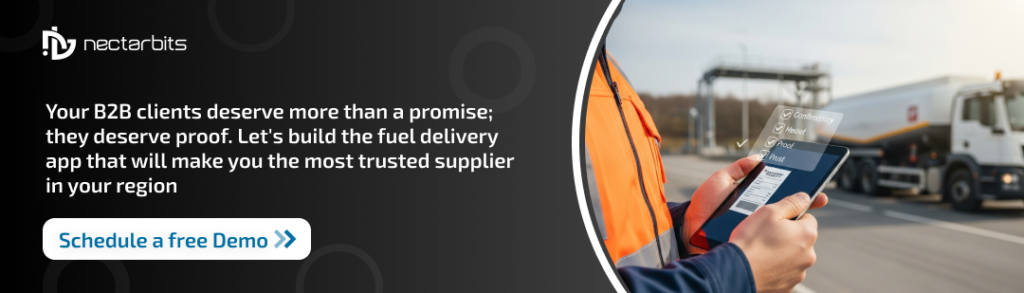
The Feature: A real-time delivery proof app that captures multiple points of data: GPS-stamped arrival/departure, barcode/QR code scans to confirm the site, pre- and post-delivery photos of the fuel meter, and a client’s e-signature on the driver’s device.
How it Wins Contracts: This eliminates the single most contentious issue in fuel delivery: quantity disputes. A signed piece of paper can be challenged. A digital record containing a photo of the meter reading “10,000 liters” next to a GPS pin at the client’s location and a time stamp is indisputable. This feature demonstrates integrity. Over time, a reputation for perfect, provable accuracy becomes your most powerful sales tool. You’re not just selling fuel; you’re selling peace of mind and an end to billing disputes.
3. Unbeatable Security and Loss Prevention
The Feature: An integrated fuel logistics management solution that includes geofencing, route deviation alerts, and integration with digital flow meters.
How it Builds Trust: This directly addresses the rampant problem of fuel theft.
- Geofencing: Managers are automatically alerted if a truck strays from its designated route.
- Route Deviation Alerts: The system flags unplanned or lengthy stops.
- Digital Metering: The pump can be locked and unlocked remotely from the app, ensuring fuel can only be dispensed at the verified customer location.
When you present this to a potential client, you are showing them that you have invested in technology to protect their product from the moment it leaves your depot. This commitment to security is a massive differentiator that proves you are a serious, professional partner.
4. Precision Matching with RFID/QR-Based Vehicle Verification
The Feature:
Each client vehicle or asset is assigned a unique RFID tag or QR code. Before dispensing fuel, the driver scans the code using the delivery app, instantly verifying that the correct vehicle, location, and fuel order are matched in the system.
How it Builds Trust:
This eliminates one of the most subtle—but costly—risks in fuel delivery: fuel going into the wrong asset or unauthorized equipment. In large fleets or construction sites with multiple machines, manual verification is prone to human error or misuse. With RFID/QR validation, fueling becomes a controlled, system-verified action—not a judgment call by the driver.
It tells the client: “Every drop of fuel is going exactly where it’s supposed to—no assumptions, no errors.”
How it Wins Contracts:
For enterprise clients managing hundreds of vehicles or machines, this feature is a game-changer. It ensures:
- Accurate allocation of fuel to specific assets
- Clean, automated audit trails for internal reporting
- Zero ambiguity in fuel usage tracking
When pitching, this becomes a powerful differentiator:
“We don’t just deliver fuel—we ensure it reaches the exact asset it was intended for, with full system validation. “
Table: Translating Technology into Contract-Winning Value
| Technology Feature | Direct Benefit | How It Builds Trust | The Winning Pitch |
| Live GPS Tracking & Predictive ETAs | Full visibility for the client and dispatch. | Eradicates anxiety and allows clients to plan their operations around delivery. | “You’ll never have to call us to ask, ‘Where’s my fuel?’ You’ll see it on a map, in real-time.” |
| Digital Proof of Delivery (Photos, e-Sig) | Irrefutable proof of quantity and time. | Eliminates all billing and quantity disputes, fostering a relationship of integrity. | “Our invoices are backed by photo proof. You will always get exactly what you pay for, guaranteed.” |
| Geofencing & Route Deviation Alerts | Prevention of fuel theft and unauthorized stops. | Shows a proactive commitment to securing the client’s high-value asset. | “We’ve invested in technology to ensure your fuel is protected from our depot to your site.” |
| Fleet Performance & Analytics | Optimized routes, reduced idling, and better driver monitoring. | Demonstrates a commitment to efficiency, safety, and professionalism. | “Our efficient, data-driven operation means we are a more reliable and cost-effective partner for you.” |
| RFID/QR-Based Vehicle Verification | Ensures fuel is delivered to the correct vehicle or asset | Eliminates human error and unauthorized fueling | “Every delivery is matched to the exact vehicle—verified, tracked, and recorded automatically.” |
The ROI: A Fleet Performance and Delivery Proof App Pays for Itself
Investing in this technology isn’t an expense; it’s an investment with a clear and rapid return.
- Winning and Retaining Contracts: The ability to demonstrate this level of transparency and security becomes a key reason why clients choose you and, more importantly, stay with you.
- Eliminating Fuel Loss: Preventing even a single incident of fuel theft can save thousands of dollars, often paying for the software investment in a short period.
- Operational Efficiency: Optimized routes and reduced vehicle idling lower your fuel consumption. Automated data entry and invoicing drastically cut administrative overhead.
- Reduced Disputes: The time and money saved by eliminating billing disputes and lengthy investigations go straight to your bottom line.
What the Numbers Actually Show
Qualitative trust arguments are compelling, but B2B procurement managers need numbers to justify an investment internally. Based on reported outcomes from verified operators across the African and UAE fuel logistics markets:
| Metric | Before Digital Tracking | After Digital Tracking |
| Billing disputes per month | Frequent (reported as top client complaint) | Near-zero with photo POD |
| Transit fuel loss (Africa long-haul) | Reported at 5–15%+ per route | Reduced significantly with geofencing |
| Driver accountability incidents | Multiple per week | Rare — GPS deviation alerts catch issues in real time |
| Contract renewal rate (B2B) | Varies — often depends on relationship | Higher — transparency removes switching incentive |
| Client onboarding time | Slow — requires reference calls and trust-building | Faster — demo of live tracking closes trust gap immediately |
These are directional figures drawn from industry operator reports and platform case studies rather than a single study. Results depend on fleet size, route type, and implementation quality. The point is not the exact percentage — the point is that technology removes the trust variable entirely, replacing it with verifiable proof.
For operators considering on-demand fuel delivery software, the most important ROI calculation is not cost-per-feature — it is the value of a single retained B2B contract versus the cost of the platform that made it possible.

Africa vs UAE: How Tracking Requirements Differ by Market
Real-time tracking matters in both markets — but for different reasons and with different implementation priorities. Understanding these differences is critical before building or selecting a platform.
| Factor | Africa (Kenya, Nigeria, Ghana, Zambia) | UAE (Dubai, Abu Dhabi) |
| Primary trust concern | Fuel theft and adulteration during transit | Quantity accuracy and service punctuality |
| Connectivity challenge | Low-bandwidth rural areas require offline mode | High connectivity — cloud-first works well |
| Verification priority | GPS route monitoring + geofence deviation alerts | RFID vehicle tagging + digital meter proof |
| Client profile | Mining, agriculture, infrastructure projects | Luxury fleets, logistics companies, corporate campuses |
| Regulatory layer | Varies by country — less digitally enforced | ADNOC-aligned — digital audit trails expected |
| Contract decision driver | Track record + anti-theft proof | Speed, precision, and professional digital experience |
| App offline requirement | Critical — drivers often lose signal | Nice to have — not a deal-breaker |
| Integration priority | Anti-siphoning hardware + flow meter lock | ADNOC-compliant supply chain + ERP billing integration |
The practical implication: A single app platform can serve both markets, but it needs to be built with these differences in mind. A product built only for UAE conditions — assuming good connectivity, RFID-tagged fleets, and enterprise ERP integration — will fail in rural Kenya. A product built only for Africa — prioritising offline resilience and anti-theft hardware — will feel underbuilt to a Dubai corporate fleet client expecting real-time dashboard access and instant digital invoicing.
The strongest platforms for B2B fuel delivery in 2026 are built to handle both environments: online when connectivity allows, offline-capable when it doesn’t, with hardware integrations flexible enough to serve both markets without rebuilding from scratch.
Conclusion: Stop Promising, Start Proving
In the demanding fuel markets of Kenya, across Africa, and within the UAE, your word is only as good as the proof that backs it up. Relying on outdated, paper-based methods is like navigating a modern highway with a 19th-century map—it’s inefficient, risky, and you will be left behind by competitors who have embraced the digital age.
By implementing a comprehensive Fuel Delivery App in Kenya, Africa, and the UAE, you are making a powerful statement. You are telling every potential client that you value transparency, that you are committed to integrity, and that you have invested in the best technology to be the most reliable partner they can choose.
Stop promising trust. Start delivering proof. That is how you win the contracts that build empires.
Recommended Reading
Interested in how on-demand technology is revolutionizing logistics beyond just fuel? See how the core principles of real-time tracking and customer notifications are key to success in any delivery business.
➡️ Read More: Benefits and Features of Successful On-Demand Delivery Apps
FAQs:
In both markets, B2B fuel clients manage high-value operations where a delayed or short delivery has serious financial consequences. Real-time tracking replaces the old “call the driver” model with verifiable, live visibility — eliminating the uncertainty that destroys trust and costs contracts. In Africa, it also directly addresses fuel theft. In the UAE, it meets the precision standard that enterprise clients contractually expect.
A real-time delivery proof app captures multiple verification layers — GPS-stamped arrival, timestamped meter photos before and after dispensing, RFID or QR verification of the delivery asset, and a client e-signature. Any one of these alone is stronger than a paper receipt. Together, they create an audit trail that cannot be disputed — eliminating both deliberate theft claims and honest misunderstandings about quantity.
Yes — and the question is increasingly moot. Cloud-based on-demand fuel delivery software is now available on subscription models rather than large upfront licenses. A small distributor running 3–5 trucks pays a monthly fee rather than a six-figure development cost. The threshold for getting started has dropped significantly in the last two years, meaning the technology that was once exclusive to enterprise operators is now accessible to regional distributors who want to compete for better contracts.
Corporate and industrial clients now prioritize reliability and traceability over pricing. When your company can offer live tracking, automated ETAs, and tamper-proof proof of delivery, you demonstrate professionalism and integrity—two critical factors in securing long-term supply agreements in Africa and the UAE markets.
A standalone GPS tracker tells you where a vehicle is. A fuel delivery tracking system integrates that location data with the order, the driver, the delivery site, the fuel meter, the client’s e-signature, and the invoice — creating a single, connected audit trail for every delivery. GPS is one component. The delivery management platform is the system that gives the GPS data meaning and legal weight.