
 Anil Patel
In the competitive landscape of fuel delivery, many businesses struggle with a critical challenge: they’re perceived as interchangeable commodity suppliers rather than valued brand partners. According to recent industry research, 64% of fuel delivery customers say they can’t distinguish between different suppliers, viewing fuel delivery purely as a price-driven transaction.
This commoditization trap keeps profit margins razor-thin and customer loyalty virtually nonexistent. However, forward-thinking fuel delivery businesses are breaking free from this cycle through strategic branding that transforms their operations from faceless suppliers into trusted industry icons.
The difference between a commodity supplier and a recognized brand isn’t just marketing fluff—it translates directly to the bottom line. Branded fuel delivery businesses command a 27-43% premium, experience 3.2x higher customer retention rates, and achieve enterprise valuations 4-6x higher than those of unbranded competitors.
This comprehensive guide reveals how to grow your fuel delivery business through strategic branding that creates lasting competitive advantages, builds customer loyalty, and positions your company as an industry leader rather than just another fuel supplier.
The Branding Crisis in Fuel Delivery
Why Most Fuel Suppliers Remain Invisible
The fuel delivery industry has traditionally operated with a commodity mindset. Consider these sobering statistics:
| Branding Metric | Industry Average | Impact |
| Brand Recognition | Only 23% of customers can name their fuel supplier | Commoditization |
| Switching Barriers | 67% would switch for 5% price reduction | No loyalty |
| Brand Differentiation | 78% see all suppliers as identical | Price competition |
| Marketing Investment | Less than 2% of revenue | Invisible presence |
| Digital Presence | 43% lack professional websites | Lost opportunities |
The True Cost of Being a Commodity
Operating as an undifferentiated fuel supplier carries hidden costs:
1. Price Pressure: Without brand value, price becomes the only competitive factor
- Average margin erosion of 1.2-1.8% annually
- Inability to maintain pricing during market fluctuations
- Constant vulnerability to low-cost competitors
2. Customer Churn: Commodity suppliers face perpetual customer loss
- Average annual churn rate of 32-38%
- Customer acquisition costs are 5-7x higher than retention
- Unpredictable revenue streams
3. Limited Growth Options: Without brand equity, scaling is capital-intensive
- Difficulty attracting investors or financing
- Lower enterprise valuations (2-3x EBITDA vs. 6-8x for branded companies)
- Reduced strategic partnership opportunities
4. Talent Challenges: Top talent gravitates toward recognized brands
- 47% higher employee turnover in commodity businesses
- Difficulty recruiting skilled professionals
- Lower employee engagement scores
The Branding Opportunity
Despite these challenges, fuel delivery presents exceptional branding opportunities:
- Local Market Dominance: Most fuel delivery is geographically constrained, allowing focused branding efforts
- Recurring Revenue Model: Regular deliveries create multiple brand touchpoint opportunities
- Essential Service: Fuel delivery’s critical nature builds trust and reliability in associations
- Relationship Intensity: B2B fuel delivery involves significant client relationships
- Digital Transformation: Technology creates new branding and differentiation avenues
The fuel delivery businesses that recognized these opportunities early have achieved remarkable transformations.
Brand Transformation Success Stories
Case Study 1: Regional Supplier to Premium Brand
Company Profile: Mid-sized fuel delivery serving construction and agricultural sectors
Before Branding Initiative:
- Generic company name (“ABC Fuel Supply”)
- No visual identity beyond basic logo
- Commodity pricing strategy
- 34% annual customer churn
- $4.2M annual revenue
Branding Transformation (18-month initiative):
- Strategic Repositioning: From “fuel supplier” to “energy logistics partner.”
- Visual Identity Overhaul: Professional logo, color scheme, vehicle branding
- Digital Presence: Modern website, mobile app, social media presence
- Service Innovation: Subscription models, IoT monitoring, 24/7 emergency service
- Content Marketing: Educational content, industry thought leadership
Results After 18 Months:
- Brand recognition increased from 18% to 73% in target markets
- Premium pricing is accepted by 82% of customers (15-20% higher than commodity rates)
- Customer churn reduced to 11%
- Revenue grew to $8.7M (107% increase)
- Enterprise valuation increased from $8.4M to $34.8M
Case Study 2: From Generic to Category Leader
A fuel delivery business serving commercial fleets transformed through a fuel supplier marketing strategy focused on sustainability and technology:
Key Branding Initiatives:
- Sustainability Brand: First carbon-neutral fuel delivery in their region
- Technology Leadership: Pioneered mobile fuel delivery service with real-time tracking
- Industry Expertise: Published annual “Fleet Fuel Efficiency Report.”
- Community Engagement: Sponsored local business events and trade shows
Measurable Outcomes:
- Became the #1 recognized brand in the local market within 24 months
- Featured in 47 media articles (vs. zero previously)
- Attracted 34% of new market entrants
- Customer lifetime value increased 267%
- Became an acquisition target for a national distributor at 7.2x EBITDA
These transformations weren’t accidental; they resulted from deliberate, strategic branding initiatives.
The Strategic Framework for Fuel Delivery Branding
Phase 1: Brand Foundation (Months 1-3)
1. Brand Positioning Strategy
Define your unique position in the market:
Positioning Dimensions:
- Service Excellence: Ultra-reliable, never-miss deliveries
- Technology Leadership: Most advanced digital capabilities
- Sustainability: Greenest fuel delivery option
- Industry Specialization: Exclusive focus on specific sectors
- Premium Service: White-glove treatment and personalized attention
- Value Leader: Efficient operations delivering cost savings
Example:
“For construction fleet managers, EnergyFlow is the fuel delivery partner that eliminates downtime and reduces fuel costs because our AI-powered logistics guarantee on-time delivery and optimize consumption patterns.”
2. Brand Identity Development
Create visual and verbal identity elements:
| Element | Considerations | Investment |
| Logo Design | Professional, memorable, scalable | $2,500-$8,000 |
| Color Palette | Industry-appropriate, differentiated | Included in logo |
| Typography | Readable on vehicles and digital | Included in logo |
| Brand Voice | Tone, language, personality | $1,500-$5,000 |
| Tagline/Slogan | Memorable, benefit-focused | $1,000-$3,000 |
| Brand Guidelines | Consistent application standards | $2,000-$5,000 |
3. Competitive Differentiation Analysis
To clearly understand your market position, compare your brand against competitors across two key dimensions: Service Quality (Commodity → Premium) and Technology Adoption (Low Tech → High Tech).
Brand Positioning Framework
Axis Definition:
- Vertical Axis (Y-axis): Commodity Service → Premium Service
- Horizontal Axis (X-axis): Low Tech → High Tech
Market Positioning Breakdown
| Position Area | Description | Example Players |
| Top-Right (Premium + High Tech) | High-value, innovation-driven services with advanced technology | Your Target Position |
| Top-Left (Premium + Low Tech) | Strong service quality but limited technological advancement | Brand Leader |
| Center | Balanced offerings with moderate service and technology | Competitor A |
| Bottom-Right (Commodity + High Tech) | Tech-enabled but cost-focused, lower service differentiation | Competitor C |
| Bottom-Left (Commodity + Low Tech) | Basic, price-driven services with minimal differentiation | Competitor B |
Key Insight
The goal is to identify untapped market gaps (white space)—areas where:
- Customer needs are not fully addressed
- Competition is low or weak
- Your brand can deliver unique value
Positioning your brand in this space helps you build a strong competitive advantage and long-term differentiation.
Phase 2: Digital Brand Building (Months 3-6)
1. Professional Web Presence
Your website is often the first brand impression. Essential elements:
- Modern, Mobile-Responsive Design: 68% of fuel delivery searches occur on mobile devices
- Clear Value Proposition: Visitors should understand your differentiation within 5 seconds
- Trust Indicators: Certifications, testimonials, case studies, safety records
- Easy Quote/Order System: Frictionless customer acquisition
- Educational Content: Demonstrate expertise and build authority
- Professional Photography: Show your team, vehicles, and operations
Website Investment: $8,000-$25,000 for professional development
2. Branded Mobile Experience
A branded fuel delivery app development initiative creates powerful differentiation:
Brand Benefits of Custom App:
- Daily Brand Interaction: App icon on customer phones
- Premium Perception: Professionalism and technological sophistication
- Customer Lock-In: Switching costs increase with app usage
- Data Collection: Understand customer behavior and preferences
- Marketing Channel: Push notifications for promotions and updates
App Branding Elements:
- Custom-branded UI/UX design
- Consistent color scheme and visual identity
- Brand personality reflected in microcopy and interactions
- Branded loading screens and empty states
- Personalized user experience
Working with an experienced On-Demand App Development Company ensures your app reflects your brand positioning effectively.
3. Social Media Brand Presence
Strategic social media builds brand awareness and credibility:
Platform Strategy:
| Platform | Primary Use | Content Focus | Posting Frequency |
| B2B networking | Industry insights, company news | 3-5x weekly | |
| Community engagement | Customer stories, local presence | 2-3x weekly | |
| Visual storytelling | Behind-scenes, team, equipment | 3-4x weekly | |
| Industry news | Real-time updates, customer service | Daily | |
| YouTube | Educational content | How-tos, safety tips, company story | 2-4x monthly |
Content Themes:
- Safety tips and industry best practices
- Customer success stories
- Team spotlights and company culture
- Industry news and commentary
- Sustainability initiatives
- Technology innovations
- Community involvement
Phase 3: Service Experience Branding (Months 4-9)
1. Branded Customer Journey
Every stage of the customer journey should consistently reflect and reinforce your brand identity, values, and experience.
Customer Journey & Brand Touchpoints
| Stage | Key Touchpoint | Brand Integration |
| Awareness | Social Media | Communicate clear brand message |
| Consideration | Website Experience | Highlight brand promise and value proposition |
| Purchase | Sales Process | Reinforce brand trust and credibility |
| Delivery | Delivery Experience | Ensure brand consistency in execution |
| Retention | Customer Portal / Support | Provide branded support and engagement |
| Advocacy | Referral Program | Offer branded rewards and loyalty incentives |
Journey Flow Overview
Awareness → Consideration → Purchase → Delivery → Retention → Advocacy
At each step, your brand should deliver a consistent message, experience, and value, ensuring customers recognize and trust your business throughout their journey.
Key Insight
A strong branded journey ensures:
- Higher customer trust
- Better experience consistency
- Increased retention and referrals
2. Fleet Branding
Your delivery vehicles are mobile billboards:
Vehicle Branding Elements:
- Professional vehicle wraps reflecting brand identity
- Consistent branding across the entire fleet
- Contact information and website URL
- Tagline or key brand message
- Clean, well-maintained vehicles (brand reflects on condition)
- Driver uniforms with branded apparel
Investment: $2,500-$5,000 per vehicle for professional wraps
Impact: Each branded vehicle generates 30,000-70,000 daily impressions
3. Driver Brand Training
Drivers are brand ambassadors:
Brand Training Program:
- Brand story and values
- Customer service standards
- Professional appearance requirements
- Communication protocols
- Problem resolution approaches
- Upselling and cross-selling techniques (if applicable)
Companies with formalized driver brand training see 42% higher customer satisfaction scores.
4. Branded Service Innovations
Differentiate through branded services:
Examples:
- “FuelGuard™ Monitoring”: IoT tank monitoring service
- “Priority Delivery Promise”: Guaranteed delivery windows
- “ZeroWait™ Service”: Proactive delivery before empty
- “FleetOptimize™ Program”: Fuel efficiency consulting
- “GreenFleet Initiative”: Carbon offset program
These branded services create proprietary differentiation that competitors can’t easily replicate.
Phase 4: Thought Leadership & Authority (Months 6-12)
1. Content Marketing Strategy
Position your company as the industry authority:
Content Types:
Blog Articles (2-4 monthly):
- Industry trends and analysis
- Fuel cost forecasting and management
- Fleet efficiency best practices
- Regulatory updates and compliance
- Safety guidelines
- Case studies and success stories
Whitepapers/Guides (Quarterly):
- Comprehensive resources (e.g., “Complete Guide to Fleet Fuel Management”)
- Industry benchmarking reports
- ROI calculators
- Best practice frameworks
Video Content (Monthly):
- Educational tutorials
- Customer testimonials
- Company culture videos
- Industry expert interviews
Email Newsletters (Bi-weekly/Monthly):
- Curated industry news
- Company updates
- Helpful tips and resources
- Special offers for subscribers
2. Industry Engagement
Build brand visibility through participation:
- Trade Shows & Conferences: Booth presence, sponsorships
- Industry Associations: Active membership and leadership roles
- Local Business Groups: Chamber of Commerce, networking organizations
- Speaking Engagements: Present at industry events
- Awards Programs: Apply for industry recognition awards
- Media Relations: Pitch expert commentary to industry publications
3. Strategic Partnerships
Enhance brand credibility through alliances:
- Equipment Manufacturers: Co-marketing with truck/tank manufacturers
- Technology Providers: Partner with fleet management software for fuel delivery providers
- Complementary Services: Partner with maintenance, parts suppliers
- Industry Associations: Official partnerships and endorsements
- Sustainability Organizations: Environmental certifications and partnerships
Building a Fuel Delivery App Brand
Why a Branded App Transforms Your Business
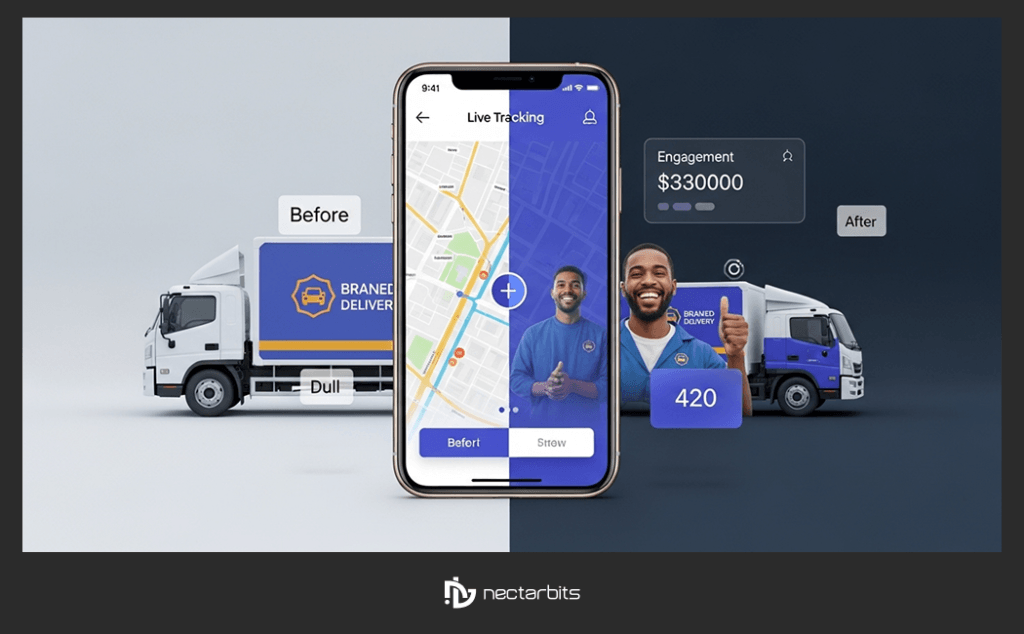
Building a fuel delivery app brand strategy represents one of the most powerful branding opportunities in modern fuel delivery:
Brand Impact Statistics:
- 89% of mobile time is spent in apps vs. mobile web
- Branded apps increase customer engagement by 3-4x
- App users spend 58% more than non-app customers
- Apps create 27 brand impressions weekly (vs. 4 for website-only brands)
App Branding Strategy
1. Brand-Aligned UX Design
Your app’s user experience should embody your brand personality:
| Brand Personality | UX Design Approach |
| Premium/Luxury | Minimalist, elegant, high-quality imagery |
| Efficient/Fast | Streamlined, one-tap actions, speed-focused |
| Trustworthy/Reliable | Clear information, transparent processes |
| Innovative/Tech-Forward | Cutting-edge features, modern design |
| Friendly/Approachable | Conversational copy, warm colors, helpful |
2. Branded App Features
Differentiate through unique, branded features:
Examples:
- “SmartRefill™”: AI-powered automatic reorder suggestions
- “DeliveryVision™”: Uber-like real-time driver tracking
- “FuelIQ™ Dashboard”: Consumption analytics and insights
- “QuickQuote™”: Instant pricing for any delivery
- “LoyaltyPlus™ Rewards”: Integrated rewards program
These proprietary features become associated with your brand specifically.
3. White-Label vs. Custom Development
| Consideration | White-Label Solution | Custom Development |
| Branding Control | Limited customization | Complete control |
| Time to Market | 4-8 weeks | 4-6 months |
| Investment | $15,000-$40,000 | $80,000-$200,000 |
| Differentiation | Shared features | Unique capabilities |
| Ongoing Costs | Monthly SaaS fee | Maintenance costs |
| Best For | Quick market entry | Long-term brand building |
For most fuel delivery businesses, working with a Full-cycle Product Development partner provides the optimal balance—professional quality with reasonable investment and timeline.
4. App Launch & Promotion
Your app launch is a major branding opportunity:
Launch Campaign Elements:
- Pre-launch Teasers: Build anticipation through email and social media
- Launch Event: Virtual or in-person celebration
- Incentivized Downloads: “Download bonus” for early adopters
- Press Release: Local media and industry publications
- Customer Education: Tutorials, demos, onboarding sequence
- App Store Optimization: Keywords, screenshots, description optimized for discovery
Fuel Industry Digital Transformation & Brand Evolution
The Digital Branding Imperative
The fuel industry’s digital transformation is fundamentally reshaping customer expectations and competitive dynamics:
Digital Transformation Statistics:
- 73% of B2B buyers prefer self-service digital ordering
- Digital-first brands grow 2.5x faster than traditional competitors
- 82% of fuel delivery customers research suppliers online before contact
- Companies with integrated digital experiences see 35% higher customer satisfaction
Digital Brand Ecosystem
Modern fuel delivery brands need an integrated digital presence:
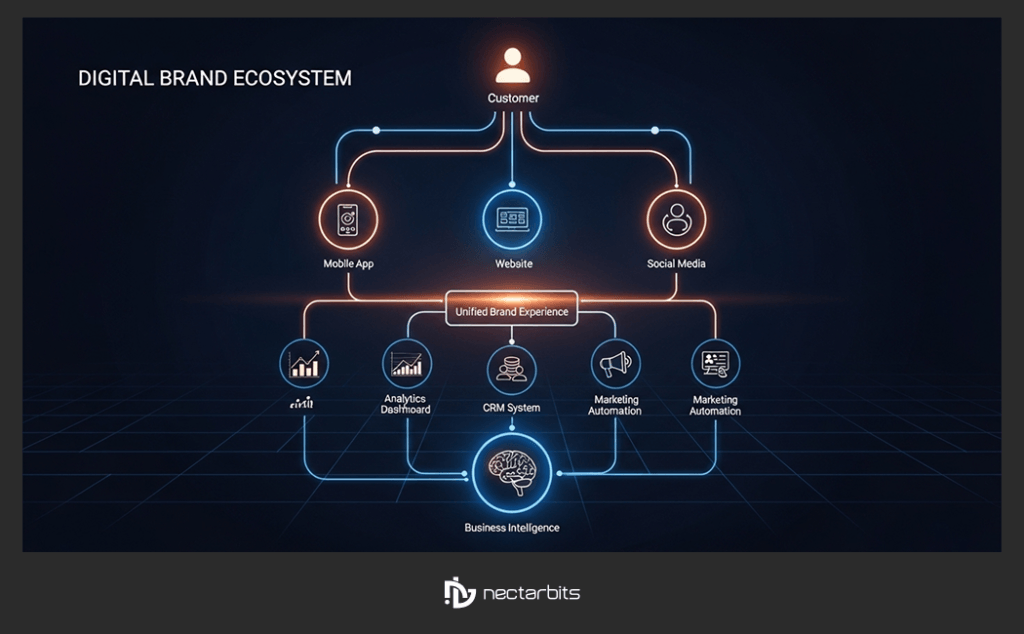
Each digital touchpoint should deliver a consistent brand experience while serving specific functions.
Technology as Brand Differentiator
Strategic technology investments become brand assets:
1. Fuel Delivery Software as a Brand
Advanced operational software creates customer-facing benefits:
- Delivery Precision: “We guarantee 30-minute delivery windows.”
- Transparency: “Track every aspect of your delivery in real-time.”
- Reliability: “99.7% on-time delivery rate powered by AI routing”
- Efficiency: “Our technology saves customers an average of 18% on fuel costs.”
These technology-enabled brand promises create competitive moats.
2. Data-Driven Brand Personalization
Use customer data to deliver branded, personalized experiences:
- Personalized Recommendations: Delivery schedule optimization based on usage patterns
- Proactive Communication: “Your tank is at 30%—schedule delivery?”
- Customized Reporting: Branded dashboards showing consumption, costs, trends
- Predictive Service: Anticipate needs before customer requests
3. Innovation as Brand Identity
Position your brand as the industry innovator:
- First-to-Market: Pioneer new technologies in your market
- Beta Programs: Engage customers in testing new features
- Innovation Showcase: Regular announcements of new capabilities
- Technology Partnerships: Align with cutting-edge tech providers
Brands positioned as innovators command 34% premium pricing compared to “fast follower” competitors.
Measuring Brand Performance
Key Brand Metrics
Track these metrics to measure branding effectiveness:
| Metric Category | Specific Metrics | Target | Measurement Method |
| Brand Awareness | Unaided brand recall | >40% in target market | Annual customer surveys |
| Aided brand recognition | >70% in target market | Annual customer surveys | |
| Website traffic | 20%+ quarterly growth | Google Analytics | |
| Brand Perception | Net Promoter Score (NPS) | >50 | Quarterly NPS surveys |
| Brand attributes association | >60% on key attributes | Brand tracking studies | |
| Review ratings | >4.5/5 stars | Review platforms | |
| Brand Equity | Price premium | 15-25% vs. commodity | Competitive analysis |
| Customer lifetime value | 2.5x+ acquisition cost | CRM analysis | |
| Brand valuation | Increasing annually | Professional valuation | |
| Brand Engagement | App engagement rate | >40% monthly active | App analytics |
| Social media engagement | 5%+ engagement rate | Social analytics | |
| Content consumption | Increasing trend | Website/content analytics | |
| Business Impact | Customer retention | <15% annual churn | CRM analysis |
| Share of wallet | >60% of customer fuel spend | Customer surveys | |
| Referral rate | >25% of new customers | Sales tracking |
Brand Health Dashboard
Create a quarterly brand health dashboard:
Brand Health Scorecard – Q4 2024
Awareness Metrics:
Unaided Recall: ████████░░ 42% ↑ (+8% YoY)
Website Traffic: ███████████ 12,400 visits ↑ (+34% YoY)
Perception Metrics:
Net Promoter Score: ████████████ 58 ↑ (+12 pts YoY)
Customer Satisfaction: ██████████░ 4.6/5 ↑ (+0.4 YoY)
Equity Metrics:
Price Premium: ████████░░ 18% ↑ (+5% YoY)
Customer LTV: ███████████ $47,200 ↑ (+28% YoY)
Engagement Metrics:
App Monthly Active: ████████░░ 47% ↑ (+19% YoY)
Social Engagement: ███████░░░ 6.2% ↑ (+2.1% YoY)
Overall Brand Health: ██████████░ Strong & Improving
ROI of Branding Investments
Quantify branding return on investment:
Sample 18-Month Branding Investment:
| Investment Category | Amount |
| Brand Strategy & Identity | $15,000 |
| Website Development | $18,000 |
| mobile app development | $45,000 |
| Vehicle Branding (10 vehicles) | $35,000 |
| Content Marketing | $24,000 |
| Social Media Management | $18,000 |
| Advertising & Promotion | $30,000 |
| Total Investment | $185,000 |
Measurable Returns:
| Return Category | Value |
| Revenue Growth (brand-attributed) | $1,240,000 |
| Margin Improvement (premium pricing) | $186,000 |
| Customer Retention Value | $312,000 |
| Reduced Acquisition Costs | $78,000 |
| Total Measurable Return | $1,816,000 |
| Net ROI | 881% |
| Payback Period | 4.2 months |
Beyond quantifiable returns, branding creates intangible value, including an enterprise valuation increase, competitive positioning, talent attraction, and partnership opportunities.
Common Branding Mistakes to Avoid
Pitfall 1: Inconsistent Brand Application
The Problem: Brand elements applied inconsistently across touchpoints
Examples:
- Different logos on website vs. vehicles vs. uniforms
- Inconsistent color schemes
- Varying tone of voice in communications
- Unprofessional or outdated materials mixed with new branding
Solution: Create comprehensive brand guidelines and enforce consistency
Pitfall 2: Copycat Branding
The Problem: Mimicking larger competitors rather than differentiating
Why It Fails: You’ll always be seen as the inferior alternative to the original
Solution: Identify unique positioning and own it authentically
Pitfall 3: Inauthentic Brand Claims
The Problem: Promising what you can’t deliver
Examples:
- “24/7 service” when you’re actually 6 am-8 pm
- “Always on time” with a poor delivery record
- “Premium service” with commodity execution
Impact: Brand damage is worse than no brand promise
Solution: Build a brand around genuine strengths and deliver consistently
Pitfall 4: Neglecting Internal Branding
The Problem: External branding without employee buy-in
Statistics: Companies with strong internal branding see 26% higher employee engagement and 41% lower turnover[^14]
Solution:
- Communicate brand vision to the entire team
- Train employees on brand values and standards
- Recognize and reward brand-aligned behavior
- Make the brand part of the company culture
Pitfall 5: Short-Term Focus
The Problem: Expecting immediate branding results
Reality: Brand building is a 12-24-month process before major results
Solution: Commit to long-term brand building with realistic milestones
Creating Your Fuel Delivery Brand Strategy
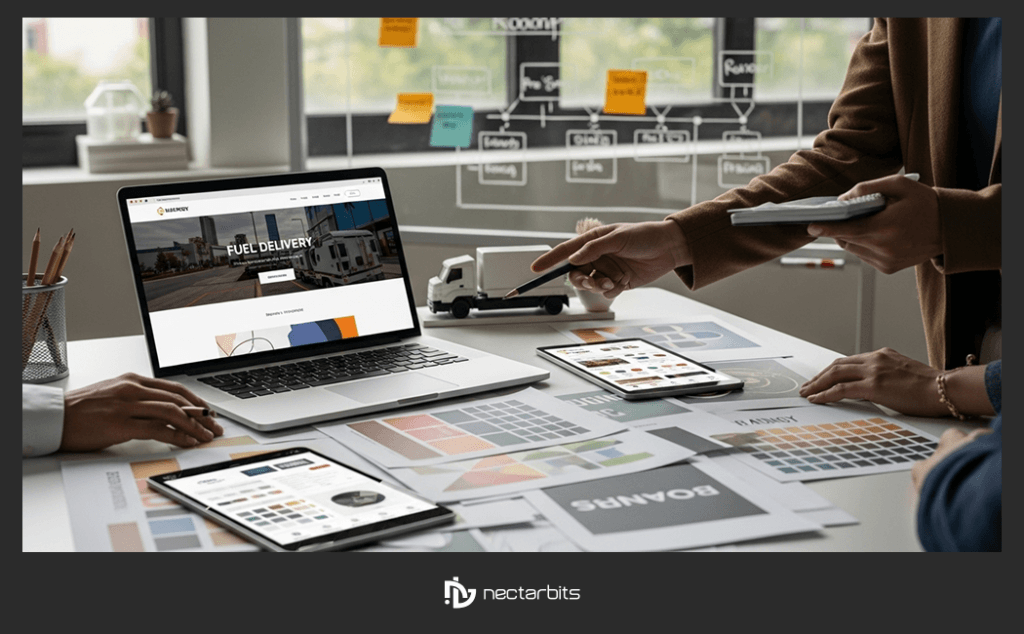
90-Day Quick-Start Plan
Month 1: Foundation
Week 1-2:
- Conduct competitive brand analysis
- Define brand positioning and differentiation
- Identify target customer personas
- Articulate brand values and personality
Week 3-4:
- Develop brand identity (logo, colors, typography)
- Create brand voice guidelines
- Develop brand tagline/slogan
- Document brand guidelines
Month 2: Digital Presence
Week 5-6:
- Redesign/develop a professional website
- Establish social media profiles
- Create initial content library
- Set up Google My Business
Week 7-8:
- Launch website
- Begin social media posting
- Initiate email marketing program
- Start content marketing (blog)
Month 3: Experiential Branding
Week 9-10:
- Brand fleet vehicles
- Implement driver uniforms/branding
- Create branded customer materials
- Launch the customer app or portal
Week 11-12:
- Train team on brand standards
- Launch brand awareness campaign
- Implement customer feedback systems
- Measure initial brand metrics
Long-Term Brand Evolution
Quarters 4-6: Expansion & Optimization
- Expand content marketing efforts
- Develop thought leadership initiatives
- Optimize based on initial metrics
- Launch branded service innovations
- Deepen community engagement
Year 2: Market Leadership
- Establish a category leadership position
- Expand geographic presence
- Develop strategic partnerships
- Launch advanced digital capabilities
- Pursue industry recognition/awards
Year 3+: Brand Dominance
- Own category in target markets
- Franchise or license brand (if applicable)
- Explore acquisition opportunities
- Become an industry thought leader
- Maximize enterprise value for exit
The Competitive Advantage of Strong Branding
Quantifiable Brand Benefits
Research shows branded fuel delivery businesses outperform commodity suppliers across every metric:
| Performance Metric | Commodity Supplier | Branded Business | Advantage |
| Price Premium | Baseline | +15-25% | Higher margins |
| Customer Retention | 62-68% | 85-92% | Predictable revenue |
| Customer Acquisition Cost | Baseline | -35-45% | Efficient growth |
| Customer Lifetime Value | Baseline | +180-240% | Profitability |
| Employee Retention | 68% | 84% | Lower HR costs |
| Enterprise Valuation | 2-3x EBITDA | 6-8x EBITDA | Exit value |
Strategic Brand Benefits
Beyond metrics, strong brands create strategic advantages:
1. Market Disruption Resistance
- Branded businesses weather competitive threats better
- Customer loyalty creates switching costs
- Brand equity provides a buffer during price wars
2. Expansion Efficiency
- Established brands enter new markets faster
- Brand reputation precedes geographic expansion
- Reduced customer acquisition costs in new areas
3. Partnership Attraction
- Recognized brands attract better partners
- Technology providers seek brand-name clients
- Strategic alliances more accessible
4. Talent Magnetism
- Top performers want to work for known brands
- Reduced recruitment costs
- Higher quality applicant pools
5. Crisis Resilience
- Strong brands recover faster from service failures
- Customer base gives the benefit of the doubt
- Reputation provides a buffer during challenges
Implementation: Your Next Steps
Immediate Actions (This Week)
- Audit Current Brand: Assess your existing brand presence honestly
- Competitive Analysis: Research how competitors brand themselves
- Customer Interviews: Ask 10 customers how they perceive your business
- Internal Assessment: Evaluate team readiness for branding initiative
- Budget Allocation: Determine realistic branding investment capacity
Short-Term Actions (Next 30 Days)
- Brand Workshop: Facilitate session with leadership to define brand strategy
- Partner Selection: Identify branding/development partners (if outsourcing)
- Quick Wins: Implement easy brand improvements (email signatures, business cards)
- Social Media: Establish professional profiles on key platforms
- Content Planning: Develop 90-day content calendar
Medium-Term Actions (Next 90 Days)
- Visual Identity: Complete logo and brand identity development
- Website Launch: Deploy professional, brand-aligned website
- Fleet Branding: Begin vehicle wrap installations
- App Planning: Initiate fuel delivery app development process
- Team Training: Educate the entire organization on brand standards
Advanced Branding Strategies
Niche Brand Positioning
Rather than competing broadly, consider specializing:
Vertical Specialization Examples:
- “Construction Fuel Experts”: Exclusive focus on the construction industry
- “Agricultural Energy Partners”: Specialized for farms and ag operations
- “Fleet Fuel Solutions”: Commercial fleet-only positioning
- “Marine Fuel Specialists”: Boats and maritime focus
- “Generator & Emergency Fuel”: Backup power specialization
Benefits of Niche Branding:
- Deeper expertise and credibility
- Reduced competition
- Premium pricing for specialization
- Targeted marketing efficiency
- Network effects within the industry
Sustainability Brand Positioning
Environmental focus creates powerful differentiation:
Green Branding Strategies:
- Carbon-Neutral Delivery: Offset all delivery emissions
- Renewable Fuel Options: Biodiesel, renewable diesel offerings
- Efficiency Consulting: Help customers reduce consumption
- Environmental Reporting: Provide sustainability metrics
- Community Environmental Programs: Tree planting, conservation partnerships
Market Opportunity: 67% of commercial buyers are willing to pay a premium for sustainable suppliers
Technology Leadership Positioning
Position as the most technologically advanced option:
Tech-Forward Brand Elements:
- Advanced mobile fuel delivery service app
- IoT tank monitoring and predictive delivery
- AI-powered route optimization
- Blockchain fuel tracking (for quality assurance)
- API integration capabilities for fleet management systems
Appeal: Particularly effective for technology-oriented customers and younger decision-makers
Building Brand Loyalty Programs
Fuel Delivery Loyalty Strategies
Transform occasional customers into brand advocates:
Loyalty Program Structures:
| Program Type | Mechanics | Benefits | Best For |
| Points-Based | Earn points per gallon/dollar | Rewards catalog, discounts | High-frequency customers |
| Tiered Status | Bronze/Silver/Gold levels | Progressive benefits | Customer segmentation |
| Subscription | Monthly fee for benefits | Guaranteed pricing, priority | Predictable demand customers |
| Referral | Rewards for new customers | Account credits, bonuses | Satisfied customers |
| Volume-Based | Discounts at thresholds | Price reductions | Large-volume buyers |
Loyalty Program ROI:
- 65% increase in repeat purchase frequency[^16]
- 2.3x higher customer lifetime value
- 45% reduction in price sensitivity
- 54% more likely to recommend the brand
Building Community Around Your Brand
Create emotional connection beyond transactions:
Community Building Tactics:
- Customer Advisory Board: Engage top customers in business decisions
- Educational Events: Workshops, webinars, training sessions
- User Groups: Facilitate peer networking among customers
- Exclusive Content: Premium resources for customers only
- Celebration Events: Appreciate customer partnerships
These initiatives transform transactional relationships into genuine brand loyalty.
The Future of Fuel Delivery Branding
Emerging Trends
1. Electric Fleet Transition Branding
As fleets electrify, fuel delivery brands must evolve:
- Position as “energy delivery” rather than just “fuel delivery.”
- Offer EV charging solutions alongside fuel
- Brand around energy transition expertise
- Partner with electric infrastructure providers
2. Hyper-Personalization
Technology enables individualized brand experiences:
- AI-powered personalized recommendations
- Customized pricing based on patterns
- Individualized communication preferences
- Unique dashboard configurations
3. Purpose-Driven Branding
Modern businesses demand brands with purpose:
- Clear environmental commitments
- Community involvement and social responsibility
- Ethical business practices and transparency
- Industry advocacy and leadership
4. Omnichannel Brand Consistency
Seamless experience across all channels:
- Consistent brand across app, web, phone, and in-person
- Unified customer data and preferences
- Synchronized communications
- Cross-channel loyalty recognition
Conclusion
The journey from commodity fuel supplier to industry icon isn’t mysterious; it’s methodical. By implementing strategic fuel delivery business branding initiatives, you create lasting competitive advantages that translate directly to premium pricing, customer loyalty, and enterprise value.
The fuel delivery businesses that will thrive in the next decade won’t be those with the lowest prices; they’ll be those with the strongest brands. They’ll be the companies that customers trust, employees are proud to work for, and partners seek to collaborate with.
The question isn’t whether to invest in branding—it’s whether you can afford not to. Every day without a strong brand is a day of commodity pricing, customer churn, and diminished value.
The transformation starts today. The icon you can become awaits.
FAQs:-
Fuel delivery business branding is the process of turning your service from a basic fuel supplier into a recognizable, trusted brand with a unique identity, value, and customer experience.
Focus on branding, digital tools, and customer experience. Offering services like real-time tracking, subscriptions, and reliable delivery helps you stand out instead of competing only on price.
Yes, a branded app improves customer experience, increases loyalty, and strengthens your market position by offering easy ordering, tracking, and personalized services.
Typically, it takes 6–12 months to see noticeable results, but strong brand positioning and customer loyalty build over time with consistent effort.