
 Anil Patel
Your 50-truck transport fleet is leaking money in ways that never show up on a single line item.
Fuel theft quietly drains 5–7% of your total annual fuel spend. Poor driving habits and unmonitored idle time burn through another 10–25%. Manual IFTA filing eats 8–15 hours per quarter across your compliance team, and a single miscalculation risks a $50/day penalty per jurisdiction. Meanwhile, your drivers are still making 30-minute detours to gas stations during active routes, costing your operation over 1,500 productive hours every year.
That is not a fuel problem. That is an operations problem with a software solution.
Modern logistics and transport companies are replacing fuel cards, gas station networks, and manual logs with contract-based, technology-driven fuel delivery app development solutions that bring fuel directly to their depots, tracked, compliant, and connected to the systems they already run.
This guide breaks down exactly how B2B fuel delivery software works, what to look for, the real costs of getting it wrong, and why fleets that move early are building a structural cost advantage that compounds every quarter.
What Is B2B Fuel Delivery Software – and How Is It Different From Consumer Apps?
Most content written about fuel delivery targets startup founders building consumer apps. This guide is written for fleet operations managers, logistics directors, and transport company owners who need to understand what enterprise-grade fuel delivery software actually does, and why it is a fundamentally different category.
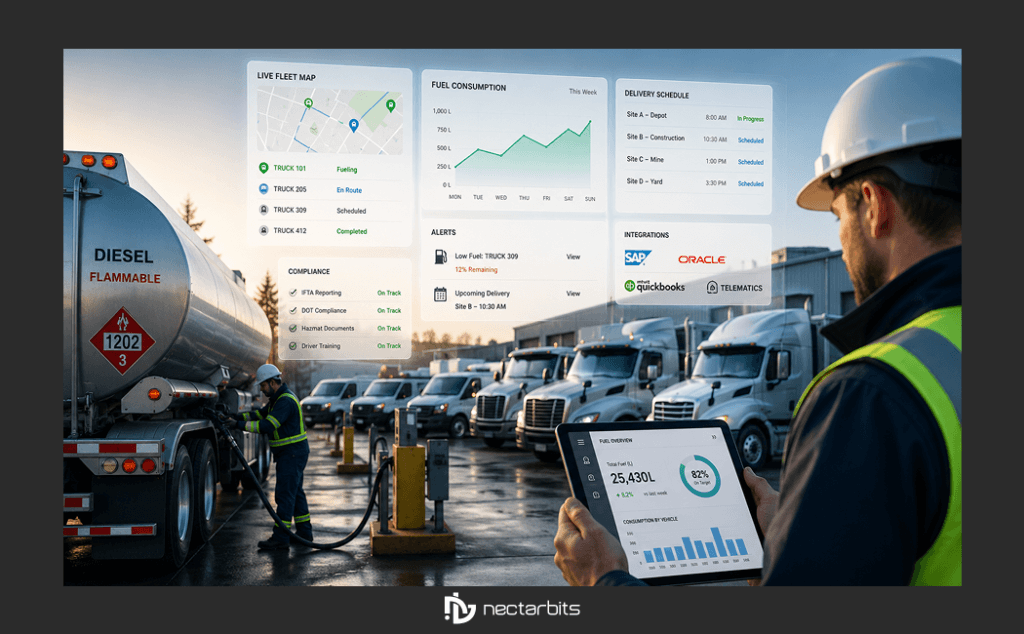
B2B fuel delivery software is an operational platform that manages the complete fuel lifecycle for commercial fleets. It handles automated dispatch, scheduled on-site delivery, real-time consumption analytics, compliance documentation, and full ERP integration in a single connected system.
It is not a consumer ordering app with a business account bolted on.
What makes B2B requirements completely different from consumer fuel apps:
| Requirement | Consumer fuel app | B2B fleet platform |
| Ordering model | On-demand, per vehicle | Contract-based recurring schedules |
| Delivery destination | Individual vehicle location | Depot, lot, or job site |
| Compliance | None required | DOT, ADR, TDG, IFTA, hazmat |
| Invoicing | Per-transaction card charge | ERP-matched PO and invoice cycle |
| Reporting | Basic receipt | Jurisdiction-level IFTA + consumption analytics |
| Fleet size served | 1–5 vehicles | 15–500+ vehicles across multiple depots |
| Integration | None | SAP, Oracle, QuickBooks, TMS, telematics |
The primary buyers of B2B fuel delivery platforms are transport companies, third-party logistics (3PL) providers, construction fleet operators, mining companies, and government vehicle pools, businesses where fuel is not a convenience cost but the single largest variable operational input.
The global on-demand fuel delivery market, valued at approximately $5.84 billion in 2025, is projected to reach $11.93 billion by 2035. The fastest-growing segment is commercial B2B fleet operations, not consumer apps, and the companies capturing that growth are the ones replacing paper-based refuelling with purpose-built software.
The 7 Real Costs of Not Using B2B Fuel Delivery Software
Without a dedicated fleet fuel management system, a logistics company running 50 trucks typically loses $111,000 per year across seven distinct cost categories, most of which never appear as a single line item in monthly reporting.
Most fleet managers track fuel cost as one number: price per litre multiplied by total consumption. The actual cost structure is far more complex, and the largest losses are invisible until someone builds the full picture.
1. Fuel theft – the silent P&L drain
Industry data consistently puts fuel theft at 5–7% of total annual fleet fuel spend. For a transport company spending $500,000 per year on diesel, that is $25,000 to $35,000 disappearing through unauthorized dispensing, card fraud, siphoning, and GPS-pump location mismatches. Without automated detection, these losses appear as normal consumption variance in monthly reports, invisible until they are quantified.
2. Untracked idle time – the budget line nobody measures
A single truck idling 30% of an 8-hour shift at 1.5 gallons per hour burns $14.40 per day in unproductive fuel at $4/gallon. Across a full year, that is $3,600 per truck. For a 50-truck fleet, $180,000 per year is evaporating with zero freight miles to show for it. Aggressive acceleration and speeding compound the problem, factors that route optimization software can monitor and reduce automatically
3. Gas station detours – hidden productivity loss
Every time a driver diverts to a fuel station during an active route, you lose a minimum of 20–30 minutes of productive time. For a 50-truck fleet, eliminating daily station detours recovers over 1,500 driver-hours per year, hours that become completed deliveries rather than fuel queues.
4. Manual IFTA compliance – the quarterly time bomb
Commercial fleets operating across two or more IFTA member jurisdictions must file quarterly fuel tax returns. For a 15-truck fleet running across 12 states, that is 60 filings per year — compiled manually from fuel cards, paper logs, and GPS exports sitting in separate systems. Manual IFTA preparation takes 8–15 hours per quarter. A single calculation error triggers a $50/day penalty per jurisdiction and a potential 3-year audit lookback. Most logistics companies are still doing this by hand.
5. Paper invoicing – books that never close on time
Manual dispatch and paper delivery tickets create billing cycles that stretch weeks past the delivery date. Inaccurate invoices trigger disputes. Disputes delay payment. Payment delays strain cash flow. At scale, paper invoicing is not an administrative inconvenience — it is a structural revenue leak that gets worse as delivery volume grows.
6. Zero consumption visibility – managing blind
Without real-time consumption data, fleet managers make fuel decisions based on estimates and monthly reports. They cannot identify which vehicles are underperforming, which routes are fuel-inefficient, or which drivers are idling excessively. The data exists inside vehicle ECUs, GPS telematics, and fuel card transactions, but without system integration, it stays siloed. You cannot reduce what you cannot see.
7. Compliance exposure – the risk that lands on your desk
Fuel is classified as hazardous cargo under DOT regulations in the United States, ADR standards in Europe, and the TDG Act in Canada. Every delivery without automated compliance documentation is a manual record-keeping task waiting to become a regulatory penalty. Regulators increasingly require digital audit trails, and fleets still relying on paper are carrying compliance risk that compounds with every delivery.
How Does B2B Fuel Delivery Software Handle IFTA Compliance Automatically?
This is the compliance capability that almost no competitor blog addresses in depth, and it is one of the most operationally significant features of a purpose-built fleet fuel management platform.
The International Fuel Tax Agreement (IFTA) requires commercial fleets operating across the 48 contiguous US states and 10 Canadian provinces to track miles driven by jurisdiction and fuel purchased by location, then file a quarterly return reconciling the two. The goal is to ensure fuel taxes are paid proportionally based on where fuel was actually consumed.
Manual IFTA compliance for a cross-state logistics fleet typically requires:
- Pulling GPS mileage records by state from one system
- Extracting fuel purchase data by location from another
- Reconciling both manually in a spreadsheet
- Calculating net tax owed or refunded per jurisdiction
- Filing the return four times per year, per base jurisdiction
A purpose-built fuel delivery platform eliminates every manual step in this process. GPS telematics with state-line detection logs every border crossing with timestamp, coordinates, and odometer reading. OBD-II and J1939 CAN bus integration captures actual engine fuel consumption from the ECU, significantly more accurate than fleet-average MPG estimates, especially on variable-load logistics routes. These two data streams feed automatically into IFTA calculation logic, generating a jurisdiction-ready quarterly report in minutes rather than days.
For a 15-truck fleet running across 12 states, the difference between manual and automated IFTA compliance is approximately 12 hours of compliance staff time per quarter, plus the complete elimination of audit exposure from estimation errors.
For Canadian fleets operating under the TDG Act: The Transportation of Dangerous Goods Act requires every fuel delivery to be accompanied by a compliant shipping document specifying product class, quantity, and emergency contact information. TDG documentation must be retained for a minimum of two years. Purpose-built platforms generate TDG-compliant shipping documents automatically at the point of delivery, eliminating manual form creation and the compliance risk that comes with it.
Read more: Real-Time Fleet Fuel Monitoring: How Modern Platforms Track Consumption
How Does Fuel Delivery Software Prevent Fuel Theft?
Most fleet operators know theft is happening. Very few have the visibility to prove it, quantify it, or stop it systematically. Modern B2B fuel delivery software addresses theft through multiple overlapping detection and prevention layers that generic fleet tracking tools simply do not include.
5 ways B2B fuel delivery software prevents fuel theft
1. RFID authentication at the pump: RFID tags or cards assign unique identifiers to each vehicle and driver. Fuel can only be dispensed after successful authentication — preventing unauthorized access entirely. One logistics company that implemented RFID alongside fleet cards reported a 25% reduction in fuel theft and a 15% drop in total fuel costs within six months.
2. GPS-to-pump location mismatch alerts: When a fuel purchase transaction is recorded at a location that does not match the vehicle’s GPS coordinates, the system flags it immediately. This catches card fraud, card sharing, and off-route dispensing in real time rather than weeks later during a manual audit.
3. Liquid Control Register (LCR) dispense verification: An LCR system electronically records the exact quantity of fuel dispensed at the end of the delivery hose. This creates a digital proof-of-delivery record that matches the invoice, and flags any discrepancy between fuel dispensed and fuel billed instantly.
4. Overnight IoT level-drop detection: Fuel level sensors connected through IoT app development on tankers and storage tanks detect abnormal drops in fuel levels outside of active delivery windows. Siphoning during off-hours triggers an immediate alert to the fleet or depot manager.”
5. Barcode-verified product dispensing for multi-compartment tankers: For tankers carrying multiple fuel types- diesel, gasoline, dyed diesel- barcode scanner verification at the point of dispense confirms the correct product is going into the correct vehicle. This prevents costly contamination incidents where off-road diesel ends up in an on-road vehicle.
How Much Does B2B Fuel Delivery Software Cost?
B2B fuel delivery software costs range from $3–$45 per vehicle per month for SaaS platforms, while custom-built enterprise solutions are scoped per fleet configuration, with most mid-sized fleet implementations delivering full ROI within 6–12 months of deployment through fuel savings alone.
Understanding the cost structure before talking to any vendor is critical. There are two fundamentally different buying options, and they suit different fleet profiles.
SaaS Fuel Management Platform Pricing
Off-the-shelf SaaS platforms charge per vehicle per month and typically include fuel tracking, basic IFTA reporting, and telematics integration:
| Tier | Price Range | Best For |
| Basic tracking | $3–$6 per vehicle/month | Small fleets, fuel card integration only |
| Mid-tier (IFTA + telematics) | $15–$25 per vehicle/month | 15–50 trucks, standard compliance needs |
| Enterprise (full dispatch + ERP) | $33–$45 per vehicle/month + hardware | 50+ trucks, multi-depot operations |
For a 50-truck fleet on an enterprise SaaS platform: approximately $20,000–$27,000 per year in licensing fees, before hardware, implementation, and ERP integration costs are added. Businesses with complex operational requirements often invest in ERP Software Development Services to streamline fuel management, dispatching, accounting, and compliance workflows through a unified system.
The limitation of SaaS platforms is that they are built for the average fleet. If your operation includes multi-compartment tankers, multi-depot structures, complex ERP environments, or cross-border compliance requirements, you will quickly hit the ceiling of what a generic SaaS platform can handle.
Custom-Built B2B Fuel Delivery Platform
Custom-built platforms, which NectarBits specializes in for logistics and transport operators, are scoped on fleet size, depot configuration, ERP integration requirements, compliance framework, and specific operational workflows.
Unlike SaaS licensing, a custom platform is built to your exact operation. The capabilities a custom build delivers that SaaS platforms typically cannot:
- Multi-compartment MTSP route optimization built for your specific tanker configuration
- Named, tested ERP connectors for your existing systems, not “API-ready” documentation
- Compliance documentation that covers your exact jurisdictions (DOT, ADR, TDG, or combinations)
- No per-seat or per-vehicle licensing fees after go-live; you own the platform
ROI Payback Period: What the Numbers Look Like
The right question is not “what does the software cost?”, it is “how fast does the saving pay back the investment?”
| Fleet Size | Annual Fuel Spend | Estimated Year-1 Saving | Typical Payback Period |
| 15 trucks | $150,000 | ~$33,300 | 4–6 months |
| 50 trucks | $500,000 | ~$111,000 | 6–10 months |
| 100 trucks | $1,000,000 | ~$222,000 | Under 6 months |
Estimates based on published industry benchmarks. Actual results vary by fleet configuration, geography, and operational baseline.
What Features Must a B2B Fuel Delivery Platform Include for Logistics Fleets?
Enterprise-grade B2B fuel delivery platforms must include eight core capabilities that generic fleet management tools and consumer-grade apps lack, and the absence of any one creates an operational gap that costs money every week.
These are not optional enhancements. For a logistics fleet managing multiple depots, cross-state routes, and enterprise billing cycles, they are the baseline operational requirements.
The Complete Feature Checklist for Logistics Fleet Operators
| Feature | What it does for logistics fleets | Operational impact |
| Real-time dispatch dashboard | Live map of all drivers, pending orders, delivery zones, and tanker positions | Eliminates phone-based status updates entirely |
| Multi-compartment load management | Route optimisation for tankers carrying multiple product types (MTSP algorithm) | 5–15% savings in total transport costs |
| Route optimization with fuel cost modelling | Plans routes factoring distance, fuel cost, delivery windows, and tanker capacity | Up to 15% reduction in total transport costs |
| Automated invoicing and billing sync | Delivery data flows to billing without manual re-entry | Invoices close same day as delivery |
| Consumption analytics by vehicle, driver, route | Surfaces idle time, efficiency variance, per-driver fuel economy | Turns fuel from an uncontrollable cost into a managed variable |
| Hazmat compliance documentation | Generates DOT, ADR, or TDG-compliant records automatically at every delivery | Audit-ready documentation in minutes, not days |
| IFTA-ready reporting | Auto-tracks GPS mileage by jurisdiction + OBD fuel data | Eliminates 8–15 hours of manual compliance work per quarter |
| Scheduled delivery and SLA management | Manages recurring contracts, delivery confirmations, and SLA performance | Zero driver involvement in the fueling process |
These are not optional enhancements. For a logistics fleet managing multiple depots, cross-state routes, and enterprise billing cycles, they are the baseline operational requirements. A custom software development approach ensures these capabilities are built to the exact workflow of your fleet, not forced into a generic SaaS product designed for a different buyer.
How Much Can a Logistics Company Save With B2B Fuel Delivery Software?
Companies implementing a purpose-built fleet fuel management system typically see 20–30% total cost savings and 35–45% efficiency gains within the first year. The savings come from four measurable sources simultaneously: theft recovery, idle time reduction, route optimization, and elimination of manual compliance and invoicing costs.
While the initial logistics app development cost may seem significant, the long-term operational savings often outweigh the investment through reduced fuel losses, improved efficiency, and automated fleet management.
| Fleet size | Annual fuel spend | Theft recovered (6%) | Idle time savings (15%) | IFTA hours saved | Est. total annual saving |
| 15 trucks | $150,000 | $9,000 | $22,500 | $1,800 in staff time | ~$33,300 |
| 50 trucks | $500,000 | $30,000 | $75,000 | $6,000 | ~$111,000 |
| 100 trucks | $1,000,000 | $60,000 | $150,000 | $12,000 | ~$222,000 |
Estimates based on published industry benchmarks. Actual results vary by fleet configuration, geography, and operational baseline.
One Canadian transport operator using a custom-built fuel delivery platform recovered more than $40,000 in previously undetected fuel losses in their first quarter alone, simply by enabling GPS-pump mismatch alerts and LCR delivery reconciliation that had not existed in their previous system.
Where Does Generic Software Fail Multi-Depot and Multi-Compartment Fleets?
This is the most technically under-addressed problem in the entire B2B fuel software category, and it is precisely where logistics companies with scale discover the limits of off-the-shelf tools.
A transport company operating three to ten depots across different regions faces operational challenges that no generic fleet management tool was designed to solve.
Per-depot fuel inventory and demand forecasting. Each depot has its own consumption patterns, storage capacity, and delivery schedule. A platform that treats all locations as a single pool cannot optimise delivery frequency per depot or prevent location-level runouts.
Zone management without developer involvement. Delivery zones should be configurable by operations staff, not engineering teams. Fleet managers need to define, adjust, and activate delivery zones without waiting for a code deployment.
Multi-tenant reporting for 3PL operators. Third-party logistics providers managing fuel across multiple client fleets need per-client consumption reporting, per-client invoicing, and per-client compliance documentation, all from a single platform.
Multi-compartment route optimization. A tanker carrying diesel in compartment one, gasoline in compartment two, and dyed diesel in compartment three requires route planning that accounts for product compatibility, delivery sequence, compartment availability, and cross-fill prevention simultaneously. This is a computationally distinct problem, known as the Multi Travelling Salesman Problem (MTSP), and most logistics software vendors have never built a solution for it.
This is why architecture decisions matter from day one. A purpose-built mobile app development approach, built specifically for fuel logistics, solves these problems at the infrastructure level, not as afterthought features patched onto a consumer platform.
Scheduled Contract vs On-Demand: Choosing the Right Fuel Delivery Model
The right fuel delivery model depends on your depot structure and consumption predictability: scheduled contract delivery is the best fit for fleets of 15 or more trucks with centralized operations, while on-demand delivery suits dispersed or variable deployments, and most enterprise operators use both models together.
Enterprise transport companies are not deciding between ordering fuel on an app or driving to a gas station. The real decision is between two distinct B2B service structures, each suited to a different operational profile.
Scheduled Contract Delivery
Scheduled contract delivery is the model built for large, centralized fleets. Transport operators enter into recurring service agreements for daily, weekly, or custom delivery slots, in which fuel tankers arrive at their depot within a defined window, typically overnight or during shift changeovers.
Pricing is contract-based and SLA-governed, with ERP billing cycles aligned to the service schedule. Drivers arrive for their shift to a full tank. Zero time spent at fuel stations. Zero driver involvement in the fuelling process whatsoever. This model works best for fleets with predictable consumption patterns and 15 or more vehicles operating from a central depot location.
On-Demand Fuel Delivery
On-demand delivery suits fleets with variable deployment schedules, dispersed vehicle locations, or emergency refuelling needs. Pricing carries a convenience premium, typically $0.30 to $1.50 per gallon above contract rates, in exchange for the flexibility of requesting delivery without a pre-set schedule.
This model works best for smaller or irregularly deployed fleets where scheduled delivery windows cannot be planned.
Comparison: Scheduled Contract vs On-Demand
| Factor | Scheduled Contract | On-Demand |
| Best for | Large centralized fleets (15+ trucks) | Dispersed or variable deployments |
| Pricing | Contract rates, lowest possible cost | Premium per gallon ($0.30–$1.50 above contract) |
| Driver involvement | Zero, overnight or shift-change delivery | Driver coordinates location with dispatcher |
| SLA | Guaranteed delivery windows (2–4 hours) | Response-time-based |
| ERP billing | Automated, contract-aligned | Per-transaction invoice |
Most enterprise logistics companies run a hybrid approach: scheduled contract delivery as the operational default, with on-demand as a backup layer for emergency situations or temporary deployments outside the normal depot network.
Read more: Fleet Management Software: Must-Have Features for Fuel Delivery Businesses
Which ERP and TMS Systems Does Fuel Delivery Software Integrate With?
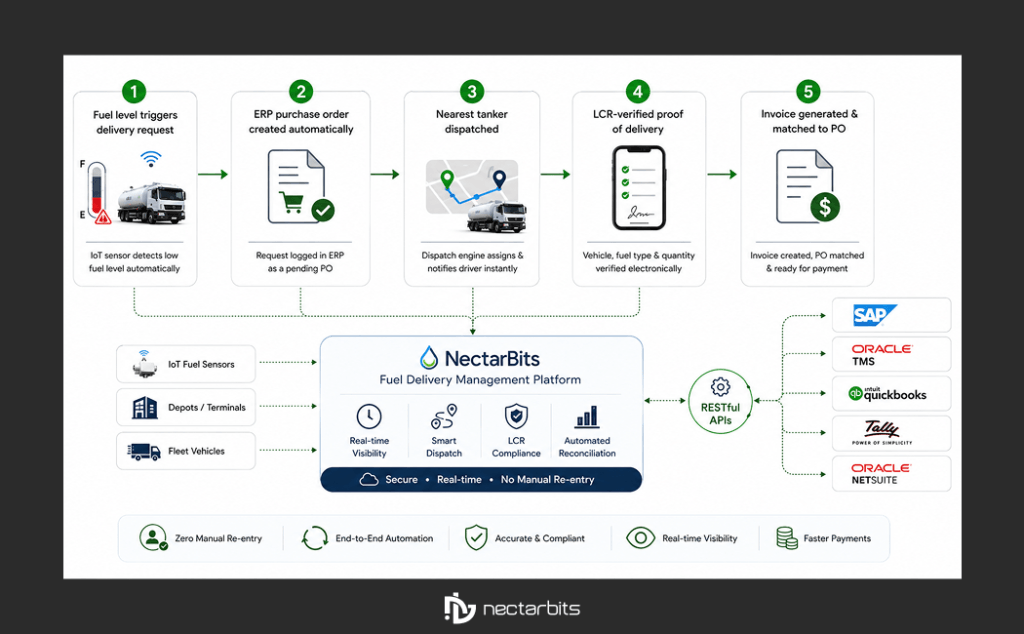
Purpose-built B2B fuel delivery software integrates with SAP, Oracle TMS, QuickBooks, Tally, and NetSuite via RESTful APIs, automating the complete cycle from fuel request to purchase order to invoice to payment with zero manual re-entry at any step in the process.
The most consistent question from logistics operations directors evaluating fuel delivery software is straightforward: “We already run an ERP. How does this actually connect?”
The Full ERP Integration Flow in a Production Environment
Here is what the full integration flow looks like in a production environment:
Step 1 Fuel level triggers automatic delivery request: A vehicle’s IoT fuel sensor detects the level has dropped below the pre-set threshold. The platform automatically generates a delivery request containing vehicle ID, depot location, fuel type, and required quantity, with no human action required.
Step 2 ERP purchase order created automatically: The request logs simultaneously in the ERP as a pending purchase order, matched against the active fuel contract pricing for that vehicle class. Your finance team can see the pending order in their system the moment it is generated.
Step 3 Dispatch engine routes the nearest available tanker: The dispatch engine identifies the nearest available tanker, optimizes the route to the depot, and pushes a delivery notification to the driver through the mobile app, all within seconds of the original sensor trigger.
Step 4 LCR-verified proof of delivery created on site: On delivery, the driver completes LCR verification: vehicle ID confirmed, fuel type confirmed, dispensed quantity recorded electronically. Proof of delivery is created instantly in the platform, no paper tickets, no manual logging.
Step 5 Invoice auto-generated and matched to PO: Delivery data pushes automatically to the accounting module. Invoice generated. Purchase order matched. Payment ready for processing. The entire back-office cycle that used to take days of manual reconciliation happens automatically.
The Critical Question to Ask Every Vendor
When evaluating platforms, ask specifically: does this system have named, tested production connectors for SAP, Oracle, and QuickBooks, or does it just describe itself as “API-ready”?
The difference between a demo promise and a tested production connector is weeks of implementation work and real operational risk. Always ask for reference clients running your specific ERP system before signing anything.
NectarBits has verified, tested production connectors for: SAP · Oracle TMS · QuickBooks · Tally · NetSuite
How Is B2B Fuel Delivery Software Evolving for EV and Alternative Fuel Fleets?
Transport companies are actively planning for electrification and alternative fuel transitions. The question is no longer whether to plan for this shift; it is whether your current fuel management software can extend to support it when you are ready.
Modern platforms built on modular architecture are already adapting:
CNG and LNG fleet tracking. Compressed and liquefied natural gas fleets require the same consumption tracking, route optimization, and compliance documentation as diesel operations. Purpose-built platforms treat CNG/LNG as additional fuel product types within the same dispatch and reporting framework; no separate system required.
EV charging schedule management. Managing EV fleet charging is operationally identical to managing scheduled fuel delivery: depot-level capacity constraints, shift-based charge windows, state-of-charge monitoring, and priority dispatch for vehicles with low range. Companies preparing for fleet electrification often invest in EV Fleet Management Software Development to optimize charging schedules, improve vehicle utilization, and maintain operational efficiency across their fleets.
Biofuel product compatibility. B20 and B100 biodiesel blends require product-specific handling in multi-compartment tankers. Barcode-verified dispensing and product compatibility rules in the dispatch engine prevent accidental cross-contamination with conventional diesel during mixed-fleet operations.
Carbon and sustainability reporting. Fleet sustainability obligations are expanding for large transport operators. A fuel delivery platform that logs consumption by fuel type, vehicle, route, and depot can generate the emissions data that ESG reporting frameworks require, without a separate analytics system.
Platforms built on modular architecture, which is how the custom software development teams at NectarBits approach fuel logistics builds, support these extensions through the existing architecture rather than requiring a rebuild as fleet fuel mix evolves.
Read More: Discover how modern Fleet Management Software helps transportation companies optimize operations, support fleet growth, and prepare for EV and alternative-fuel adoption.
A Real-World Scenario: How an 80-Truck Transport Company Transformed Its Fuel Operations
Consider a mid-sized regional transport company. Eighty trucks. Three depots spread across two states. Drivers running cross-state routes six days a week.
Before B2B fuel delivery software: Drivers refuel at approved gas stations on route, logging purchases on paper cards submitted weekly. The compliance team spends two full working days every quarter pulling fuel card statements, GPS mileage exports, and paper receipts to build IFTA filings. The operations manager spots consumption anomalies in the monthly report, three weeks after they occurred. Invoicing runs 30 days behind delivery dates. Fuel theft is assumed to be happening but cannot be quantified or stopped.
After implementing a purpose-built platform: Fuel is delivered overnight to all three depots on a weekly contract schedule. Drivers arrive each shift to full tanks with zero time spent at gas stations. IoT sensors confirm fill levels before routes begin. Every delivery generates a compliance document automatically. IFTA quarterly reports are ready within minutes of quarter-end. Consumption anomalies trigger alerts within hours. Invoices close the same day delivery is confirmed.
The financial outcome is not marginal. Fleet management systems of this kind typically deliver a 25–30% reduction in operational costs and a 35% improvement in delivery efficiency within the first year. One NectarBits client recovered more than $40,000 in undetected fuel losses in their first quarter after go-live.
8 Questions to Ask Before Choosing a B2B Fuel Delivery Software Vendor
The 8 questions below separate platforms that perform in production from platforms that only perform well in sales demos; ask every single one before signing any contract or beginning any implementation.
Most procurement processes focus on price and feature checklists. The questions that reveal real capability are far more specific than anything on a standard vendor scorecard.
Question 1: Does the Platform Handle IFTA Reporting Natively?
Ask for a live demonstration generating an actual IFTA report from real GPS mileage and OBD fuel data, not a spreadsheet export or a PDF template. If any manual step is involved in producing that report, the compliance burden stays with your team, not the software.
Question 2: Does It Support Multi-Compartment Tanker Operations?
Generic fleet software cannot optimize routes for multi-product tankers while simultaneously preventing cross-fill contamination. Ask specifically whether MTSP route optimization and barcode-verified product dispensing are supported and operational in existing client deployments, not just described in a product brochure.
Question 3: Which ERP Systems Have Tested, Production-Deployed Connectors?
Ask for specific names: SAP, Oracle, QuickBooks, Tally, NetSuite. “API-ready” is not the same as “tested integration with your specific ERP version.” Request references from clients actively using your specific ERP system and speak with their operations team directly. Understanding the underlying Fuel Delivery Platform Architecture can also help evaluate how well a solution supports integrations, scalability, and long-term operational requirements.
Question 4: How Is Fuel Theft Detected and What Alerts Fire in Real Time?
The answer should include GPS-pump mismatch alerts, overnight level-drop detection, LCR dispense verification, and RFID authentication at the point of dispense. If the answer is only “we support fuel card controls,” the platform is not purpose-built for the theft problem and will not solve it.
Question 5: What Compliance Frameworks Does the Documentation Cover?
At minimum: DOT regulations (US), ADR standards (Europe), TDG Act (Canada). If your fleet crosses international borders or operates across multiple regulatory jurisdictions, ask about each framework explicitly and ask to see example generated documents.
Question 6: What Are the SLA Terms on Scheduled Delivery Windows?
Delivery windows of 2–4 hours are standard for enterprise contracts. Get in writing exactly what happens when a window is missed, automatic rebooking, credit against your account, or a contractual penalty clause in your favour.
Question 7: Who Owns the Data and in What Format Is It Exportable?
Your consumption data, compliance records, and IFTA history belong to your business, not the platform provider. Confirm that full export in standard formats (CSV, JSON, PDF) is available at any time without requiring vendor involvement or incurring additional fees.
Question 8: What Does the Implementation Timeline Look Like for a Fleet Our Size?
Purpose-built platforms for mid-sized fleets typically deploy from kickoff to full production in 8–16 weeks. If the answer is open-ended or vague, ask for a reference client at a similar fleet size and have a direct conversation with their operations team about what the actual implementation experience looked like.
How NectarBits Builds B2B Fuel Delivery Platforms for Logistics Companies
With over 16 years of experience in custom software development and a focused track record in fuel delivery app development, the NectarBits engineering team has built enterprise fuel logistics platforms for transport companies across North America, the UAE, and Southeast Asia.
The development approach is built around the specific operational requirements of logistics and transport fleets, not adapted from a consumer product:
Discovery and fleet workflow mapping. Every engagement begins with a structured analysis of your depot configuration, fleet size, existing ERP and TMS stack, compliance obligations, and current fuel management pain points. The platform architecture is determined by your actual workflow, not retrofitted to a generic template. This approach is backed by our industry recognition and Awards for delivering enterprise-grade logistics solutions.
Purpose-built dispatch and route optimization engine. Including multi-compartment MTSP routing, zone management configurable by operations staff, per-depot demand forecasting, and SLA-governed scheduled delivery windows built for enterprise contracts.
Full compliance documentation suite. Automated DOT, ADR, and TDG-compliant delivery records generated at point of delivery. IFTA-ready jurisdiction tracking via GPS + OBD integration. Audit-ready in minutes, not days.
ERP and TMS integration. Named, tested connectors for SAP, Oracle, QuickBooks, Tally, and NetSuite, not API documentation with implementation left to your internal team.
Native mobile app development for drivers and dispatchers. iOS and Android apps built specifically for fuel delivery workflows, not adapted from a generic logistics driver app. Dispatch confirmation, LCR verification, proof of delivery, and real-time status, mall in a single purpose-built interface.
Deployment timeline. Mid-sized fleet implementations typically reach full production in 8–16 weeks from kickoff. Custom enterprise deployments with complex ERP integration are scoped individually.
If you are evaluating whether a custom-built or white-label fuel delivery platform is the right fit for your fleet size, depot configuration, and budget, the right first step is a scoped conversation, not a generic demo.
Why the Fleets That Act Now Build a Lasting Advantage
The logistics and transport companies that move to B2B fuel delivery software early are not just saving on fuel costs. They are building a data advantage: consumption patterns, driver efficiency benchmarks, route-level cost models, depot-level demand forecasts that compound into a structural competitive moat over time.
Fleets that delay are not simply losing money on theft and idle time. They are falling behind on the operational intelligence that their competitors are accumulating every week.
The technology to eliminate manual IFTA filing, catch fuel theft in real time, optimize multi-depot delivery schedules, and close invoices the same day they are generated exists today, and the cost of not using it is measurable on every quarterly P&L.
If you are evaluating a custom B2B fuel delivery platform for your fleet, exploring a White Label Fuel Delivery App Development solution for your logistics business, or assessing whether a purpose-built build is right for your depot configuration and ERP environment, the right next step is a direct conversation about your specific situation.
Conclusion
B2B fuel delivery software is reshaping how logistics companies manage fuel costs, compliance, and fleet efficiency. From reducing fuel theft and automating IFTA reporting to improving multi-depot operations, it delivers measurable operational gains across every level of a transport business.
Fleets that adopt B2B fuel delivery solutions early gain better visibility, lower costs, and stronger long-term efficiency compared to those still relying on manual processes.
If your business is planning to scale or optimize fuel operations, the right time to move is now.
Frequently Asked Questions:
B2B fuel delivery software is an enterprise operations platform that manages scheduled or on-demand fuel delivery to commercial vehicle fleets — covering dispatch, route optimization, consumption tracking, compliance documentation, and ERP integration. Consumer fuel apps serve individual vehicle owners with single on-demand transactions and no compliance, ERP, or multi-vehicle reporting requirements. The two categories share a name but serve completely different operational needs.
Most logistics fleets achieve 20–30% total fuel cost savings and 35–45% efficiency improvements within the first year. The savings break down across four sources: fuel theft recovery (typically 5–7% of annual spend), idle time reduction (10–25% efficiency improvement), route optimisation (5–15% transport cost reduction), and elimination of manual IFTA compliance and invoicing overhead. For a 50-truck fleet spending $500,000 annually on fuel, that adds up to approximately $111,000 in recoverable cost per year.
Yes. Purpose-built platforms combine GPS mileage tracking by jurisdiction with OBD-II fuel consumption data from each vehicle’s ECU to generate IFTA-ready quarterly reports automatically. This eliminates 8–15 hours of manual compliance work per quarter and removes the audit risk created by manual estimation errors. For Canadian fleets, the same architecture also generates TDG Act-compliant shipping documents at point of delivery.
Enterprise fuel delivery platforms connect via RESTful APIs to SAP, Oracle TMS, QuickBooks, Tally, and NetSuite. A properly integrated platform automates purchase order creation at point of fuel request, invoice generation at point of delivery, and payment processing — with no manual re-entry at any step. When evaluating vendors, ask specifically for named production-deployed connectors, not general API availability claims.
Through five overlapping layers: RFID authentication at the pump prevents unauthorized dispensing; GPS-to-pump location mismatch alerts flag card fraud in real time; Liquid Control Register (LCR) integration verifies dispensed quantity against invoiced quantity; IoT overnight level-drop detection identifies siphoning during off-hours; and barcode-verified product dispensing prevents fuel type contamination in multi-compartment tankers. Together these layers make theft both harder to execute and immediately visible when it occurs.