
 Anil Patel
The gas station model is over 100 years old. And for the first time in a century, customers don’t need to go to the fuel station; the fuel comes to them.
The global on-demand fuel delivery market has witnessed a 45% surge in users over the past two years and is projected to reach $5 billion by the end of 2026, growing at a CAGR of approximately 18%. Behind this growth: rising urbanization, fleet digitization, and consumers who expect the same on-demand experience from fuel that they already get from food and rides.
If you are a startup founder, gas station owner, oil and gas retailer, or fleet operator looking to go digital, your first decision is choosing the right fuel delivery app development company. That decision alone will determine how fast you launch, how much you spend, and whether your app survives past the first six months.
This guide cuts through the noise. You will find an honest, research-backed list of the 10+ leading fuel delivery app development companies in the USA, along with a complete breakdown of features, costs, business models, US compliance requirements, and exactly what to ask before signing a contract.
Why the Fuel Delivery Market Is Booming in 2026
Three forces are converging to make on-demand fuel delivery one of the most attractive verticals in mobile commerce right now.
Convenience is non-negotiable. Studies consistently show that over 74% of consumers will pay a premium for services that save them time. Fuel is one of the last major recurring purchases that still requires a physical trip. Apps that eliminate that trip are tapping directly into consumer behavior that has already been trained by food delivery, grocery delivery, and ride-hailing.
Fleet operators are under pressure to digitize. Construction companies, logistics providers, rental fleets, and transport companies are actively replacing manual fueling logs with automated, trackable, app-based solutions. B2B fuel delivery is now a serious enterprise category, not just a startup novelty.
Regulatory pressure is accelerating digital tracking. Across the USA, fuel transportation is increasingly subject to digital reporting requirements, from EPA compliance to DOT hazmat tracking. Companies that build digital-first fuel delivery platforms are better positioned to meet these requirements than those still operating on paper-based systems.
The result: whether you are targeting individual consumers, corporate fleets, or fuel station chains, the market timing has never been better to invest in on-demand fuel delivery app development.
What Is a Fuel Delivery App and How Does It Work?
A fuel delivery app is a mobile platform that connects customers who need fuel with certified delivery providers who bring it directly to the customer’s vehicle or location. Think of it as “Uber for fuel”, but with hazmat compliance, real-time inventory management, and fleet-level controls built in.
The 3-App Architecture Every Fuel Delivery Platform Needs
Unlike most on-demand apps, a fuel delivery platform is not one app. It is three separate products running in coordination:
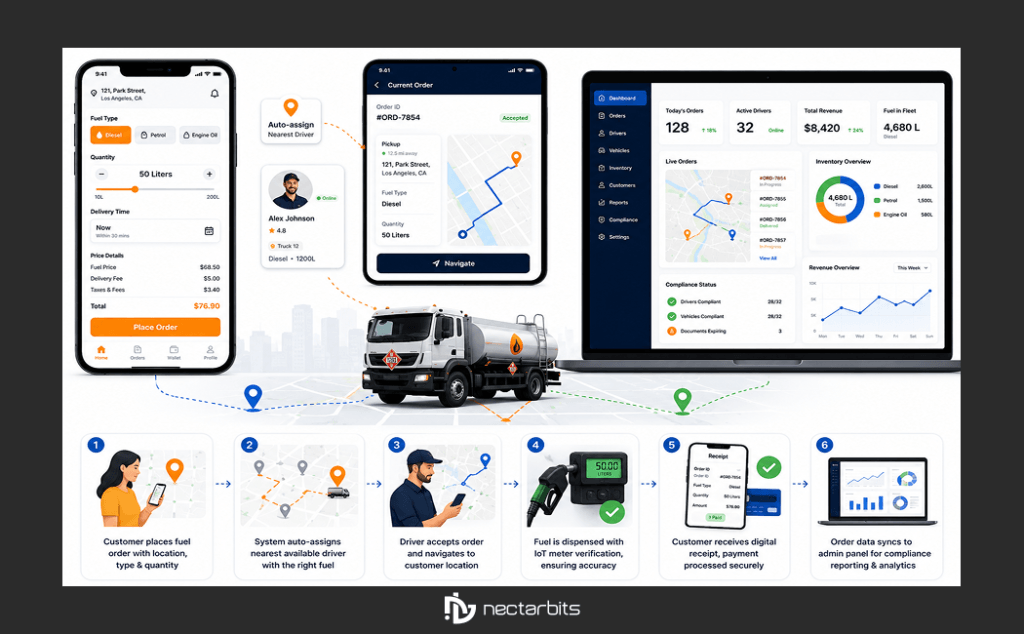
Customer App: The interface your end users interact with. They open the app, enter their location, select fuel type and quantity, choose delivery time, and pay. The experience should be as frictionless as ordering a pizza.
Driver/Delivery Agent App: The tool your fuel delivery agents use in the field. It shows incoming orders, optimized routes, customer location, fuel type, and quantity, and provides digital confirmation of delivery with photo proof and quantity verification.
Admin Panel: Your command center. From here, you manage drivers, set pricing, view real-time order status, track inventory across your fleet, generate compliance reports, and analyze business performance.
How a Single Order Flows Through the System
- The customer opens the app and places a fuel order with location, type, and quantity.
- The system auto-assigns the nearest available driver with the right fuel type on board.
- The driver accepts the order and navigates to the customer’s GPS location.
- Fuel is dispensed with IoT meter verification, preventing human error and theft.
- Customer receives a digital receipt with quantity confirmed and payment processed.
- Order data syncs to the admin panel for compliance reporting and analytics.
Real Fuel Delivery Apps Operating in the USA Right Now
Before investing in development, it helps to understand what is already working in the market, and what has failed. These are the real fuel delivery apps operating (or that operated) in the USA:
| App | Market Focus | Business Model | Key Differentiator | Status |
| EzFill | Florida, NYC | B2C + Fleet | Marine + car fueling, contactless | Active, publicly traded |
| Booster Fuels | Corporate/Fleet | B2B office parking lots | Pre-scheduled fleet fueling | Active |
| Yoshi | Southeast USA | B2C + Fleet | Subscription + oil change combo | Active |
| GasNGO | Texas | B2C | Emergency roadside fueling | Active |
| 2uFuel | USA-wide | White-label | Smart ZIP verification, fleet bulk upload | Active |
| Filld | West Coast | B2C | Gas station partnerships | Closed 2019 |
What Filld’s closure teaches builders: Filld failed not because the idea was wrong, but because unit economics were difficult at low scale in markets with dispersed demand. The lesson for anyone building a fuel delivery app: choose a dense, high-demand market first, build your delivery density before expanding geography, and design your app with operational efficiency, not just user experience, as a primary goal.
Which Business Model Is Right for You?
Not all fuel delivery businesses work the same way, and the business model you choose will directly shape what your app needs to do. Here are the four primary models operating in the USA in 2026.
Model 1: Direct-to-Consumer (B2C)
You deliver fuel to individual consumers, their car in a parking lot, their generator at home, their boat at the marina. The customer pays a convenience fee on top of the fuel price.
- Revenue: Per-delivery fee ($5–$20) + fuel price markup (usually $0.20–$0.60/gallon)
- Best for: Urban and suburban startups targeting individual drivers
- App complexity: Medium, real-time tracking, scheduling, multi-payment options
- Challenge: Customer acquisition cost is high; repeat usage is key to profitability
Model 2: B2B Fleet Management
You contract with companies to fuel their vehicle fleets regularly, logistics companies, construction firms, rental fleets, and transport operators. Deliveries are scheduled, volumes are predictable, and billing is consolidated monthly.
- Revenue: Volume-based contracts ($5,000–$500,000/year per client), subscription pricing
- Best for: Companies targeting enterprise clients in logistics, construction, or transport
- App complexity: High, bulk orders, fleet vehicle management, driver scheduling, invoice generation, compliance reporting
- Challenge: Longer sales cycles; requires strong operational infrastructure
Read More: How Booster Fuels Built a $100M+ B2B Fleet Fueling Business. Booster Fuels transformed fleet fueling with scheduled on-site fuel delivery, route optimization, and digital compliance tools for enterprise fleets.
Model 3: Aggregator/Marketplace
You build a platform that connects independent fuel suppliers with end customers; you do not own the fuel or the trucks. Like Uber connecting drivers with riders, you connect licensed fuel providers with buyers and take a commission per transaction.
- Revenue: 8–15% commission per transaction
- Best for: Tech-first founders who want to build a platform without managing physical logistics
- App complexity: High, multi-vendor management, payout systems, quality verification, ratings
- Challenge: Supply-side onboarding is the hardest problem; trust and quality control are critical
Model 4: White-Label SaaS
You build a fuel delivery platform and license it to gas station chains, fuel retailers, or regional operators who want to offer on-demand delivery under their own brand. You provide the technology; they provide the fuel and drivers.
- Revenue: Monthly SaaS license ($2,000–$15,000/month per client) + setup fee
- Best for: Tech companies or agencies with deep on-demand development experience
- App complexity: High, multi-tenant architecture, white-label customization, API integrations
Read More: How EzFill Scaled to a Nasdaq-Listed Company Using a Multi-Model Approach. EzFill expanded from a B2C fuel delivery app into fleet and marine fueling, building a multi-service platform capable of serving consumers, businesses, and marinas from one backend system.
10+ Top Fuel Delivery App Development Companies in the USA
Choosing the wrong development partner is the most expensive mistake you can make in this space. Below is an honest profile of each leading fuel delivery app development company actively serving clients in 2026, evaluated on technical capability, fuel-specific experience, pricing transparency, and post-launch support.
1. Nectarbits
Website: nectarbits.com
Rating: 4.9/5
Timeline: 6–20 weeks, depending on scope
Tech Stack: React Native, Flutter, Node.js, Google Maps API, Stripe, AWS
Nectarbits fuel delivery app development is one of the most recognized services among fuel delivery app development companies serving clients across North America, the UAE, and the UK. With 250+ successful projects and a dedicated on-demand delivery vertical, the team brings genuine fuel app expertise, not just generic mobile development skills repurposed for the fuel sector.
What sets Nectarbits apart is the depth of its on-demand delivery ecosystem. The team has built fuel delivery platforms for gas station owners, fuel startups, and oil and gas retailers, offering both white-label fuel delivery app solutions for fast-launch clients and fully custom builds for those who need proprietary architecture. Clients get complete source code ownership, transparent sprint-based project management, and post-launch maintenance as a standard inclusion, not an add-on.
Core Fuel App Services:
- Custom on-demand fuel delivery app (iOS + Android + Web)
- White-label fuel delivery platform with full branding customization
- Uber-like gas delivery app with real-time driver tracking
- B2B fleet fuel management systems
- Multi-vendor fuel marketplace development
- AI-powered route optimization and driver dispatch
Best For: Startups validating their model quickly, gas station owners going digital, enterprises needing scalable fleet fueling platforms, and clients in the USA and Canada who need a team familiar with local compliance requirements.
2. Hyperlink InfoSystem
Website: hyperlinkinfosystem.com
Rating: 4.8/5
Timeline: 8–24 weeks
Tech Stack: React Native, Swift, Kotlin, Node.js, Google Maps, Stripe, Firebase
Hyperlink InfoSystem’s fuel delivery app development is a well-established player in the on-demand fuel delivery app development space with a strong portfolio in GPS tracking systems, automated scheduling, and inventory management. Their development team has meaningful experience building scalable solutions for both startups and established fuel distribution businesses, with a consistent focus on high-transaction-volume backends.
The company offers a comprehensive set of fuel delivery services: custom app builds, driver management dashboards, customer CRM integration, and analytics reporting. Hyperlink’s strength lies in building apps that handle complexity gracefully — multi-vehicle support, surge pricing, and multi-fuel-type ordering all within a single, user-friendly interface.
Core Fuel App Services:
- On-demand fuel delivery app development (iOS + Android)
- Real-time GPS fleet tracking and dispatch
- Automated delivery scheduling system
- Customer loyalty and referral program integration
- Admin analytics and inventory dashboards
Best For: Businesses that need a feature-rich, proven platform with a well-documented development process and a track record of delivering at scale.
3. JPLoft
Website: jploft.com
Rating: 4.8/5
Timeline: 10–24 weeks
Tech Stack: Flutter, React Native, Node.js, Python, AWS, Google Maps, Stripe
JPLoft fuel delivery app development is widely recognized as one of the top on-demand fuel delivery app development companies for scalable, enterprise-grade platforms. With 15+ years of experience and a dedicated on-demand vertical, the team builds platforms that go well beyond basic GPS and payment. AI-powered route optimization, ML-based demand forecasting, and blockchain-based delivery verification are all within their standard toolkit.
JPLoft’s approach to fuel app development is particularly strong on the B2B side. Their fleet management modules, bulk order management, consolidated invoicing, driver performance analytics, and compliance documentation make them a strong choice for companies targeting enterprise fleet contracts rather than individual consumer markets.
Core Fuel App Services:
- Custom fuel delivery app with AI route optimization
- B2B fleet fuel management platform
- White-label on-demand fuel delivery solution
- Driver app with real-time navigation and earnings tracking
- App Store optimization and launch support
Best For: Companies targeting B2B fleet contracts, or startups that need an enterprise-grade platform built to handle rapid scaling.
4. Sapphire Software Solutions
Website: sapphiresolutions.net
Rating: 4.7/5
Timeline: 6–20 weeks
Tech Stack: React Native, Angular, Laravel, MySQL, Google Maps API, Stripe
Sapphire Software Solutions’ fuel delivery app development is a certified IT company with a consistent track record in fuel delivery app development services across multiple markets. Their fuel delivery apps are built around three core principles: flexible payment options, precise real-time tracking, and delivery scheduling, addressing the three features that most directly impact customer retention in this category.
The Sapphire team is particularly strong in multi-payment gateway integration, supporting credit cards, debit cards, e-checks, and digital wallets within a single checkout experience. Their development timelines for standard fuel apps (4–8 weeks) are among the fastest options in this list, making them a strong choice for founders who need to get to market quickly without sacrificing quality.
Core Fuel App Services:
- On-demand fuel delivery app (iOS + Android)
- Scheduled delivery and real-time order tracking
- Multi-payment gateway integration
- Gas station management and vendor panel
- Customer rating and review system
Best For: Startups and SMEs that need a reliable, well-structured fuel delivery platform delivered on a clear timeline and budget.
5. Appinop Technologies
Website: appinop.com
Rating: 4.7/5
Timeline: 6–18 weeks
Tech Stack: Flutter, React Native, Node.js, MongoDB, AWS, Google Maps
Appinop Technologies fuel delivery app development brings a strong focus on UX-led design to their fuel delivery app development work. Their platforms are consistently noted for intuitive interfaces that require minimal user onboarding — a critical factor in fuel delivery apps where the target user base spans tech-savvy urban professionals and less digitally experienced fleet drivers alike.
Appinop’s cloud integration capabilities are a notable strength. Their fuel delivery platforms are built on scalable cloud infrastructure from day one, meaning the app can handle 100 orders a day or 10,000 orders a day on the same codebase without architectural rework. This makes them a smart choice for startups that expect to grow fast but don’t want to pay enterprise prices upfront.
Core Fuel App Services:
- Custom on-demand fuel delivery app development
- Scalable cloud-native backend architecture
- Intuitive UX design for both consumer and driver apps
- Real-time tracking and driver dispatch
- API integrations with third-party logistics tools
Best For: Startups and growing businesses that prioritize UX quality and scalable architecture at a competitive price point.
6. On-Demand App
Website: on-demand-app.com
Rating: 4.6/5
Timeline: 2–8 weeks (white-label ready)
Tech Stack: React Native, Node.js, Google Maps, Stripe, Firebase
On-Demand App fuel delivery app development offers one of the fastest paths to launching a white-label fuel delivery app in the market. Their ready-made fuel delivery solution is pre-built, fully tested, and designed to be deployed with branding customization in a matter of days rather than months, making it the most practical option for founders who need to launch fast, capture a market window, and iterate based on real user feedback.
The platform covers the full delivery stack: customer ordering, driver dispatch, vendor management, and admin control, all accessible as a white-label product that can be rebranded to match any business identity. For entrepreneurs exploring the fuel delivery space for the first time, this offers the lowest-risk, lowest-cost entry point available.
Core Fuel App Services:
- Ready-made white-label fuel delivery platform
- Full suite: customer app, driver app, admin panel
- Quick deployment (48–72 hour setup available)
- Branding customization and feature configuration
- Ongoing technical support
Best For: Entrepreneurs who want to launch a fuel delivery business in weeks rather than months, or existing on-demand businesses adding fuel as a new vertical.
7. TechBuilder
Website: techbuilder.ai
Rating: 4.6/5
Timeline: 8–20 weeks
Tech Stack: React Native, Node.js, AWS, Google Maps API, Stripe, Firebase
TechBuilder fuel delivery app development is a US-based fuel delivery app development company that combines domain expertise with an agile development methodology. Their fuel delivery solutions are built around four core panels: Customer App, Delivery Agent App, Vendor Panel, and Admin Panel, ensuring that every stakeholder in the delivery chain has a purpose-built interface.
The team’s AI-powered fuel monitoring system is worth noting. Using GPS connectivity and predictive analytics, their platform provides live delivery status updates down to the minute, allowing customers to plan their schedule around the delivery rather than waiting around. Their transparent pricing model (no hidden charges) and fixed-price contracting are particularly valued by clients who have been burned by scope creep in previous projects.
Core Fuel App Services:
- Full 4-panel fuel delivery platform (customer, driver, vendor, admin)
- AI-powered real-time fuel monitoring and GPS tracking
- Subscription-based fuel delivery model support
- Agile sprint-based development with transparent pricing
- Fleet vehicle bulk ordering and corporate account management
Best For: US-based businesses that want a locally headquartered development team and fixed-price contracts with no scope creep surprises.
8. TecOrb Technologies
Website: tecorb.com
Rating: 4.6/5
Timeline: 6–16 weeks
Tech Stack: React Native, Node.js, Google Maps, IoT sensors, MySQL, AWS
TecOrb Technologies fuel delivery app development is a global fuel delivery app development company with a strong presence across the USA, UK, UAE, Canada, and Singapore. What distinguishes TecOrb in this category is their IoT integration capability, Smart Locks on fuel vehicles, IoT-based tank sensors, and GPS-driven fleet monitoring are built into their standard fuel delivery stack, not offered as expensive add-ons.
Their fuel delivery apps support fuel type comparison (diesel, petrol, engine oil) with transparent pricing so customers can make informed decisions before ordering — a feature that significantly improves order conversion rates and customer trust. The multi-region compliance knowledge the team brings (having served clients across five major markets) is especially valuable for businesses planning to operate across state lines or internationally.
Core Fuel App Services:
- IoT-enabled fuel delivery app with Smart Lock vehicle integration
- Multi-fuel-type ordering with real-time price comparison
- Scheduled delivery and fuel type selection (diesel, petrol, oil)
- Driver referral and surge pricing system
- Remote fueling payment and management solution
Best For: Businesses that need IoT integration for fleet fuel monitoring, or companies operating across multiple US states or internationally who need multi-compliance expertise.
9. Hyperlocal Cloud
Website: hyperlocalcloud.com
Rating: 4.5/5
Timeline: 4–16 weeks
Tech Stack: React Native, Node.js, Google Maps, Firebase, Stripe
Hyperlocal Cloud fuel delivery app development specializes in on-demand delivery platforms with a particular focus on hyperlocal market dynamics, meaning apps designed to work efficiently within a defined geographic zone rather than at a national scale. For fuel delivery startups that are launching in a single city or metro area, this focused approach is an advantage: the platform is optimized for density and short-range delivery efficiency rather than built for scale it may never reach.
Their fuel delivery solutions are well-suited for gas station owners who want to extend their reach into a local delivery radius, rather than startups trying to compete nationally from day one.
Core Fuel App Services:
- Hyperlocal on-demand fuel delivery app
- Gas station owner digital platform
- Real-time driver tracking and dispatch
- Loyalty program and referral system
- White-label ready solution
Best For: Gas station owners and local fuel startups launching in a defined metro area who need a cost-effective, quick-to-deploy platform.
10. Comfygen
Website: comfygen.com
Rating: 4.5/5
Timeline: 5–16 weeks
Tech Stack: Flutter, React Native, Laravel, Node.js, MySQL, Google Maps
Comfygen fuel delivery app development is an on-demand app development specialist with a fuel delivery vertical that covers the full technology stack from mobile apps to backend APIs and admin dashboards. Their team works with both startups entering the fuel delivery market for the first time and established fuel businesses that need to digitize their existing operations.
Comfygen’s competitive positioning is their ability to deliver a functional MVP, a working app with core features, within a shorter timeframe and lower budget than most custom development companies, making them a practical choice for entrepreneurs who need to validate their business model before committing to a full-scale build.
Core Fuel App Services:
- On-demand fuel delivery MVP development
- Customer app, driver app, and admin panel
- Real-time GPS tracking and payment integration
- Push notification and order status system
- Post-launch support and maintenance
Best For: First-time founders who need an MVP-first approach to validate their fuel delivery concept before scaling.
11. NCrypted Technologies
Website: ncrypted.co
Rating: 4.5/5
Timeline: 6–20 weeks
Tech Stack: PHP, React, React Native, Node.js, MySQL, Google Maps, PayPal, Stripe
NCrypted Technologies fuel delivery app development brings a product-minded approach to fuel delivery app development, offering both custom-built solutions and white-label clone platforms that significantly reduce time-to-market. Their fuel delivery platform includes a ready-made software framework that can be customized to fit a specific brand, market, and business model, rather than starting every project from a blank canvas.
This approach is particularly effective for entrepreneurs who have a clear vision of their business model but don’t have the budget or timeline for a completely bespoke build. NCrypted handles the complexity so clients can focus on market entry and operations.
Core Fuel App Services:
- White-label fuel delivery script and clone app
- Custom on-demand fuel delivery app development
- Multi-revenue stream platform (delivery fee, subscription, commission)
- Payment gateway integration (Stripe, PayPal, Braintree)
- API-ready backend for third-party integrations
Best For: Entrepreneurs who want a white-label or clone-based fuel delivery platform with meaningful customization options at a controlled budget.
Side-by-Side Comparison Table
| Company | Best For | Timeline | White-Label | Custom Build | Free Consultation |
| Nectarbits | Startups & enterprise, USA/Canada | 6–20 wks | Yes | Yes | Yes |
| Hyperlink InfoSystem | Feature-rich scalable platforms | 8–24 wks | Yes | Yes | Yes |
| JPLoft | B2B fleet & enterprise scale | 10–24 wks | Yes | Yes | Yes |
| Sapphire Software | SMEs needing fast delivery | 6–20 wks | Partial | Yes | Yes |
| Appinop Technologies | UX-first, scalable cloud apps | 6–18 wks | Yes | Yes | Yes |
| TechBuilder | US-based, fixed-price | 8–20 wks | Yes | Yes | Yes |
| TecOrb Technologies | IoT integration, multi-region | 6–16 wks | Yes | Yes | Yes |
| Hyperlocal Cloud | Local/metro launch | 4–16 wks | Yes | Yes | Yes |
| Comfygen | MVP-first, first-time founders | 5–16 wks | Partial | Yes | Yes |
| NCrypted Technologies | White-label clone + custom | 6–20 wks | Yes | Yes | Yes |
| On-Demand App | Fastest white-label launch | 2–8 wks | Yes | No | Yes |
White-Label vs. Custom: Which Should You Build?
This is the question most founders get stuck on — and most blogs give you a useless answer. Here is the honest framework.
| Decision Factor | White-Label | Custom Build |
| Time to launch | 2–8 weeks | 3–8 months |
| Development cost | $5,000–$40,000 | $30,000–$150,000+ |
| Source code ownership | Vendor retains IP | You own 100% |
| Feature flexibility | Only what the vendor built | Build anything you need |
| Branding | Partial (your logo, your colors) | 100% your design |
| Scalability ceiling | Vendor’s infrastructure limits | Unlimited |
| Best for | Validating the market; launching fast | Long-term competitive advantage |
| Risk | Vendor dependency; switching cost later | Execution risk; longer timeline |
The practical recommendation: If you are pre-revenue and trying to prove there is demand for fuel delivery in your market, start with a white-label fuel delivery app from a proven provider. Launch in 4–6 weeks. Get your first 100 orders. Then, with real data and real revenue, engage a custom development partner to build the proprietary platform you actually need for scale.
If you already have a proven business model, a customer base, and you are ready to build a competitive moat, go custom from the start. The IP ownership, feature control, and architectural freedom will matter significantly as you grow.
For a detailed side-by-side breakdown of both approaches, read the complete white-label vs. custom app development guide from Nectarbits, covering architecture differences, total cost of ownership, and which model fits which stage of business.
Must-Have Features for a Fuel Delivery App in 2026
The features that defined a “good” fuel delivery app in 2022 are now table stakes. In 2026, users expect more — and regulators increasingly require more. Here is a complete feature breakdown organized by panel.
Customer App Features
| Feature | Why It Matters in 2026 |
| One-tap fuel ordering | Reduces friction; drives repeat usage |
| Real-time driver GPS tracking | The #1 feature users expect — non-negotiable |
| Multi-fuel-type selection | Diesel, petrol, premium; one order flow |
| Scheduled delivery | Pre-book for fleet needs or planned trips |
| In-app payment (card, wallet, UPI) | PCI-DSS compliant; multiple options required |
| Digital receipt and order history | Compliance and user trust |
| Loyalty points and referral rewards | Drives retention and word-of-mouth |
| In-app chat with driver support | Reduces failed deliveries |
| Fuel cost estimator | Helps users budget; increases conversion |
| Push notifications | Order confirmed, driver en route, delivered |
Driver App Features
| Feature | Why It Matters in 2026 |
| Optimized route navigation | Cuts delivery time by 20–35% |
| Order management dashboard | Accept, track, and complete in-app |
| IoT fuel meter integration | Prevents quantity disputes and theft |
| Digital proof of delivery (photo + signature) | Legal and compliance requirements |
| Earnings tracker | Driver motivation and retention |
| In-app driver support | Real-time issue resolution |
| Shift management | Allows scheduled vs. on-call operation |
Admin Panel Features
| Feature | Why It Matters in 2026 |
| Real-time fleet map | See every driver and order in real time |
| Driver onboarding and verification | DOT + hazmat certification tracking |
| Dynamic pricing engine | Surge pricing, promotional discounts |
| Inventory management by vehicle | Track fuel on each truck in real time |
| Compliance documentation | Generate DOT, EPA, and state-level reports |
| Analytics dashboard | Revenue, delivery efficiency, customer LTV |
| Multi-region management | For operators across states or countries |
2026 Advanced Features (What Separates Market Leaders)
The on-demand fuel delivery apps that will dominate in 2026 and beyond are those that invest early in:
- AI-Powered Predictive Ordering: Machine learning analyzes a customer’s fuel usage patterns and sends them a reorder notification before they even realize they need fuel.
- IoT Fuel Tank Integration: Sensors on customer-side tanks that auto-trigger orders when levels drop below a threshold, used heavily in B2B fleet and industrial applications.
- Blockchain Delivery Verification: Immutable records of fuel quantity and quality at delivery, critical for enterprise B2B contracts and regulatory audit trails.
- EV Charging Integration: The smartest fuel delivery platforms of 2026 are hedging by supporting both traditional fuel and EV charging booking within a single app.
- Predictive Fleet Maintenance: AI monitors delivery vehicle health in real time and alerts operators to maintenance needs before breakdowns cause delivery failures.
For a deeper look at what these features cost to build, the mobile app development services behind each module vary significantly; understanding that before scoping your project saves significant budget.
How Much Does Fuel Delivery App Development Cost in 2026?
Cost is the question every founder asks first. The honest answer: it depends — but here are the real numbers.
White-Label Fuel Delivery App Cost
| Tier | Key Features | Development Time | Cost Range |
| Basic | Ordering, GPS tracking, and payment | 1–2 weeks | $5,000–$10,000 |
| Standard | + Order history, push notifications, ratings | 2–4 weeks | $10,000–$20,000 |
| Advanced | + Admin panel, analytics, CRM integration | 4–8 weeks | $20,000–$40,000 |
Custom Fuel Delivery App Development Cost
| Tier | Key Features | Development Time | Cost Range |
| MVP / Basic | Custom design, ordering, GPS, payment | 2–3 months | $20,000–$35,000 |
| Standard | + Fleet support, loyalty, driver analytics | 3–6 months | $35,000–$70,000 |
| Enterprise | + AI optimization, IoT, blockchain, multi-region | 6–9 months | $70,000–$150,000+ |
What Factors Move the Cost Up or Down?
Platform choice: Cross-platform (React Native, Flutter) costs 30–40% less than separate native iOS + Android builds. For most fuel delivery startups, cross-platform is the right starting point.
Developer location: North American developers bill at $100–$200/hour. South Asian teams cost $30–$70/hour with equivalent quality from the right partners. Many of the best fuel delivery apps in the USA are built by Indian development teams with US project oversight.
Feature complexity: AI route optimization, IoT integration, and blockchain add high cost. These are worth budgeting for in v2 rather than v1 for most startups.
Compliance requirements: Apps operating in California (CARB compliance), New York, or Texas (Railroad Commission) may require additional compliance engineering. Budget $5,000–$15,000 for full regulatory compliance implementation.
Post-launch maintenance: Plan for 15–20% of your initial development cost per year for ongoing maintenance, updates, and feature additions.
For a market-specific breakdown covering both Canada and the USA, the fuel delivery app development cost guide for Canada and the USA covers every cost factor, from platform selection to hidden compliance costs, in complete detail.
US Regulations Your Fuel Delivery App Must Comply With
This section is missing from nearly every fuel delivery app blog on the internet — and it is the section that matters most to anyone actually operating in the USA.
Fuel is a federally regulated hazardous material. Building an app is only part of launching a fuel delivery business. Here is what the regulatory environment actually requires:
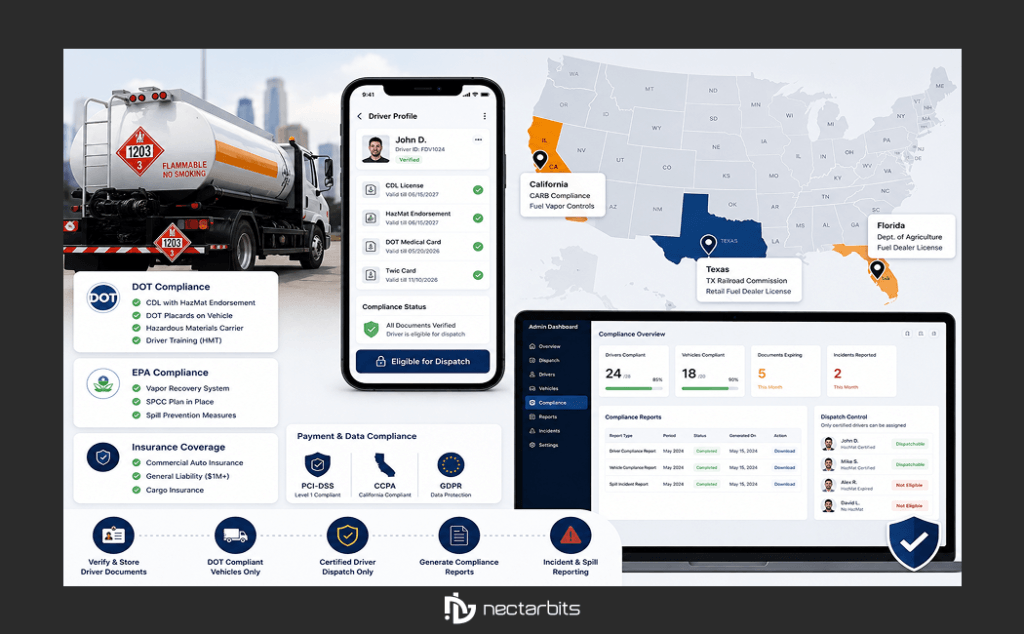
DOT (Department of Transportation) Requirements
- Drivers transporting more than a threshold quantity of fuel must hold a Commercial Driver’s License (CDL) with a Hazardous Materials (HazMat) endorsement.
- Delivery vehicles must carry proper DOT placards and be registered as hazardous materials carriers.
- Your driver onboarding module must capture and store CDL + HazMat certification documentation.
EPA (Environmental Protection Agency)
- Mobile fuel dispensing vehicles are subject to EPA vapor recovery system requirements in many states.
- Spill prevention plans (SPCC) are required for operations above certain volume thresholds.
- Your admin panel should be capable of generating spill incident reports if required.
State-Level Licenses
- California: CARB (California Air Resources Board) compliance for fuel vapor controls — among the strictest in the country.
- Texas: Texas Railroad Commission oversight for retail fuel dealers.
- Florida: Department of Agriculture and Consumer Services fuel dealer licensing.
- Most states: Fire Marshal permit required for mobile fuel dispensing vehicles.
For businesses operating across state lines, understanding how fuel transportation compliance requirements differ by jurisdiction is a critical step before deployment.
Data and Payment Compliance
- PCI-DSS compliance for all payment processing, your payment gateway integration must meet Level 1 or Level 2 PCI-DSS standards.
- CCPA compliance for users in California requires a privacy policy, opt-out mechanisms, and data deletion capabilities.
- GDPR compliance if you have any users in EU countries.
Insurance Requirements
- Commercial auto insurance covering hazardous materials transport.
- General liability insurance, minimum $1M per occurrence in most states.
- Cargo insurance covering fuel in transit.
The practical implication for your app: Your driver onboarding module must verify and store compliance documentation. Your dispatch system must only assign deliveries to certified drivers. Your admin panel must be capable of generating compliance reports. These are not optional features; they are legal requirements. Building them properly from the start is far less expensive than retrofitting them after a regulatory violation.
Can a Fuel Delivery App Be Profitable?
The short answer is yes, but the unit economics require deliberate design. Here is a realistic breakdown.
Revenue Streams Available to a Fuel Delivery Business
- Per-Delivery Convenience Fee: $5–$20 per delivery, charged to the consumer above the fuel price. This is the most straightforward revenue stream.
- Fuel Price Spread: Buy at wholesale; deliver at retail + convenience premium. Margin typically $0.15–$0.50/gallon.
- Subscription Plans: Charge a monthly fee ($30–$100 for consumers, $500–$5,000 for fleet accounts) for priority delivery, discounted rates, or guaranteed availability.
- B2B Annual Contracts: Corporate fleet agreements can range from $50,000 to $500,000+ per year for large fleets. These are the highest-margin, most predictable revenue streams.
- Surge Pricing: Higher rates during peak demand (storms, events, extreme weather) — automated within your pricing engine.
- Commission (Aggregator Model): 8–15% per transaction if you operate as a marketplace connecting suppliers and buyers.
A Simple ROI Scenario
Conservative B2C scenario (single city launch):
- 80 deliveries/day × $12 average convenience fee = $960/day
- Minus driver costs, insurance, fuel, and vehicle overhead: ~40% margin
- Net: ~$384/day = ~$11,500/month from convenience fees alone
- Plus fuel price spread margin on volume delivered
B2B fleet scenario (one enterprise contract):
- Fleet of 50 vehicles × $500/month/vehicle = $25,000/month from a single client
- At 35% net margin: $8,750/month net from one B2B relationship
The profitability challenge in fuel delivery is delivery density; you need enough orders in a tight geographic area to keep drivers productive. That is why choosing your launch market carefully (dense urban area, or a corporate campus with concentrated fleet vehicles) is more important than the technology you build.
For a deeper look at how successful fuel delivery businesses structure their revenue streams and scale profitably, read the Fuelster business model and ROI guide.
How to Build a Fuel Delivery App: Step-by-Step
Step 1: Market Research and Competitive Analysis
Before any code is written, map your target market: Who are your customers (individual drivers, fleets, gas station chains)? What geography will you serve first? Who are your local competitors? What regulations apply in your operating state?
Step 2: Define Your Business Model and MVP Scope
Choose your business model (B2C, B2B fleet, aggregator, white-label SaaS). Then ruthlessly prioritize: what is the minimum set of features that lets you deliver fuel to a paying customer and collect money? That is your MVP.
Step 3: Choose Your Technology Partner
Evaluate fuel delivery app development services providers against the 10 questions in the next section. Shortlist two or three, get proposals, and review past fuel-specific work.
Step 4: UI/UX Design and Prototyping
Build clickable prototypes for all three apps (customer, driver, admin) before development begins. Test with real potential users. Discovering usability issues in prototyping costs $0 to fix; discovering them in development costs days of rework.
Step 5: Development (Front-End, Back-End, APIs)
Build in sprints. A solid mobile app development team will deliver working features every 2 weeks for review — not a finished product 6 months later. Insist on sprint demos.
Step 6: Compliance Engineering
Integrate CDL/HazMat verification into driver onboarding. Build the compliance reporting module into your admin panel. Implement PCI-DSS-compliant payment processing. This step is non-negotiable for operating legally in the USA.
Step 7: QA Testing and Beta Launch
Test every user flow end-to-end. Stress test your backend against peak order volumes. Run a private beta with 20–50 real users and real drivers in your target city before public launch.
Step 8: Launch, Monitor, and Iterate
Launch in a defined geographic zone. Monitor delivery success rate, driver utilization, customer NPS, and order frequency weekly. Use the data to identify which features to build next.
10 Questions to Ask Before You Hire a Development Company
Before signing any contract with a fuel delivery app development company, ask these questions. The quality of the answers will tell you everything you need to know.
- Can I see a live fuel delivery app you have built on the App Store or Google Play right now? Not screenshots. A live, downloadable app.
- Who will actually work on my project? Ask for CVs of the specific developers and project manager assigned, not the company’s general capability overview.
- Who owns the source code? The answer must be: you do. Completely. From day one.
- Have you built driver apps with DOT/HazMat compliance documentation before? If they look confused, they have not.
- What is your project management process? You should hear: sprint-based, weekly demos, Jira or equivalent tracking, and daily standups. Vague answers signal chaos.
- What happens if a feature takes longer than estimated? Fixed-price contracts protect you. Time-and-materials contracts require you to trust the estimate and ask for a detailed work breakdown structure.
- What APIs do you have pre-built for GPS, dispatch, and payment? Experienced fuel app developers have reusable components that cut timeline and cost. First-timers build everything from scratch.
- What is your post-launch SLA? How fast do critical bugs get fixed after your app is live? 4 hours? 24 hours? 72 hours? This matters enormously when drivers are stuck in the field.
- Can we speak directly with a past fuel delivery client? A reference call with a real client is worth more than any portfolio page.
- Do you offer both white-label and custom development? A company that has experience with both understands the full spectrum of what you actually need at your current stage.
Conclusion
The fuel delivery app market in 2026 is real, growing, and still early enough that a well-built platform can establish a dominant market position in a given geography. But the difference between a fuel delivery startup that succeeds and one that burns through its seed round is almost always the development partner decision.
The best fuel delivery app development company for your business is the one that understands your specific market, has built working fuel delivery apps before (not just claimed to), is transparent about cost and timeline, and treats compliance as a first-class concern, not an afterthought.
Nectarbits has built on-demand fuel delivery platforms for clients across the USA, Canada, the UAE, and the UK. If you are ready to discuss your project, whether you are evaluating white-label vs. custom, scoping your MVP, or planning an enterprise fleet platform, reach out for a free discovery consultation.
Continue Your Journey
Ready to go deeper? These guides cover the strategies, models, and technology behind the most successful fuel delivery businesses operating today.
- Booster Fuels business model: mobile fuel delivery app development guide — a detailed breakdown of the B2B fleet model that took Booster to 30+ cities and contracts with Walmart and Amazon.
- Best tech stack for fuel delivery app development — covers every technology layer from mobile frameworks and GPS APIs to IoT meter integration and backend architecture for on-demand fuel platforms.
- On-demand fuel delivery business growth tips — proven operational strategies to build delivery density, retain customers, and grow revenue in your launch market.
Frequently Asked Questions:
A white-label fuel delivery app costs between $5,000 and $40,000 depending on features and customization level. A fully custom fuel delivery app built from scratch ranges from $20,000 to $150,000 or more, depending on feature complexity, platform choice (iOS + Android vs. cross-platform), and your development team’s location. For a detailed breakdown by market, the fuel delivery app development cost guide for Canada and the USA covers every cost factor in detail.
A white-label app is a pre-built platform that is rebranded with your company identity and configured to your business rules — fast and cost-effective, but you don’t own the underlying code and feature flexibility is limited. A custom app is built specifically for your business from the ground up — you own 100% of the source code, can build any feature you need, and the architecture is designed for your specific operational model. White-label is ideal for validating a market; custom is ideal for building a competitive moat.
A white-label solution can be deployed in 2–8 weeks. A custom MVP with core features (ordering, GPS tracking, payments, admin panel) typically takes 2–4 months. A full-featured enterprise platform with AI optimization, IoT integration, and fleet management can take 6–9 months. Timeline varies significantly based on scope, team size, and how clearly requirements are defined before development starts.
Yes. Fuel is a federally regulated hazardous material. Drivers need CDL-HazMat endorsements. Vehicles need DOT registration and placards. Most states require a Fire Marshal permit for mobile fuel dispensing. California has additional CARB vapor recovery requirements. Payment processing must be PCI-DSS compliant. A fuel delivery app development company with US market experience will build compliance documentation management directly into the driver onboarding and admin panel modules.
For startups that need to validate their concept with minimal upfront investment, a white-label solution from a provider like On-Demand App (from $5,000) or Hyperlocal Cloud (from $8,000) offers the fastest, lowest-cost path to a live product. For startups that need a custom build but are budget-conscious, Appinop Technologies and Comfygen both offer strong custom development starting around $10,000–$15,000. The key is to scope your MVP tightly — launch with the minimum features needed to deliver fuel and collect payment, then add advanced features as revenue grows.