
 Anil Patel
Fuel prices are highly dynamic and influenced by multiple factors, including fluctuations in crude oil prices, global supply chains, local taxation policies, currency exchange rates, and regional demand patterns. In many markets, fuel rates can change daily, and sometimes multiple times within a short period. For businesses operating in this environment, even minor pricing shifts can directly impact profitability, operational planning, and customer acquisition strategies.
Meanwhile, the rapid expansion of on-demand fuel delivery services has introduced a new layer of complexity to pricing. Unlike traditional fuel stations with fixed overheads, an on‑demand fuel delivery app solution must account for route distance, vehicle availability, labor costs, time sensitivity, and demand surges. Relying on static pricing in such a fast-moving ecosystem often results in margin erosion or uncompetitive rates.
This is why real-time fuel pricing has become essential for modern fuel delivery platforms. By combining live fuel data with automated pricing logic, businesses can adjust prices instantly in response to market changes and operational conditions.
A well-structured real-time pricing model strengthens the overall delivery app pricing strategy, ensuring transparency for customers while maintaining sustainable profit margins and long-term scalability.
Why Static Fuel Pricing Fails in On-Demand Delivery
Static pricing models are ineffective in the fuel industry because fuel costs are highly volatile and influenced by multiple external factors. Key challenges include:
- Daily fuel price fluctuations: Crude oil benchmarks shift frequently due to geopolitical events, supply disruptions, refinery output, and global demand changes. According to the U.S. Energy Information Administration, gasoline prices can change regularly based on crude oil costs and refining margins. These fluctuations directly impact procurement costs for delivery platforms.
- Regional price differences: Fuel prices vary by city and state due to local taxes, transportation costs, and distribution infrastructure. A fixed pricing structure cannot accurately account for these geographic variations.
- Wholesale vs. retail price gaps: The spread between wholesale purchase rates and retail selling prices can shift rapidly, affecting profitability in real time.
- Demand spikes: Peak hours, fleet refueling cycles, or emergencies can trigger sudden increases in orders, requiring flexible pricing adjustments.
When an on-demand platform relies on static pricing, it either absorbs rising costs, leading to margin erosion, or becomes uncompetitive by overpricing services. Modern platforms need dynamic pricing logic powered by a robust fuel price tracking system, and that starts with understanding how fuel delivery route optimization directly affects what it costs to fulfill every order.
What Is Real-Time Fuel Pricing and How Does It Actually Work?
Real-time fuel pricing is not simply showing a customer a live fuel price. Any price display widget can do that. A real pricing engine does something more valuable: it continuously calculates what price the platform should charge to protect margin, stay competitive, and reflect actual operational costs at the moment of each order.
The difference between a price display and a pricing engine is control. A display shows you what the market is doing. An engine decides what you should do about it.
At its core, a real-time fuel pricing system combines three inputs:
Live market data. Wholesale rack prices, regional retail benchmarks, crude oil spot prices, and local competitor rates are pulled from API feeds on a defined refresh interval (typically every 15 minutes to 1 hour for most delivery apps).
Operational variables. Delivery distance, vehicle availability in the service zone, driver labor cost, time of day, and order volume in the queue all of which change the true cost of fulfilling an order.
Business rules. The markup logic, margin floors, surge multiplier caps, volume discount thresholds, and fleet-specific pricing tiers that translate cost inputs into a customer-facing price.
The output is a price that is profitable, competitive, and fair, recalculated automatically for every order, in every location, under any market condition.
This is what separates leading platforms like CAFU (operating across the UAE with location-based dynamic pricing) from early-stage apps still updating prices manually every Monday.
How Dynamic Pricing Works in Fuel Delivery Apps
Dynamic pricing in fuel delivery apps is powered by real-time data, automated pricing engines, and intelligent delivery logic. Instead of fixed pricing tables, platforms use real time fuel pricing models that respond instantly to operational and market conditions.
Here are the 5 key real-time triggers that drive pricing adjustments:
1. Demand-Based Surge Pricing
When fuel orders spike in a specific location, such as during rush hours, extreme weather, or fuel shortages, the system applies a controlled surge multiplier. This balances order flow while protecting margins.
2. Peak-Hour Multipliers
High-traffic periods increase delivery time, routing complexity, and operational costs. Dynamic pricing automatically factors in these peak-hour conditions.
3. Driver Availability
If delivery vehicle availability drops in a region, pricing adjusts to regulate demand and prevent service delays. This ensures operational stability and service reliability.
4. Delivery Distance
Longer delivery routes increase fuel consumption and labor costs. Pricing engines calculate geo-based adjustments to reflect distance and location-specific logistics expenses, which is where hyperlocal delivery management software becomes essential for accurate calculations.
5. Order Urgency
Priority or express refueling services trigger additional dynamic fees based on time sensitivity.
This logic is similar to ride-hailing platforms, where fares adjust according to demand and supply conditions. However, fuel delivery apps must also integrate commodity volatility through a fuel price tracking system.
For example, CAFU operates using location-based service models that combine live fuel rates with smart delivery adjustments. By integrating operational triggers with real-time market data, dynamic pricing supports a stronger delivery app pricing strategy while ensuring profitability in volatile fuel markets.
Read More: How CAFU Took Rapid Strides in Less Than a Year
Dynamic pricing ensures your fuel delivery platform remains competitive and profitable, but operational efficiency is equally important.
The 5 Core Components of a Fuel Pricing Engine
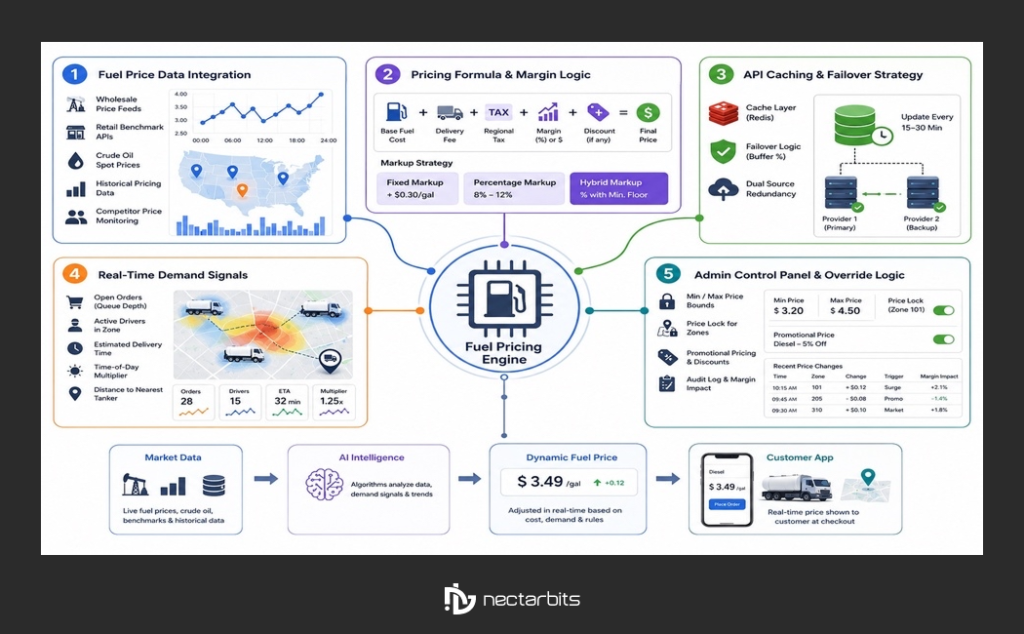
1. Fuel Price Data Integration
A pricing engine is only as accurate as its data. The most reliable systems connect to multiple data sources simultaneously and reconcile them to produce a verified regional benchmark.
Data inputs typically include:
- Wholesale rack price feeds from regional distributors (updated every 15–60 minutes)
- Retail benchmark APIs providing city- and ZIP-code-level pricing
- Crude oil spot price feeds (WTI, Brent) as leading indicators of downstream price movement
- Historical pricing datasets for volatility modeling and trend analysis
- Competitor price monitoring for market positioning
The historical data layer is particularly important for AI-driven forecasting. Platforms that store 12+ months of pricing data alongside order volume and route distance have enough signal to build accurate demand prediction models — the same data that powers fuel delivery dispatch software with intelligent, real-time order routing.
2. Pricing Formula and Margin Calculation Logic
Every order price is the output of a formula. Here is the standard structure:
Final Customer Price =
Base Fuel Cost (per gallon/liter)
+ Platform Margin (fixed or percentage)
+ Delivery Fee (distance-based)
+ Regional Tax Component
+ Demand Surge Adjustment (if applicable)
− Volume/Fleet Discount (if applicable)
The choice between fixed and percentage margin matters strategically:
| Markup Type | How It Works | Best For |
| Fixed markup | $0.30 added per gallon regardless of base cost | Price-sensitive consumer markets |
| Percentage markup | 8–12% above wholesale cost | Protects margin during price spikes |
| Hybrid | Percentage with a minimum floor | Most scalable for multi-region ops |
Geo-based adjustments must account for state and local tax differences, rural delivery cost premiums, and urban congestion surcharges. The choice of markup structure is also a revenue model decision — for a deeper look at how leading platforms structure their revenue tiers, see our breakdown of fuel delivery business models for startups.
Volume discounts for fleet accounts typically activate at defined thresholds — for example, orders above 200 gallons per delivery, or accounts exceeding 50 orders per month. These are configured as rules in the pricing engine, not manual overrides.
3. API Caching and Failover Strategy
A pricing engine that goes offline during an API disruption cannot charge customers. Worse, if it falls back to a stale price from six hours ago during a market spike, the platform absorbs the loss.
Best-practice caching strategy:
- Redis or Memcached layer stores the last successfully fetched price per location, refreshed on a defined schedule (typically every 15–30 minutes)
- Fallback pricing logic activates automatically when a live feed fails, using the cached price plus a configurable buffer percentage to account for potential market movement since the last successful fetch
- Dual-source redundancy connects to at least two independent fuel price API providers so that a single vendor outage does not cascade into a pricing failure
4. Real-Time Demand Signals
Operational data feeds into the pricing engine alongside market data. This is what allows the system to adjust prices not just for fuel cost changes, but for delivery cost changes.
Active demand signals include:
- Number of open orders in a delivery zone (queue depth)
- Active driver count in the zone
- Estimated delivery time based on current route density
- Time-of-day multiplier (peak hour flags)
- Distance from nearest available tanker to order location
5. Admin Control Panel and Override Logic
Pricing engines need human oversight, especially during unusual market events. A well-designed admin panel allows operations teams to:
- Set minimum and maximum price bounds (preventing runaway surge pricing)
- Manually lock prices for specific zones during a defined window
- Push promotional pricing for specific fuel types or customer segments
- Review a full audit log of every price change, its trigger, and the resulting margin impact
Surge Pricing Logic for Fuel Delivery Apps
Surge pricing in fuel delivery works differently from ride-hailing for two reasons: fuel is a commodity with volatile wholesale costs (adding a second pricing variable), and customers are often businesses with budget sensitivity rather than individuals with urgent travel needs.
The five triggers that activate pricing adjustments in a well-designed fuel delivery engine:
1. Demand-queue surge. When open orders in a zone exceed a defined threshold relative to available drivers and tankers, the system applies a controlled multiplier. The customer sees the reason: high demand in your area.
2. Peak-hour multiplier. Morning fleet refueling windows (typically 5–8 AM) and end-of-day commercial delivery windows (4–7 PM) generate predictable demand spikes. These can be configured as time-based rules rather than demand triggers.
3. Driver availability reduction. If active driver count in a zone drops below a defined threshold (illness, route conflicts, maintenance), the pricing engine adjusts to regulate inbound demand and prevent service degradation.
4. Delivery distance premium. Orders outside the core service radius incur a geo-based premium that scales with distance from the nearest tanker. This is not a surge event — it is a permanent cost-based rule that reflects actual logistics expenses.
5. Commodity price threshold breach. When the live wholesale price moves more than a configured percentage above the last pricing update (for example, 3% within a 4-hour window), the engine automatically recalculates all active zone prices to protect margin. This is the fuel-specific trigger that ride-hailing apps do not need.
The critical difference between effective surge pricing and customer-alienating pricing is transparency and proportionality. Platforms that show customers the exact reason for a price adjustment, “Diesel prices increased 4% today due to regional supply constraints”, see significantly higher order completion rates during surge events than platforms that simply show a higher total with no explanation.
Fuel Price API Comparison: Which Data Source Should You Use?
This is the question no other guide answers properly for on-demand fuel delivery builders. Here is an honest comparison of the major options:
| API Provider | Update Frequency | Geographic Coverage | Best For | Approx. Cost |
| OPIS (Dow Jones) | Near real-time | 1,000+ U.S. terminals | High-volume platforms needing rack price accuracy | Enterprise pricing |
| OilPriceAPI | Every 5 minutes (market hours) | Global, major fuel types | Startups needing REST API access, free tier available | $49–$199/month |
| DataWeave Fuel Intelligence | Hourly | 30,000+ U.S. ZIP codes | Platforms needing hyperlocal street-level prices | Custom/enterprise |
| EIA API (U.S. Gov) | Weekly averages | U.S. regional | Secondary reference / historical modeling | Free |
| GasBuddy API | Crowdsourced, variable | U.S. and Canada | Consumer-facing price display, not for margin calc | Custom |
Recommendation for most fuel delivery startups: Use OilPriceAPI or a comparable REST-based provider for live wholesale data, combined with the EIA API as a free historical dataset for trend modeling. As you scale past 500 daily orders, upgrade to OPIS or DataWeave for hyper-local accuracy that directly maps to your delivery zones.
The Fuel Price API Integration for Navigation market — the broader category that includes delivery apps — was valued at $1.18 billion in 2024 and is growing at 13.7% CAGR through 2033, according to Growth Market Reports. API-based pricing infrastructure is not optional infrastructure; it is a core competitive asset.
AI & Predictive Fuel Pricing Models
AI-powered predictive models are redefining how on-demand fuel delivery platforms handle market volatility. Instead of reacting to fuel price changes after they occur, predictive systems analyze historical data and forecast pricing trends in advance, enabling proactive, data-driven decision-making.
Modern predictive fuel pricing begins with analyzing historical fuel price trends. Years of wholesale and retail fuel data reveal patterns tied to crude oil movements, refinery cycles, seasonal travel demand, regional consumption shifts, and supply disruptions. Since retail fuel prices closely correlate with global crude oil benchmarks, AI models continuously monitor these indicators to anticipate downstream price changes.
Using advanced machine learning algorithms, pricing engines evaluate:
- Historical fuel pricing datasets
- Seasonal demand forecasting models
- Regional supply-demand patterns
- Order volume density by location
- External volatility signals, such as crude oil fluctuations
This intelligence allows platforms to move from reactive pricing to predictive pricing.
- Reactive pricing adjusts rates only after fuel costs rise or demand spikes.
- Predictive pricing anticipates those changes and adapts in advance, protecting margins and maintaining competitiveness.
AI significantly enhances real-time fuel pricing by automating complex calculations and continuously optimizing rates based on probability-driven forecasts. It strengthens the overall delivery app pricing strategy by aligning commodity costs with operational variables such as distance, urgency, and driver availability.
When embedded within modern fuel management software, AI‑powered fuel pricing and logistics transform pricing from a simple cost-update mechanism into a strategic revenue optimization engine, improving scalability, stability, and long-term profitability in volatile fuel markets.
Pricing Transparency and Customer Trust
Pricing transparency is not just a UX consideration — it is a retention strategy. Fuel is a commodity where price sensitivity is high and switching costs are low. A customer who does not understand why they paid more today than yesterday is a customer who compares you to competitors tomorrow.
A well-designed price breakdown screen shows:
- Base fuel cost per gallon/liter (updated live)
- Delivery fee (with distance shown)
- Tax component (broken out, not bundled)
- Any active surge or peak-hour adjustment (with the reason stated)
- Final total
The key detail most platforms get wrong is the surge explanation. “Prices are higher during peak hours” is not an explanation; it is a statement. “Diesel wholesale prices increased 3.8% today due to Gulf Coast supply disruptions” is an explanation that builds trust because it shows the platform is responding to real market conditions, not arbitrarily padding margins.
Customers are significantly more likely to complete a higher-priced order when the reason is stated clearly and tied to an external factor. Uber’s data showed that riders were more accepting of surge pricing when they saw the demand map, even if they disliked the higher fare. The same psychology applies to fuel delivery.
Subscription pricing is an increasingly effective tool for managing customer price sensitivity. Platforms that offer a monthly fleet subscription (flat delivery fee regardless of market conditions, in exchange for a volume commitment) can separate the commodity price conversation from the delivery convenience conversation. The customer knows they are paying market rate for fuel but never pays a variable delivery surcharge, which removes the most common source of pricing friction.
User Experience & Price Transparency in Fuel Apps
In fuel delivery apps, pricing transparency is not just a feature; it directly influences customer trust and retention. Because fuel is a price-sensitive commodity, users expect clear, accurate, and real-time cost visibility before placing an order.
A well-designed platform should display a real-time price breakdown, showing exactly how the final amount is calculated. This includes separating:
- Base fuel cost (per gallon or liter)
- Delivery fee
- Taxes and regulatory charges
- Surge or peak-time adjustments
Clearly distinguishing fuel cost vs. delivery fee helps customers understand that price changes may result from market volatility rather than arbitrary markups. When surge pricing applies, the app should explain why, such as high demand, peak hours, or limited driver availability, instead of simply increasing the total price without context.
Transparent pricing builds credibility. Users are more likely to trust platforms that openly communicate cost components rather than hide them behind a single total figure.
From a business perspective, transparency improves customer retention in fuel delivery apps. When users feel informed and treated fairly, they are more likely to reorder, recommend the service, and remain loyal. Considering different fuel delivery business models can help operators structure pricing strategies that balance profitability with customer satisfaction, even during periods of market volatility driven by real-time fuel pricing adjustments.
Common Dynamic Pricing Mistakes (and How to Avoid Them)
Understanding what goes wrong is often more valuable than knowing what goes right.
Mistake 1: No price ceiling cap. Without a maximum surge multiplier, the pricing engine can reach prices that generate customer backlash and platform reputation damage, particularly during emergencies. Always configure a hard ceiling. A 1.4x cap on the base delivery fee, not the fuel cost component, is a reasonable starting point for most markets.
Mistake 2: Stale cache without failover logic. If your API call fails and your cache is 6 hours old during a rapid market spike, you sell fuel below actual cost until someone notices manually. The fix: implement a configurable staleness buffer that adds a protection percentage to cached prices when the cache exceeds a defined age.
Mistake 3: Pricing without geo-zone accuracy. A pricing engine that applies the same regional price to a dense urban core and a 40-mile rural delivery with the same markup is not a pricing engine; it is a price list. Geo-zone granularity is the difference between a 6% and a 12% net margin on rural orders.
Mistake 4: Triggering surge pricing on driver absence without customer communication. If 30% of your drivers call in sick on a Friday afternoon and prices jump automatically, customers see a price spike with no explanation. The fix: tie the customer notification to the trigger. When driver availability triggers a pricing adjustment, the push notification reads “High demand in your area, limited delivery slots available” before the customer opens the price screen.
Mistake 5: Price wars through uncapped competitive matching. Some pricing engines are configured to automatically match or undercut competitor prices. Without a margin floor, this logic can drive prices below the break-even point. Always configure a minimum margin rule that overrides competitive matching logic.
Mistake 6: Not monitoring the surge opt-out rate. If 40% of customers cancel orders when a surge multiplier activates, the surge is too aggressive for your market. Track the cancellation rate by surge tier as a primary pricing health metric, and calibrate accordingly.
Mistake 7: Treating fleet customers the same as consumer customers. Fleet operators plan their fuel spend weekly or monthly. Applying consumer-style surge pricing to fleet accounts alienates your highest-value customers. Fleet accounts should be on contracted pricing structures with a separate, insulated pricing tier — the same logic that makes fuel delivery subscription models one of the most effective tools for protecting fleet relationships from market volatility.
ROI Calculator: What Real-Time Pricing Is Actually Worth
This is the calculation that justifies the investment.
Scenario: Mid-scale fuel delivery platform
- Daily orders: 500
- Average order size: 15 gallons
- Average wholesale cost: $3.40/gallon
- Current fixed markup: $0.25/gallon
- Daily delivery revenue (fuel only): 500 × 15 × $0.25 = $1,875/day
After implementing dynamic pricing:
- Margin improvement during peak hours (assumed 35% of orders): +$0.08/gallon
- Margin protection during wholesale price spikes (assumed 18 spike events/year, average impact $0.12/gallon per spike over 3 days): recovered $0.12 × 15 gallons × 500 orders × 3 days × 18 events ÷ 365 days = ~$135/day average
- Surge pricing revenue on high-demand orders (15% of orders, 1.2x multiplier on $5 delivery fee): 500 × 0.15 × ($1.00 additional) = $75/day
Conservative combined daily gain: ~$210/day → ~$76,650/year
The one-time cost to build a dynamic pricing engine (covered in the next section) starts at $8,000–$20,000 for the module itself. Full integration into an existing fuel delivery platform runs $30,000–$70,000. At a $76,650 annual gain, the investment pays back within 6–12 months.
Even at half this gain — on a smaller platform or conservative market conditions — the ROI is clear. A 3% margin improvement on a platform doing $2M in annual fuel revenue is $60,000 in additional profit. Real-time pricing is not a feature investment; it is a revenue investment.
For fleet clients specifically, commercial fleets face average downtime costs of approximately $760 per hour when vehicles run dry. A platform that eliminates that downtime commands premium pricing and long-term contracts that static-pricing competitors cannot match.
Business Benefits of Real-Time Fuel Pricing
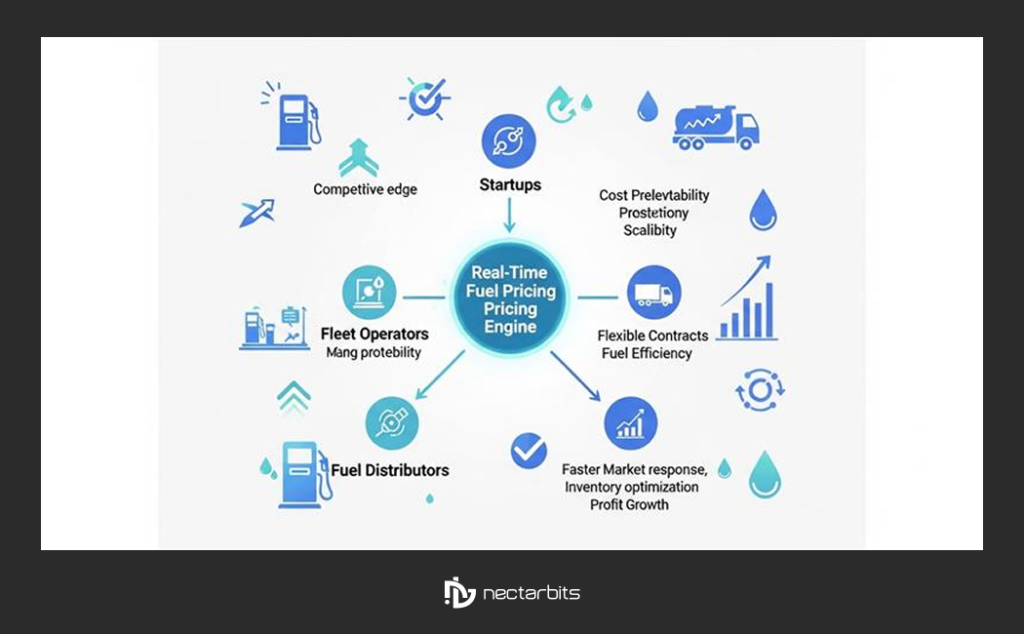
Implementing real-time fuel pricing delivers measurable advantages across the fuel supply chain, from startups building on-demand platforms to large-scale distributors and fleet operators.
1. For Startups
For startups entering the fuel delivery app development market, dynamic pricing creates a strong competitive edge. Instead of competing purely on flat rates, platforms can adjust pricing based on market conditions, location, and demand density.
Real-time pricing also protects margins. When wholesale fuel costs rise, automated adjustments prevent revenue loss. When prices fall, platforms can remain competitive without manual intervention.
Most importantly, it supports scalability. As operations expand across cities or regions, a centralized fuel price tracking system ensures consistent, location-based pricing without operational complexity.
2. For Fleet Operators
Fleet businesses benefit from improved cost predictability. Real-time data enables accurate forecasting of fuel expenses, reducing budget uncertainty.
Dynamic pricing models also support contract optimization. Fleet agreements can incorporate flexible pricing structures tied to market benchmarks rather than rigid fixed rates, improving long-term cost control.
3. For Fuel Distributors
Fuel distributors gain faster market response capabilities. When wholesale rates shift, pricing updates can be deployed instantly across digital platforms.
Real-time systems also enable smarter inventory planning. By aligning demand data with live pricing insights, distributors can optimize stock levels and reduce supply chain inefficiencies.
When integrated with advanced fuel management software, real-time pricing becomes a strategic asset, enhancing operational efficiency, profitability, and long-term growth.
Implementing real-time fuel pricing delivers measurable advantages for startups, fleet operators, and distributors alike. Curious how top apps are putting these strategies into practice? Check out the top on‑demand fuel delivery apps and features to see real-world implementations.
Technical Architecture for Real-Time Fuel Pricing
A scalable real time fuel pricing system depends on a well-structured technical architecture designed for speed, reliability, and precision. In modern fuel delivery operations, pricing operates as a dedicated, intelligent system spanning backend logic, data processing, and frontend rendering. Working with a custom fuel delivery app development company ensures modular, cloud-native architectures remain scalable and future-ready.
1. Backend Layer
The backend acts as the command center of the pricing engine. A dedicated pricing microservice processes incoming fuel data independently from the rest of the application. This microservice architecture ensures flexibility, allowing pricing rules to evolve without affecting other app functions.
- REST APIs pull real-time fuel rates from external market data providers.
- Webhooks trigger instant recalculations when price thresholds or demand conditions change.
This separation enhances maintainability and supports continuous updates to the delivery app pricing strategy.
2. Data Layer
The data layer ensures real-time responsiveness and reliability.
- Real-time API feeds provide location-specific fuel pricing inputs.
- Redis caching stores recently fetched data to minimize latency and reduce API load.
- Database storage preserves historical fuel pricing data for analytics and AI-driven forecasting.
Together, these components strengthen the overall fuel price tracking system and maintain performance during high-demand periods.
3. Frontend Layer
The frontend enables real-time price rendering and an instant quote system. When users select fuel type, quantity, and location, the system instantly calculates and displays a transparent breakdown.
Scalable Infrastructure
Cloud platforms such as AWS and Azure support serverless architecture, auto-scaling, and load balancing, ensuring fuel management software remains resilient, secure, and capable of handling rapid growth.
Cost of Building a Fuel Pricing Engine
| Component | One-Time Cost | Recurring Cost |
| Fuel price API subscription | — | $500–$2,000/year (startup tier) |
| Pricing microservice development | $8,000–$20,000 | — |
| Geo-zone configuration and tax integration | $3,000–$8,000 | — |
| AI/predictive pricing module | $15,000–$35,000 | — |
| Full integration into existing fuel delivery platform | $30,000–$70,000 | — |
| Cloud infrastructure (pricing service only) | — | $200–$800/month |
Startup path (manual rules, no AI): $40,000–$55,000 one-time, then $700–$2,800/year recurring. Payback period: 6–12 months for a platform doing 200+ daily orders.
Growth path (AI predictive module included): $60,000–$90,000 one-time. Appropriate for platforms at 1,000+ daily orders ready to optimize margins at scale.
If you are starting a new platform rather than adding pricing to an existing one, the fuel delivery app development cost breakdown covers the full investment across all platform components — not just pricing.
The Future of Real-Time Fuel Pricing in On-Demand Platforms
The future of real time fuel pricing will be shaped by deeper automation, smarter infrastructure, and decentralized transparency technologies. As fuel markets become more data-driven, on-demand platforms must evolve beyond reactive pricing toward fully autonomous systems.
AI-driven automation will play a central role. Advanced machine learning models will continuously analyze crude oil trends, regional demand, weather disruptions, and consumption behavior to auto-adjust pricing with minimal human intervention. This will reduce operational overhead while maximizing margin optimization.
IoT-connected fuel monitoring is another major advancement. Smart tank sensors, fleet telematics, and connected fuel storage systems will transmit real-time consumption data directly into pricing engines. This integration allows platforms to forecast demand spikes and optimize delivery routes alongside dynamic pricing adjustments, especially when paired with robust Fuel Delivery Dispatch Software.
Emerging blockchain-based fuel transparency solutions may also enhance trust by verifying supply chain records, wholesale transactions, and pricing benchmarks. This can improve auditability and prevent pricing disputes.
Additionally, hyperlocal dynamic pricing will enable city-block or neighborhood-level adjustments based on micro-demand patterns and logistics conditions.
Future-ready fuel delivery app development requires scalable architecture, predictive intelligence, and integrated fuel management software, ensuring platforms remain competitive in an increasingly automated
Read More: Next-Gen Logistics: The Future of On-Demand Fuel & Energy Apps
Conclusion
In a volatile fuel market, real time fuel pricing is essential for protecting margins and staying competitive. Static pricing models cannot keep up with crude oil fluctuations, regional price differences, or demand spikes. A dynamic pricing engine powered by a reliable fuel price tracking system ensures prices remain accurate, transparent, and aligned with real market conditions.
By implementing a smarter delivery app pricing strategy, businesses can automate adjustments, improve customer trust, and scale operations without revenue loss. Platforms that invest in intelligent fuel management software gain a clear competitive advantage through better profitability, responsiveness, and long-term stability.
Build a Smart Real-Time Fuel Pricing Engine with an On-Demand App and future-proof your fuel delivery platform.

FAQs:
Real-time fuel pricing is an automated system that continuously updates the price a customer pays for fuel delivery based on live wholesale market data, delivery location, driver availability, and demand conditions. Unlike fixed pricing, it adjusts instantly to protect platform margins and stay competitive.
When wholesale fuel costs rise, a dynamic pricing engine automatically increases the customer-facing price proportionally, preventing the platform from selling fuel below its acquisition cost. During cost drops, it can reduce prices to stay competitive without manual intervention.
For most startups, OilPriceAPI provides the best balance of coverage, update frequency, and cost. For platforms requiring hyperlocal accuracy at the ZIP code level, DataWeave Fuel Intelligence is more suitable. OPIS (by Dow Jones) is the enterprise standard for rack price accuracy at scale.
For a platform processing 500 orders per day, conservative modeling shows $60,000–$80,000 in additional annual margin from peak-hour pricing improvements, commodity spike protection, and controlled surge pricing. Payback period on development investment is typically 6–12 months.
Yes. IoT-connected tank sensors can trigger automatic fuel orders when levels drop below a threshold. The pricing engine handles IoT-triggered orders under a separate contracted pricing tier, typically without surge premiums, as these are planned refueling events rather than emergency orders.