
 Anil Patel
South Africa’s fuel sector is under pressure. Load shedding disrupts logistics. Fleets bleed money on idle time and manual dispatch. And six of the seven largest fuel delivery platforms in the country still rely on phone calls, email orders, or basic web forms, with no real-time GPS tracking, no AI dispatch, and no consumer mobile app.
The window to build the defining fuel delivery app in South Africa is open right now, and it will not stay open for long.
The global mobile fuel delivery market was valued at $5.84 billion in 2025 and is projected to reach $11.93 billion by 2035, growing at a steady CAGR of 7.4% (Source: Future Market Insights). Africa accounts for a growing share of that expansion, driven by rapid fleet growth, industrial demand from mining and construction, and a younger, mobile-first population demanding on-demand convenience.
In this guide, we do two things. First, we review the top fuel delivery apps and platforms in South Africa, including what they offer, what they are missing, and what market opportunity each gap represents. Second, we walk you through a complete guide to fuel delivery app development, features, tech stack, development process, cost, compliance, and revenue models, so you know exactly what it takes to build the next dominant platform in this market.
Whether you are an entrepreneur entering the fuel tech space, a fleet operator looking to digitise, or a petrol station owner ready to compete with on-demand delivery, this guide is built for you.
What Is a Fuel Delivery App and How Does the Business Model Work?
A fuel delivery app is an on-demand platform that brings fuel directly to the customer, at home, at a construction site, on the side of the road, or at a fleet depot, without requiring them to visit a petrol station.
Think of it as the Uber model applied to petroleum. A customer opens the app, selects their fuel type (diesel, petrol 93, petrol 95, or paraffin), enters their quantity and location, and a certified tanker driver dispatches and delivers to them, tracked in real time, paid digitally, with a tamper-proof e-receipt generated for every litre dispensed.
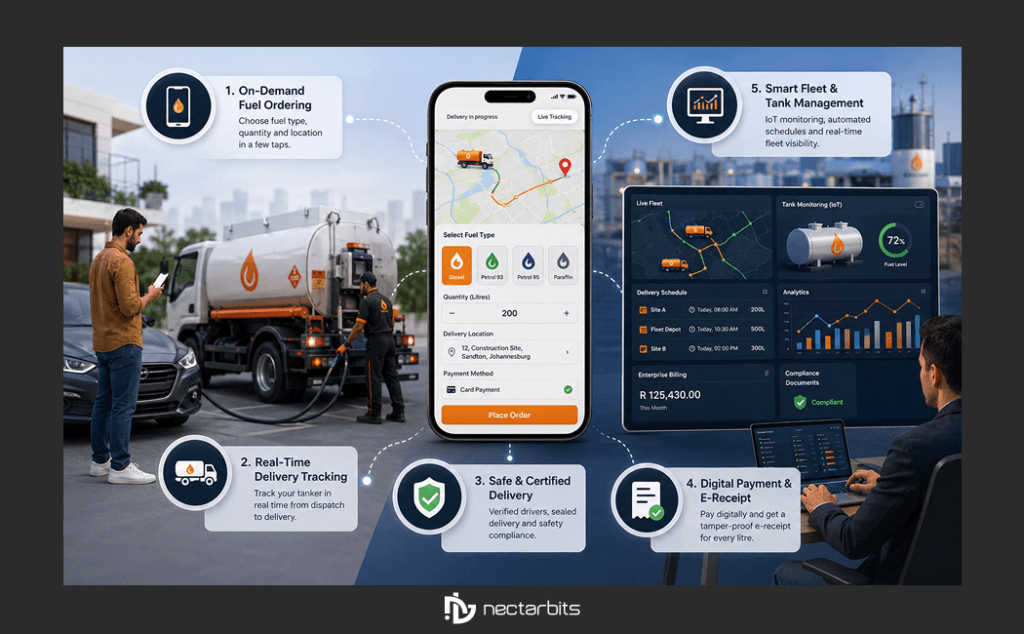
For businesses, it goes further: automated fleet refuelling schedules, IoT-connected tank monitoring, enterprise billing reconciliation, and compliance documentation, all managed from a single dashboard.
There are three types of operators who build fuel delivery apps:
- Aggregators who connect independent fuel retailers with end customers on a marketplace platform
- Petrol station owners who want to offer doorstep delivery as an extension of their existing business
- Oil and petroleum companies that want to go direct-to-consumer or direct-to-fleet, cutting out the station layer entirely
All three models work. The right one depends on your market position, existing infrastructure, and growth goals.
South Africa Fuel Market: The Numbers Behind the Opportunity
South Africa is one of the most compelling markets in Africa for fuel delivery app development — and one of the most underserved digitally.
| Metric | Figure |
| Global mobile fuel delivery market (2025) | $5.84 billion |
| Projected market value by 2035 | $11.93 billion |
| Market CAGR (2025–2035) | 7.40% |
| Africa’s share of global fuel delivery growth | Rapidly expanding |
| South Africa registered vehicles | 12.4 million+ |
| SA fleet vehicles (commercial) | 1.8 million+ |
| SA fuel consumed per day (approx.) | 500,000+ kilolitres |
Sources: Business Research Insights
South Africa’s specific dynamics that make fuel delivery app development particularly attractive:
- Mining and construction dependency: The SA economy runs on diesel. Mining operations, construction sites, and agricultural depots consume fuel in volumes that make manual procurement a daily operational cost drain.
- Load shedding pressure: Rolling blackouts have pushed businesses to rely on diesel generators at scale, creating a new category of regular, predictable fuel delivery demand that existing platforms are not built to serve digitally.
- Mobile-first population: South Africa has over 40 million smartphone users. Mobile commerce is mainstream. But fuel delivery has not caught up.
- No dominant player: Unlike the UAE where CAFU dominates or India where FuelBuddy leads, South Africa has no single market-leading fuel delivery app. The market is open.
Top 8 Fuel Delivery Apps and Platforms in South Africa: Market Overview
The following eight entries represent the current state of fuel delivery technology in South Africa, from the most advanced platform built by a global development team to traditional fuel operators with zero digital ordering capability. Understanding each is essential if you are planning to build or invest in this space.
1. Nectarbits: Fuel Delivery App Development Company (Best-in-Class Development Standard)
Website: nectarbits.com/fuel-delivery-app-development
Type: Fuel Delivery App Development Company | White-Label + Custom Build
Best For: Entrepreneurs, fleet operators, petrol stations, oil & gas companies
Nectarbits is not a fuel delivery operator, it is the technology company that builds the platforms other operators wish they had. With over a decade of on-demand app development experience and 50+ fuel delivery solutions delivered across 4 continents, Nectarbits sets the benchmark for what a fuel delivery app should look like in the South African market in 2026.
The team has delivered complete on-demand fuel delivery ecosystems featuring IoT-powered real-time metering, AI-driven route optimisation, enterprise fleet management, and multi-country regulatory compliance. Clients on live platforms have recorded 275% operational growth, with a 95% client retention rate post-launch.
What Nectarbits builds into every fuel delivery app:
- Customer app: GPS-based fuel ordering, scheduled delivery, real-time tracking, digital payments, order history
- Driver app: AI-dispatched job assignment, route optimisation, digital proof of delivery, e-receipts
- Admin dashboard: Fleet management, inventory monitoring, driver scoring, analytics, billing reconciliation
- IoT integration: Digital flow meter integration, tamper-proof volume verification, smart tank monitoring
- Compliance: NERSA, NMDPRA, HAZMAT, DOT compliance modules built in
- Offline-first architecture: PWA-based apps that queue orders locally during load shedding and sync on reconnect
Development tiers:
| Tier | Investment | Timeline |
| MVP / Market Entry | $15,000 – $30,000 | 12–14 weeks |
| Enterprise Growth | $30,000 – $75,000 | 16–19 weeks |
| Global Logistics Suite | $75,000 – $200,000+ | 19–25 weeks |
| White-Label Fast Track | From $8,000 | 3–5 weeks |
Why it matters for the SA market: Nectarbits is the only fuel delivery app development company with a documented Africa delivery track record, specific geo-expertise in South Africa, Kenya, Nigeria, and Jordan, and a white-label solution ready to deploy in weeks — not months.
Ready to build a fuel delivery app for the South African market? Explore our Fuel Delivery App Development service →
2. MyFuelOrders: myfuelorders.co.za
Type: Online Fuel Ordering Platform
Target: Residential Users and Small Fleet Businesses
Fuels Offered: Petrol and Diesel
MyFuelOrders is a South African fuel delivery platform that allows customers to order petrol and diesel online for home, business, and light fleet requirements. The company focuses on convenience-driven fuel supply by helping customers avoid trips to petrol stations and simplifying the ordering process through its web-based platform.
The platform primarily serves residential users, SMEs, and small commercial fleets looking for a faster and more flexible way to access fuel deliveries. Customers can submit fuel requests online, making it easier for businesses and individuals to manage their fuel needs without relying entirely on manual phone-based coordination.
One of the reasons MyFuelOrders stands out in the South African market is its focus on digital accessibility in a sector that is still heavily dependent on traditional ordering methods. While many fuel suppliers continue to operate through offline workflows, MyFuelOrders has adopted an online-first approach that aligns with the growing demand for on-demand convenience services in South Africa.
Key Highlights
- Online fuel ordering for petrol and diesel deliveries
- Focus on residential and small fleet customers
- Simplified web-based ordering experience
- Convenience-driven doorstep fuel delivery model
- Supports South Africa’s growing shift toward digital fuel services
Why It Matters
MyFuelOrders highlights the increasing demand for digital fuel delivery solutions in South Africa. Its model shows how fuel businesses are beginning to modernize customer experiences through online ordering, creating strong opportunities for more advanced fuel delivery app development with mobile apps, GPS tracking, fleet management, and automated dispatch systems.
3. 1Stop Energy (FuelSwift): 1stopenergy.co.za
Type: Fuel Delivery Aggregator Platform
Target: Mining, Construction, Agriculture, and Industrial Businesses
Based In: Pretoria East, South Africa
1Stop Energy operates through its FuelSwift platform, offering on-demand fuel delivery services for commercial and industrial sectors across South Africa. The company mainly serves B2B clients, including mining operations, construction sites, agricultural businesses, and large industrial facilities that require reliable bulk fuel supply and delivery management.
FuelSwift provides a centralized system for managing fuel deliveries, drivers, fleet operations, fuel pricing, and order tracking. The platform includes a real-time delivery monitoring dashboard that helps businesses track fuel operations more efficiently and improve delivery coordination.
One of the platform’s biggest strengths is its aggregator-based business model, which connects fuel suppliers with enterprise customers through a structured digital management system. This approach is particularly valuable in South Africa’s industrial sector, where fuel logistics and operational uptime are critical for daily operations.
Key Highlights
- B2B-focused fuel delivery platform
- Serves mining, agriculture, construction, and industrial sectors
- Real-time fuel delivery tracking dashboard
- Driver, fleet, and fuel management system
- Centralized operational control for fuel logistics
Why It Matters
1Stop Energy demonstrates how digital fuel management platforms are helping modernize South Africa’s industrial fuel supply chain. Its FuelSwift platform highlights the growing demand for smarter fuel delivery systems that improve operational visibility, delivery coordination, and fleet efficiency for enterprise clients.
4. Fuel Solution: fuelsolution.co.za
Type: Bulk Fuel Provider
Target: Industrial Businesses, Commercial Fleets, and Bulk Vehicle Operators
Based In: Middelburg, Mpumalanga
Fuel Solution is a South African petroleum company specializing in bulk fuel supply and commercial fuel distribution services. The company serves industries such as logistics, transport, mining, construction, and fleet operations, offering diesel and petroleum solutions tailored for large-scale business requirements.
With an established operational network, trained fuel attendants, and multiple truck stop facilities, Fuel Solution has built a strong presence in the commercial fuel sector. The company focuses heavily on long-term client partnerships, reliable fuel supply, and operational support for businesses that depend on continuous fuel availability.
One of Fuel Solution’s biggest strengths is its physical infrastructure and industry experience. Unlike many newer startups, the company already operates with the logistics capability, tanker network, and field expertise required to handle large-volume fuel operations across South Africa.
Key Highlights
- Bulk fuel supply for industrial and commercial sectors
- Strong presence in transport and fleet fuel operations
- Established truck stop and fuel logistics infrastructure
- Focus on long-term business partnerships
- Experienced operational and fuel handling teams
Why It Matters
Fuel Solution represents the traditional fuel supply businesses powering South Africa’s industrial fuel economy. With its strong logistics network, tanker infrastructure, and commercial client base already in place, the company is well-positioned to adopt modern digital systems and scalable on-demand delivery solutions that can streamline fuel ordering, improve fleet coordination, and enhance customer experience across commercial operations.
5. Online Petroleum: onlinepetroleum.co.za
Type: Online Fuel Procurement Portal
Target: Commercial and Residential Buyers
Fuels Offered: Petrol, Diesel, Paraffin, and Lubricants
Online Petroleum is a South African fuel procurement platform that enables customers to purchase petroleum products online. The company offers fuel ordering services for both residential and commercial users, providing access to products such as petrol, diesel, paraffin, and lubricants through a web-based purchasing system.
The platform focuses on simplifying fuel procurement by allowing customers to browse fuel options, compare pricing, and submit fuel requests digitally instead of relying on traditional offline ordering methods. Its transparent pricing approach and online accessibility make it useful for customers looking for a more convenient fuel purchasing experience.
One of the platform’s key strengths is its ability to bring fuel ordering into a more accessible digital environment, especially in a market where many fuel suppliers still depend on manual inquiries and quotation-based processes.
Key Highlights
- Online fuel purchasing platform
- Petrol, diesel, paraffin, and lubricant supply
- Serves both residential and commercial customers
- Simplified digital fuel procurement process
- Transparent and accessible online ordering experience
Why It Matters
Online Petroleum reflects the growing demand for digital fuel procurement and smarter fuel management systems in South Africa. Its online-first approach highlights how businesses are moving toward modern on-demand delivery solutions that improve accessibility, streamline fuel ordering, and create better customer experiences for both residential and commercial buyers.
6. Inyameko: inyameko.co.za
Type: Fuel and Energy Logistics Company
Target: Industrial and Enterprise B2B Clients
Services: Fuel Delivery and Energy Logistics
Inyameko operates in South Africa’s fuel and energy logistics sector, providing fuel supply and delivery services for industrial businesses and remote operational sites. The company focuses on maintaining reliable fuel distribution and long-term client relationships across industries that depend heavily on uninterrupted energy access.
Its services are particularly relevant for sectors such as mining, construction, logistics, and industrial operations, where consistent fuel availability is critical for daily productivity. Inyameko’s operational approach is centered around dependable supply management and enterprise-focused fuel logistics support.
One of the company’s strongest advantages is its position within the industrial fuel delivery market, a sector driven by recurring demand, large-volume fuel requirements, and long-term service contracts.
Key Highlights
- Industrial fuel delivery and logistics services
- Focus on enterprise and B2B fuel operations
- Reliable fuel supply for remote and industrial sites
- Strong positioning in mining and industrial sectors
- Long-term operational and logistics support
Why It Matters
Inyameko highlights the importance of reliable fuel logistics infrastructure in South Africa’s industrial economy. As sectors like mining, construction, and transport continue to scale, businesses are increasingly looking for smarter fuel management systems, digital operational visibility, and more efficient delivery coordination to support large-scale fuel operations.
7. Sasol: sasol.com
Type: Integrated Energy and Petrol Station Network
Target: Enterprise Businesses, Retail Customers, and Fuel Consumers
Scale: One of Africa’s Largest Energy Companies
Sasol is one of the most recognized energy brands in South Africa and across Africa, operating a large network of petrol stations, fuel supply infrastructure, and energy operations. The company serves both retail and enterprise markets through its nationwide fuel distribution ecosystem and well-established petroleum supply chain.
Sasol has built strong consumer recognition through its extensive station presence and the Sasol MORE rewards programme, which helps create long-term customer engagement and loyalty. Its large-scale operational infrastructure and nationwide accessibility make it one of the strongest traditional fuel brands in the South African market.
The company’s biggest strength lies in its trusted brand reputation, enterprise-scale logistics capabilities, and widespread physical fuel network across the country.
Key Highlights
- One of Africa’s largest integrated energy companies
- Nationwide petrol station and fuel distribution network
- Strong retail and enterprise market presence
- Sasol MORE loyalty and rewards programme
- Established fuel supply chain and logistics infrastructure
Why It Matters
Sasol highlights how traditional fuel companies in South Africa are increasingly positioned for digital transformation. Despite its massive infrastructure and customer reach, the growing demand for mobile fuel ordering, doorstep fuel delivery, real-time tracking, and digital fuel management solutions creates a significant opportunity within the South African fuel technology market.
8. DG Fuels: dgfuels.co.za
Type: Bulk Fuel Supplier and Mobile Fuel Delivery Provider
Target: Fleets, Farms, Construction Sites, and Generator Operators
Based In: South Africa
Fuels Offered: Diesel, Petrol 93 & 95, Paraffin, and LP Gas
DG Fuels is a South African fuel supply company offering bulk fuel distribution, mobile diesel delivery, generator fuel support, and on-site fuel storage solutions. The company serves industries that rely heavily on continuous fuel availability, including transport fleets, agricultural operations, construction projects, and backup power systems.
In addition to fuel delivery services, DG Fuels also provides generator servicing and bunded fuel tank solutions for businesses that require secure on-site fuel storage and management. Its 24/7 customer support and operational flexibility make it a reliable fuel partner for commercial and industrial clients across South Africa.
One of the company’s biggest strengths is its practical mobile fuel delivery operation combined with strong industry experience and customer-focused service.
Key Highlights
- Bulk fuel supply and mobile diesel delivery
- Supports fleets, farms, generators, and construction businesses
- Supplies diesel, petrol, paraffin, and LP gas
- Generator servicing and on-site fuel storage solutions
- 24/7 customer support and fuel logistics assistance
Why It Matters
DG Fuels represents how traditional fuel suppliers in South Africa are already operating mobile fuel delivery services at a practical level. As businesses increasingly demand digital convenience, real-time delivery visibility, and smarter fleet fuel management, companies like DG Fuels are well-positioned to benefit from advanced fuel delivery platforms and modern fuel logistics technology.
The Missing Technology Layer in South Africa’s Fuel Delivery Market
After reviewing all eight entries, a clear pattern emerges. The South African fuel delivery market has:
- Operational expertise: most of these companies know how to deliver fuel
- B2B relationships: the corporate and industrial client base exists
- Physical infrastructure: tankers, drivers, and depots are in place
What it almost entirely lacks:
- Consumer mobile apps (only 1 of 8 even approaches this)
- AI-powered dispatch (zero platforms)
- Real-time GPS tracking visible to customers (1–2 at most)
- IoT digital metering for theft prevention (zero)
- Offline-first architecture for load shedding resilience (zero)
- Fleet analytics dashboards for enterprise clients (zero)
- Digital compliance documentation (NERSA, HAZMAT) (zero)
This is not a market where you need to convince customers that on-demand fuel delivery is a good idea. The demand already exists, validated by every operator on this list who is delivering fuel manually. What the market is waiting for is the technology layer that makes it scalable, trackable, and trustworthy.
That is exactly what fuel delivery app development delivers.
Complete Guide to Fuel Delivery App Development
Key Features-The Three Panels
Every successful fuel delivery app is built around three user interfaces. Here is what each must include:
Customer App Features
| Feature | Why It Matters |
| GPS-based location pinning | Customers must be able to set delivery point precisely — critical for farm and construction site deliveries |
| Fuel type & quantity selection | Petrol 93, Petrol 95, Diesel, Paraffin — with volume input and price estimation |
| Scheduled delivery | Pre-book for tomorrow morning, next week, or recurring weekly fills |
| Real-time GPS tracking | Track the tanker to the minute — the #1 trust-builder for new users |
| Digital payments | Cards, bank transfer, mobile wallet — no cash handling for drivers |
| Order history & digital receipts | Essential for fleet expense tracking and VAT reconciliation |
| Push notifications | ETA alerts, driver assignment, delivery confirmation |
| Rating and review | Quality control mechanism that self-improves your service |
Driver App Features
| Feature | Why It Matters |
| AI-dispatched job alerts | Driver receives order automatically — no human dispatcher needed |
| Route optimisation | AI-calculated fastest route accounting for traffic and multi-stop sequencing |
| Digital fuel meter integration | Records exact litres dispensed — prevents siphoning and disputes |
| Digital proof of delivery | Photo capture + e-signature at every drop — creates audit trail |
| Toggle availability | Driver can go offline when their shift ends |
| SOS emergency button | Safety-critical for drivers carrying hazardous materials |
| Earnings tracker | Transparency builds driver loyalty and retention |
Admin Dashboard Features
| Feature | Why It Matters |
| Centralised order management | All bookings visible in one view — current, pending, completed, cancelled |
| Fleet management | Add/manage tankers, assign routes, track maintenance schedules |
| Driver management | Profiles, documents, performance scores, zone allocation |
| Inventory monitoring | Real-time fuel stock levels across depots — automated low-stock alerts |
| Revenue analytics | Daily, weekly, monthly revenue; cost per delivery; profitability by route |
| Customer management | View history, contact details, fleet accounts, corporate billing |
| Fuel pricing management | Update petrol/diesel prices in real time across all delivery zones |
| NERSA compliance documentation | Automated HAZMAT checklists, delivery audit logs, regulatory reports |
Advanced Features That Win the Market
Beyond the standard feature set, the platforms that dominate their markets invest in these capabilities:
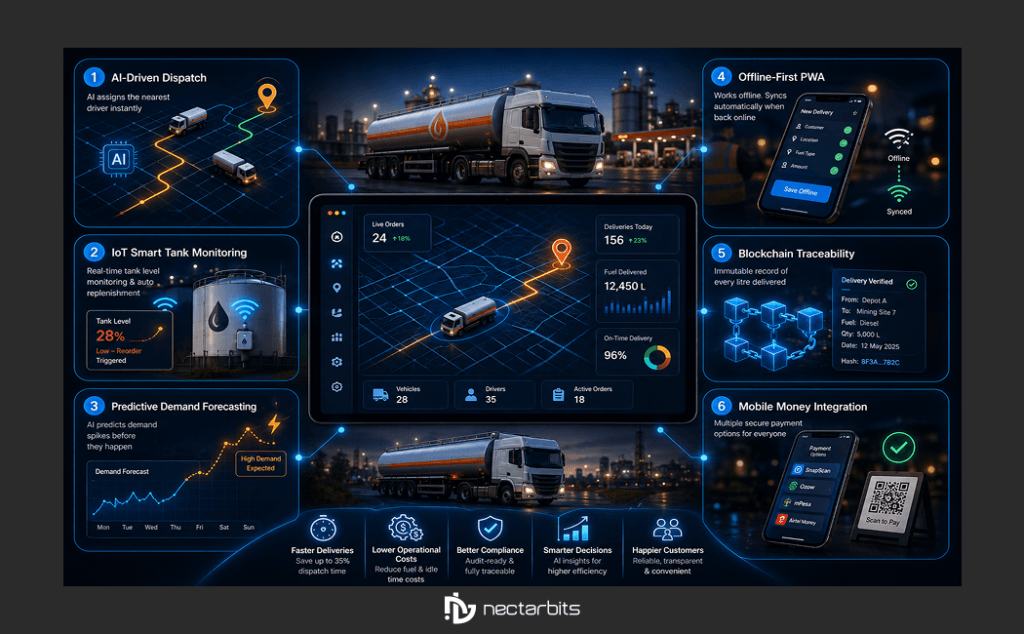
- AI-Driven Dispatch Automation: Machine learning assigns the nearest available driver the moment an order is placed, factoring in vehicle capacity, current load, and route efficiency. This reduces fleet idle time by up to 35% and eliminates the need for a human dispatcher.
- IoT Smart Tank Monitoring: Sensor-connected fuel tanks at client depots send automated replenishment orders when stock falls below a threshold. Eliminates stockouts for mining camps, construction sites, and agricultural properties — the highest-value clients in the SA market.
- Predictive Demand Forecasting: AI analyses historical ordering patterns to predict demand spikes before they happen. Particularly valuable in SA where load shedding events trigger a surge in generator fuel orders that can be anticipated and pre-positioned.
- Offline-First PWA Architecture: A critical requirement for the South African market specifically. During load shedding events, mobile data networks can be intermittent. A Progressive Web App (PWA) architecture queues all driver actions locally and syncs automatically when connectivity returns — ensuring zero order loss during blackouts.
- Blockchain Fuel Traceability: Immutable audit trails verify every litre from depot to delivery point. Increasingly required for enterprise procurement contracts and anti-adulteration compliance in markets like South Africa and Nigeria.
- Mobile Money Integration: M-Pesa, Airtel Money, and South Africa’s SnapScan/Ozow integration for cash-light payment environments, particularly valuable for rural and agricultural delivery markets.
Tech Stack for Fuel Delivery App Development
| Layer | Technologies |
| Mobile (iOS & Android) | Flutter, React Native |
| Backend | Node.js, Python, Laravel |
| Real-time tracking | Google Maps API, WebSockets, Socket.io |
| Database | PostgreSQL, MongoDB |
| Cloud infrastructure | AWS, Google Cloud, Azure |
| Push notifications | Firebase, Twilio |
| IoT integration | MQTT protocol, digital flow meter APIs |
| Payments | Stripe, PayFast (SA), Ozow, SnapScan |
| Authentication | OAuth 2.0, JWT |
| DevOps | Docker, Kubernetes, CI/CD pipelines |
The choice between Flutter app development and React Native for the mobile layer is particularly important in the SA context. Flutter delivers a single codebase for iOS and Android with native-level performance, ideal for markets where Android dominates but iOS adoption is growing among the enterprise segment. Nectarbits builds primarily in Flutter for fuel delivery apps given its performance advantage on lower-specification Android devices common in African markets.
For more on the technical foundation and architecture choices behind scalable fuel platforms, explore our guide on the best tech stack for fuel delivery app development → Best Tech Stack for Fuel Delivery App Development
Fuel Delivery App Development Process: Step by Step (12–16 Weeks)
Week 1–3: Discovery & Regulatory Audit
Strategic workshops to define your target market (B2C, B2B, or aggregator), user personas, feature scope, and MVP boundary. Regulatory audit covering NERSA licensing requirements, HAZMAT transport regulations, and payment compliance (PCI-DSS). Competitor analysis specific to your target SA geography.
Week 3–7: UI/UX Design
Wireframing and prototyping for all three panels. Design system creation. User testing with target persona representatives. South Africa–specific UX considerations: Zulu, Xhosa, Afrikaans language support; mobile data-light design; offline state handling. This is where UI/UX design investment pays off in user adoption rates.
Week 7–14: Engineering
Agile sprint-based development. Backend API architecture. mobile app development. IoT integration layer (if required). Payment gateway integration (local SA processors included). Real-time GPS and WebSocket infrastructure.
Week 14–15: QA, Security & Compliance
Full penetration testing. Load testing (simulating peak demand events like load shedding surges). NERSA compliance documentation integration. PCI-DSS payment security audit.
Week 16: Launch & ASO
App Store and Google Play submissions. App Store Optimisation (ASO), title, description, keywords and screenshots optimised for South African search. Go-live monitoring with 24/7 incident response.
Ongoing: Support & Iteration 24/7 technical monitoring. User feedback analysis. Feature roadmap development. Performance optimisation based on real usage data.
NERSA & South African Compliance for Fuel Delivery Apps
This is the section no competitor blog covers, and one of the most critical considerations for anyone building a fuel delivery app specifically for South Africa.
NERSA (National Energy Regulator of South Africa) regulates petroleum and gas distribution in SA. Any business operating a fuel delivery service must:
- Hold or operate under a valid Petroleum Products Act licence (Section 7 licence for wholesale/retail distribution)
- Comply with SANS standards for petroleum storage and transport
- Maintain HAZMAT (hazardous materials) transport compliance under the National Road Traffic Act
- Carry appropriate public liability insurance for mobile fuel operations
- Adhere to environmental regulations around fuel spill prevention and containment
Your fuel delivery app must support this compliance operationally:
- HAZMAT checklists embedded in the driver app, pre-departure safety checks required before every delivery
- Automated audit logs for every delivery: driver ID, vehicle registration, fuel type, volume dispensed, delivery location, customer sign-off
- Digital compliance documentation that can be exported for regulatory inspections
- Driver certification tracking, the app should flag and block drivers whose HAZMAT certification has expired
For a deeper read on this, see our dedicated guide: Fuel Delivery Regulations in UAE & South Africa: Safety & Compliance →
Load Shedding: Building a Fuel Delivery App for Offline-First South Africa
Every global competitor blog completely ignores this. For South Africa, it is mission-critical.
South Africa has experienced up to Stage 8 load shedding, rolling blackouts affecting up to 8 hours per day. This creates two problems and one major opportunity for fuel delivery apps:
The problems:
- Driver apps lose functionality mid-delivery when mobile data infrastructure is disrupted
- Admin dashboards become unreliable, creating operational blind spots during high-demand periods
The opportunity: Load shedding events trigger a massive, predictable surge in generator fuel demand. Businesses that cannot take digital orders during this surge lose revenue. Platforms that can are positioned as essential infrastructure.
The solution — Offline-First PWA Architecture:
- All driver app actions (order acceptance, GPS updates, proof of delivery) are queued locally on the device
- The app operates fully offline using IndexedDB for local data storage
- All queued actions sync automatically when connectivity restores
- Admin dashboard uses WebSocket reconnection logic to resume real-time monitoring without data loss
- Predictive AI layer can pre-position tankers in high-demand zones before a load shedding event based on Eskom’s published schedules
No South African fuel delivery platform currently offers this. It is a genuine competitive advantage and a strong signal to enterprise clients that you have built specifically for their operating environment.
Custom Build vs White-Label Fuel Delivery App
| Factor | Custom Build | White-Label |
| Launch time | 12–25 weeks | 3–5 weeks |
| Investment | $15,000 – $200,000+ | From $8,000 |
| IP ownership | Full ownership | Licensed use |
| Regulatory customisation | Built to your exact SA requirements | Standard templates |
| Branding | 100% your brand | Your branding applied to existing UI |
| Scalability | Unlimited — architecture is yours | Dependent on vendor roadmap |
| ERP/SCADA integration | Full custom integration | Limited integration options |
| Best for | Operators scaling to 50+ trucks; enterprise B2B | New market entrants testing the model |
For most new entrants to the SA fuel delivery market, the recommendation is to start with white-label to validate the model, then migrate to a custom build as the business scales. This mirrors the SaaS vs custom fuel delivery software decision that enterprise buyers face, and Nectarbits offers both paths, plus a migration route between them.
Fuel Delivery App Development Cost
Costs vary based on feature scope, platform targets, and integration complexity. Here are realistic investment ranges for 2026:
| Tier | Features | Investment | Timeline |
| MVP | Customer + driver app, basic admin, GPS, payments | $15,000 – $30,000 | 12–14 weeks |
| Enterprise Growth | Full fleet management, IoT integration, analytics | $30,000 – $75,000 | 16–19 weeks |
| Global / Compliance Suite | AI dispatch, blockchain, multi-country, ERP sync | $75,000 – $200,000+ | 19–25 weeks |
| White-Label Fast Track | Ready-to-brand platform, rapid deployment | From $8,000 | 3–5 weeks |
SA Rand equivalents (approximate at current rates):
| Tier | ZAR Range |
| MVP | R280,000 – R560,000 |
| Enterprise Growth | R560,000 – R1,400,000 |
| White-Label | From R150,000 |
Key cost factors:
- Number of user panels (customer, driver, admin, vendor)
- IoT hardware integration requirements
- Payment gateway complexity (local SA processors add scope)
- Compliance module depth (NERSA, HAZMAT documentation)
- Language localisation (English, Afrikaans, Zulu, Xhosa)
- Offline-first architecture (adds engineering scope but is strongly recommended for SA)
Read our related guide on how to scale your fuel delivery business → for ROI benchmarks from live deployments.
Revenue Models — How Fuel Delivery Apps Make Money
A well-built fuel delivery app is not just an operational tool, it is a revenue engine with multiple income streams:
1. Delivery Convenience Fee
Charge customers a flat or distance-based delivery fee per order. R40–R120 per delivery is typical for B2C SA market. Dynamic pricing during peak demand (load shedding events, morning fleet fill-ups) increases revenue without reducing volume.
2. Per-Litre Commission (Aggregator Model)
Take a 3–7% margin on every litre dispensed through your platform. At volume, this is the highest-revenue model — and it scales automatically as your partner network grows.
3. B2B SaaS Subscription
Charge fleet operators a monthly platform fee (R500–R5,000/month depending on fleet size) for access to fleet management, analytics, and enterprise billing. Recurring revenue that compounds as you add enterprise clients. This is where SaaS app development expertise translates directly to business model design.
4. Premium Features / White-Label for Operators
License your platform to existing fuel operators (like DG Fuels or Fuel Solution) who want to go digital without building from scratch. This model generates revenue from the very businesses you are currently outcompeting.
5. Data and Analytics Monetisation
Anonymised fuel consumption data, aggregated across your fleet client base, is valuable to automotive service partners, insurers, and logistics companies. A secondary revenue stream that grows with your data volume.
Realistic ROI benchmark: Nectarbits’ enterprise fuel delivery clients have seen an average 320% ROI within 18 months of launch on urban-market platforms.
Why Partner With Nectarbits for Fuel Delivery App Development
Nectarbits is not a generalist app development agency that occasionally builds fuel apps, we are a petroleum logistics technology specialist focused on designing scalable, real-world fuel delivery ecosystems that perform in complex operating environments like South Africa, the UAE, and across Africa.
Our expertise is backed by 50+ fuel delivery platforms delivered globally, including markets such as the UK, UAE, South Africa, Nigeria, Kenya, Jordan, Colombia, and Australia. These are not experimental builds, they are production-grade systems powering real fuel operations today.
One of our strongest proof points is the GetFuel case study, a live, revenue-generating fuel delivery platform built specifically for the African market. It demonstrates how we translate logistics complexity into a seamless on-demand fuel experience, backed by measurable operational outcomes and real business growth.
What sets Nectarbits apart is not just development capability, but deep domain engineering:
- Advanced IoT and metering integration including digital flow meters, tamper-proof volume tracking, and smart tank APIs
- South Africa–ready architecture built for NERSA compliance, HAZMAT workflows, and fuel transport regulations
- Load shedding–resilient systems designed with offline-first architecture to ensure uninterrupted operations during connectivity failures
- Local payment gateway integration including PayFast, Ozow, and SnapScan for seamless transactions in the South African market
- Flexible deployment models with both white-label fuel delivery platforms and fully custom-built enterprise systems depending on your scale and timeline
Across all deployments, we maintain a 95% client retention rate and a 4.85/5.0 satisfaction score on platforms like Google and Clutch, reflecting long-term trust and production stability rather than one-time delivery.
At our core, we don’t build generic software. We build fuel logistics systems engineered for real-world conditions — where a driver losing connectivity during Stage 6 load shedding at a mining site is not an edge case, but an expected scenario that must be solved by design.
That difference is what defines Nectarbits.
Final Thought
The South African fuel delivery market is at an inflection point. The infrastructure exists. The demand is validated. The regulatory environment is navigable. What is missing is the technology layer, and that gap will not stay open for long.
The operators and entrepreneurs who invest in fuel delivery app development today will own the market by 2027. Those who wait will be competing against an established platform with a loyal customer base and two years of operational data.
If you are ready to move, our team is ready to build →
Continue Reading:
Want to go deeper on the technology and business strategy behind fuel delivery platforms? These guides from the Nectarbits blog are worth your time:
- How to Scale Your Fuel Delivery Business: 7 Lessons from Leaders → ROI benchmarks, fleet expansion strategy, and what the fastest-growing platforms have in common
- Fuel Delivery Case Study: How a Fleet Cut Downtime by 33% with Smart Fuel Tech → Real numbers from a live deployment
- How to Build an On-Demand Fuel Delivery App Like CAFU → A deep-dive into the CAFU feature model and how to replicate it for the African market
Frequently Asked Questions:
A market-entry MVP typically costs between $15,000 and $30,000 (approximately R280,000 – R560,000), covering the customer app, driver app, admin dashboard, GPS tracking, and payment integration. Enterprise platforms with IoT metering, AI dispatch, and NERSA compliance modules range from $30,000 to $75,000+. If speed to market is the priority, a white-label solution starts from $8,000 and can be deployed in 3–5 weeks.
An MVP takes 12–14 weeks from kickoff to launch. A full enterprise platform with fleet management, IoT integration, and compliance modules typically takes 16–19 weeks. White-label deployment can be live in 3–5 weeks. The exact timeline depends on feature scope, third-party integrations, and the number of user panels required.
Yes. Any business delivering petroleum products in South Africa must hold or operate under a valid licence under the Petroleum Products Act. Your app must also support HAZMAT compliance documentation, pre-departure safety checklists for drivers, and automated delivery audit logs — all of which can be built directly into the driver app and admin dashboard.
A white-label solution is a pre-built platform rebranded to your business, it launches in 3–5 weeks from $8,000 and is ideal for validating the market quickly. A custom build is engineered from scratch to your exact specifications, giving you full IP ownership, unlimited scalability, and complete regulatory customisation. Most South African operators start with white-label, then migrate to a custom build as their fleet and client base grows.
Yes — if it is built with an offline-first architecture. The driver app queues all actions (order acceptance, GPS updates, proof of delivery) locally on the device during connectivity loss, then syncs automatically when the network restores. This is a South Africa–specific requirement that generic fuel delivery app templates do not include by default, and it is one of the most important features for enterprise clients operating in mining, construction, and agricultural sectors.