
 Anil Patel
Every fuel delivery business faces the same brutal truth: a customer who orders once may never order again.
Fuel prices spike. A competitor undercuts you by two cents per litre. A fleet manager signs a contract elsewhere. And just like that, the revenue you counted on disappears. If your business runs entirely on one-off orders, you are one bad quarter away from a cash flow crisis.
That is exactly why the subscription-based fuel delivery business model is changing how the most successful operators in this industry think about growth. Instead of chasing new orders every week, subscription businesses build a base of customers who pay consistently, month after month, making revenue predictable, operations smoother, and churn dramatically lower.
According to Future Market Insights, the global on-demand fuel delivery market is valued at $5.84 billion in 2025 and is projected to reach $11.92 billion by 2032, growing at a 7.4% CAGR. Companies that lock in customers through recurring subscription plans are positioned to capture a disproportionate share of that growth.
Whether you are an established petroleum distributor, a logistics operator adding a revenue stream, or a fuel delivery app development company building a platform for a new market, the subscription model is where the most durable revenue in this space is being built right now.
This guide breaks down exactly how the subscription-based fuel and gas delivery business model works, the five most effective models operators are using today, how to price your plans, what technology you need, and the real-world companies already doing it at scale.
What Is a Subscription-Based Fuel Delivery Business Model?
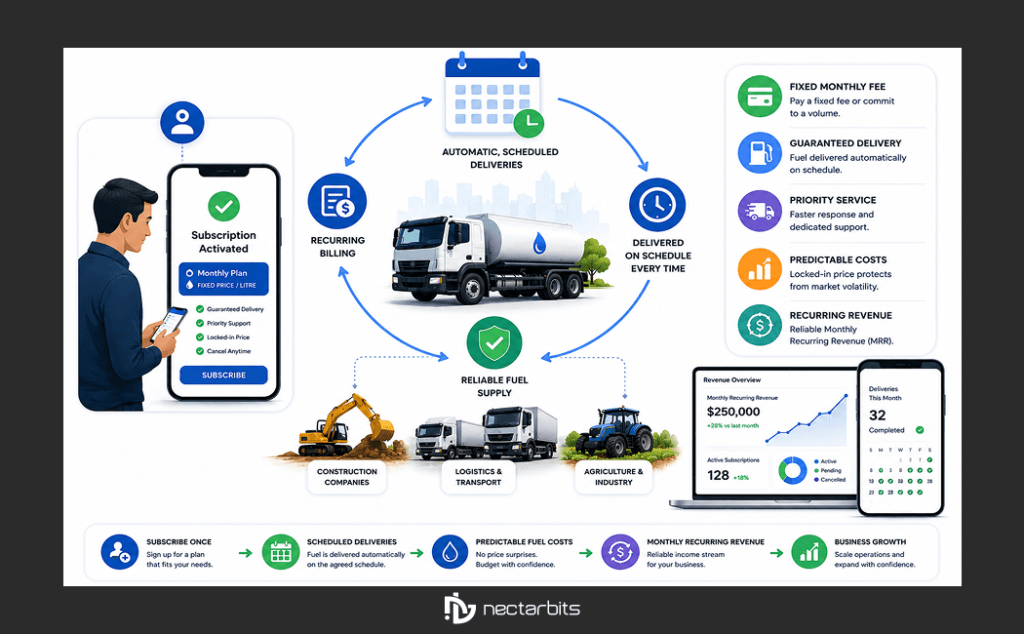
A subscription-based fuel delivery business model is a recurring service structure where customers pay a fixed monthly fee, or commit to a volume-based contract, in exchange for guaranteed deliveries, priority service, and often a locked-in price per litre or gallon.
Think of it as the Netflix model applied to fuel. Instead of placing an order each time their tank runs low, customers sign up once and fuel arrives automatically, on a schedule, at a predictable cost, without them lifting a finger.
For the business, this creates Monthly Recurring Revenue (MRR): a reliable income stream you can forecast accurately and use to scale operations with confidence. For customers, especially commercial fleets, logistics operators, and construction companies, it eliminates the risk of running dry mid-operation, removes the administrative burden of repeated ordering, and provides financial predictability during volatile market periods.
This is fundamentally different from the traditional on-demand fuel delivery model, where every order is a fresh transaction and customer retention is never guaranteed.’
The model applies equally across markets. In the UAE, companies like CAFU have built entire businesses on it. In the US, Booster Fuels and EzFill have scaled it to hundreds of millions in revenue. In East Africa and South Africa, where diesel is the operational backbone of construction, transport, and agriculture, the same recurring-contract logic is beginning to take hold, and the operators who move first own the market.
A white-label fuel delivery platform built around exactly this model gives fuel distributors and energy startups the technology infrastructure to launch recurring revenue operations without building from scratch.
Quick answer: Is a subscription fuel delivery model different from a fuel card programme? Yes. A fuel card gives customers a payment method they use at any pump. A subscription fuel delivery model delivers fuel directly to the customer’s location on a recurring schedule; the customer never goes to a station. The value is operational: no driver detour, no downtime, predictable supply.
Why Fuel Businesses Are Switching to Subscription (The Numbers Prove It)
Before diving into the models themselves, it is worth understanding why this shift is happening now, and how fast.
According to Cashfree, businesses using subscription-based models report 3 to 5 times higher customer lifetime value compared to one-off transactional businesses. On-demand service platforms that add subscription options see 30 to 50% better customer retention as a direct result.
Meanwhile, the global subscription economy itself is on a steep upward trajectory, valued at approximately $487 billion in 2024 and projected to exceed $2,100 billion by 2034, growing at a 15.9% CAGR (subscription economy market research, 2025).
In the fuel delivery space specifically, NextNRG’s EzFill division is the most compelling proof point. By shifting its model toward long-term fleet contracts and subscription-style commercial agreements, EzFill posted full-year 2025 revenue of $81.8 million, a 195% year-over-year increase from $27.7 million in 2024, according to their SEC filings. In February 2025 alone, the company hit $5.09 million in monthly revenue, up 139% year over year.
That is not growth that comes from chasing individual orders. That is what happens when you build a base of contracted, recurring fleet clients.
On-Demand vs Subscription Fuel Delivery: Side-by-Side Comparison
Entrepreneurs and startup founders frequently ask whether to launch as an on-demand platform first or go straight to a subscription model. Here is a direct, data-backed comparison to help you decide.
| Factor | On-Demand Fuel Delivery | Subscription Fuel Delivery |
| Revenue predictability | Low – fluctuates daily | High – MRR is fixed and forecastable |
| Customer retention | 68–73% industry average | 85–92% with subscription lock-in |
| Churn rate | High – price-sensitive, easy to switch | 25–40% lower than on-demand |
| Revenue per customer/month | $15–$40 (B2C), variable | $15–$30 B2C, $800–$5,000 B2B |
| Customer lifetime value | Baseline | 3–5× higher (Cashfree data) |
| Operational planning | Reactive – demand is unpredictable | Proactive – delivery schedules are fixed |
| Truck utilisation | Variable, often under 70% | Optimisable to 85–92% with route clustering |
| Competitive switching risk | High – one lower price and they leave | Low – data integration creates switching costs |
| Best suited for | Emergency refuelling, new market entry | Commercial fleets, LPG clients, urban B2C |
The recommendation for most operators: launch with a B2C on-demand offer to build brand recognition and route density in a specific zone, then use that operational foundation to pitch B2B fleet subscription contracts. The two models are not competitorsthey are sequential.
5 Subscription-Based Fuel Delivery Business Models That Actually Work
Not every subscription structure suits every market or every operator. Here are the five models running profitably right now, with context on which markets each one is best positioned for.
1. Fixed Monthly Delivery Plan (B2C)
Customers pay a flat monthly fee, typically $9.99 to $29.99, and receive a set number of fuel deliveries at their home, office, or regular parking location. EzFill built exactly this model with its Emergency Fuel Services programme, offering unlimited deliveries for $9.99 per month via app.
This works best in dense urban markets where individual vehicle owners value zero-hassle convenience above price. In cities like Dubai, Toronto, and Johannesburg, where urban commuters and rideshare drivers spend significant time in traffic and resent the additional stop at a petrol station, this model has strong product-market fit.
Best for: Residential customers, urban professionals, rideshare and gig economy drivers.
Quick answer: What monthly fee should I charge for a B2C fuel delivery subscription? The market-tested range is $9.99 to $49.99 per month depending on delivery frequency and added perks. Entry-tier plans at $9.99 with 2 deliveries per month work well for customer acquisition. Premium plans at $29.99 to $49.99 with unlimited deliveries and locked fuel pricing generate the best lifetime value. Launch with three tiers and let data show you where your market gravitates.
2. B2B Fleet Volume Contract
Commercial fleets agree to a minimum monthly fuel volume in exchange for reduced per-litre pricing, dedicated delivery windows, and a named account manager. Revenue per client typically ranges between $800 and $2,000 per month depending on fleet size. This is the model that powered Booster Fuels to over 2 million deliveries and drove EzFill’s nine-figure revenue.
In North America, this model is already mature. In the UAE, operators like CAFU have demonstrated it at scale. In Kenya and South Africa, where large construction, mining, agricultural, and logistics fleets run on diesel and often operate far from reliable filling stations, the B2B fleet contract model addresses a genuine operational pain point that no competitor has yet systematically solved with a subscription structure. The opportunity is significant and largely open.
Best for: Logistics companies, construction fleets, last-mile delivery operators, corporate campuses, mining and agricultural operators.
3. LPG and Gas Cylinder Auto-Replenishment Subscription
Restaurants, hotels, hospitals, and manufacturing facilities that run on LPG subscribe to automatic cylinder replenishment, triggered by IoT sensors monitoring tank levels in real time. Customers never run out. Suppliers never wait for a phone call.
This gas cylinder delivery subscription model is increasingly critical across the UAE, South Africa, Kenya, and India, where LPG is the primary commercial cooking and heating fuel. In markets where commercial LPG supply chains are under strain, commercial operators who lock into a reliable auto-replenishment subscription are actively reducing their operational risk.
The technology that makes this seamless is IoT smart meter and tank integration, sensors connect directly with digital flow meters, trigger automatic refill orders before a tank hits a critical threshold, and log every litre dispensed with full audit trail. For hotels in Dubai, hospitals in Nairobi, and restaurant groups in Cape Town, this model removes the single biggest operational risk: running out of LPG during service hours.
Best for: Hospitality, healthcare, manufacturing, commercial kitchens, large residential and commercial complexes.
4. Prepaid Fuel Credit Subscription
Customers pre-purchase a set fuel volume, say, 500 litres per month, at a locked-in price, protecting them from market price fluctuations. Suppliers benefit from upfront cash flow and predictable demand planning.
This model is particularly powerful during volatile price periods. When diesel prices in sub-Saharan Africa can swing significantly with currency movements or import supply disruptions, a prepaid subscription at a locked rate is a compelling offer for fleet operators managing tight project margins. This is especially relevant for construction fleet fueling, where operators running diesel-powered heavy equipment on fixed-price project contracts benefit directly from knowing their fuel cost will not change mid-project, in South Africa, Kenya, or anywhere else where fuel price adjustments are tied to monthly government-regulated cycles.
Best for: Price-sensitive fleet operators, construction companies on fixed-price contracts, agricultural operators managing seasonal costs.
5. Hybrid Subscription + On-Demand Top-Up
Subscribers receive a base monthly fuel allocation at a reduced rate, with the option to order additional deliveries on demand at standard pricing. This is how CAFU in the UAE operates, offering both a monthly subscription plan and on-demand delivery, letting customers self-select.
The hybrid model maximises customer acquisition by removing the commitment barrier while still building a recurring revenue base. It is also the most natural entry point for operators transitioning from a purely on-demand model; you do not have to rebuild your business overnight. You layer a subscription option on top of what you already have and let the market show you the adoption rate.
Operators looking to launch this kind of dual model can explore white-label on-demand app development solutions that support both recurring plan management and single on-demand orders within the same platform, reducing the technology overhead of running two separate delivery systems.
Best for: Operators scaling from on-demand to a full subscription model, mixed B2C and B2B operations, markets where subscription awareness is still developing.
B2B vs B2C: Which Subscription Model Is More Profitable?
Both work. But B2B wins on unit economics, by a significant margin.
A single residential B2C subscriber generates $15 to $30 per month in recurring revenue. A single B2B fleet subscription contract generates $800 to $2,000 per month, with lower churn, higher average order value, and predictable delivery scheduling that reduces your operational cost per litre delivered.
More importantly, B2B clients are stickier. Once a fleet operator’s vehicles, routes, invoicing systems, and fuel consumption data are integrated into your platform, switching to a competitor is genuinely painful. Booster Fuels has built its entire retention strategy around this data lock-in principle: once 12 to 18 months of fleet analytics live inside their system, clients stay because leaving means starting over operationally from zero.
You can explore how fleet fueling models drive long-term B2B retention in more detail.
| Metric | B2C Subscription | B2B Fleet Subscription |
| Monthly revenue per customer | $15–$50 | $800–$5,000+ |
| Average contract length | Month-to-month | 6–24 months |
| Churn rate | 5–12% per month | Under 4% per month |
| Acquisition cost | Low ($10–$30) | Higher ($200–$800) but returns in month 1 |
| Switching difficulty | Easy — habit-based retention only | High — data and operational integration |
| Trucks needed per $10K MRR | More | Fewer |
The recommended launch path for most startups: build B2C density in one zone first to establish route efficiency and brand presence, then use that foundation to pitch B2B fleet contracts directly. Dominating one tight geographic zone before expanding is how you reach the 85 to 90% truck utilisation rate where unit economics turn genuinely profitable.
How to Price Your Fuel Delivery Subscription Plan
Pricing is where most new operators stumble. The temptation to underprice for early customer acquisition creates a revenue structure that is impossible to sustain past month six.
Before finalising your pricing tiers, it is worth using a tool like a fuel delivery ROI calculator to model your delivery cost per litre at different volume and route density scenarios; this gives you a defensible margin floor to price from rather than pricing based on what competitors charge.
B2C Tiered Pricing Framework
| Plan | Monthly Fee | Deliveries | Key Features |
| Basic | $10 | 2 per month | Standard scheduling, app tracking |
| Pro | $25 | Unlimited | Priority scheduling, locked fuel price |
| Premium | $50 | Unlimited + emergency | Emergency guarantee, dedicated support, consumption analytics |
B2B Fleet Pricing Framework
| Contract Tier | Monthly Fee | Fleet Size | Inclusions |
| Base | $800–$1,200 | 5–15 vehicles | Dedicated windows, account manager, monthly report |
| Business | $1,500–$2,500 | 15–40 vehicles | Custom scheduling, IoT tank alerts, API integration |
| Enterprise | $2,500–$5,000+ | 40+ vehicles | Multi-site, custom windows, full fleet analytics dashboard |
The core pricing rule that protects your margins: lock the per-litre price for the billing cycle, monthly or quarterly, but include a quarterly adjustment clause tied to a published fuel price index. In the US, this would be the EIA weekly retail diesel price. In the UAE, it is the ADNOC official selling price. In South Africa and Kenya, it is the government-regulated monthly fuel price adjustment. This clause gives customers the price stability they are paying a subscription premium for, while protecting you from catastrophic margin compression if wholesale prices move sharply.
For B2B clients, a cost-plus markup of 3 to 8% above wholesale, with delivery fees waived above a minimum monthly volume threshold, is the structure that enterprise fleet operators across all five target markets respond to best.
For service businesses managing recurring service plans across multiple accounts — from billing cycle management and automated renewals to plan upgrades and customer notifications Clarro’s SaaS platform provides the back-office subscription management layer that keeps your operations clean as client volumes grow.
Quick answer: How do I protect my margins if fuel prices spike after locking a subscription rate? Build a quarterly price adjustment clause into every contract, tied to a publicly published index relevant to your market. This allows you to pass on significant market movements, typically defined as movements of 8 to 10% or more, while absorbing day-to-day volatility within your operation. Customers accept this structure because it is transparent and fair, and they still receive far more price stability than spot market buyers.
How to Start a Fuel Delivery Subscription Business: 7 Steps
If you are an entrepreneur or startup founder planning to launch in 2026, whether in the US, Canada, UAE, Kenya, or South Africa, here is the practical path. These steps are built around what actually causes subscription fuel businesses to succeed or fail in their first year.
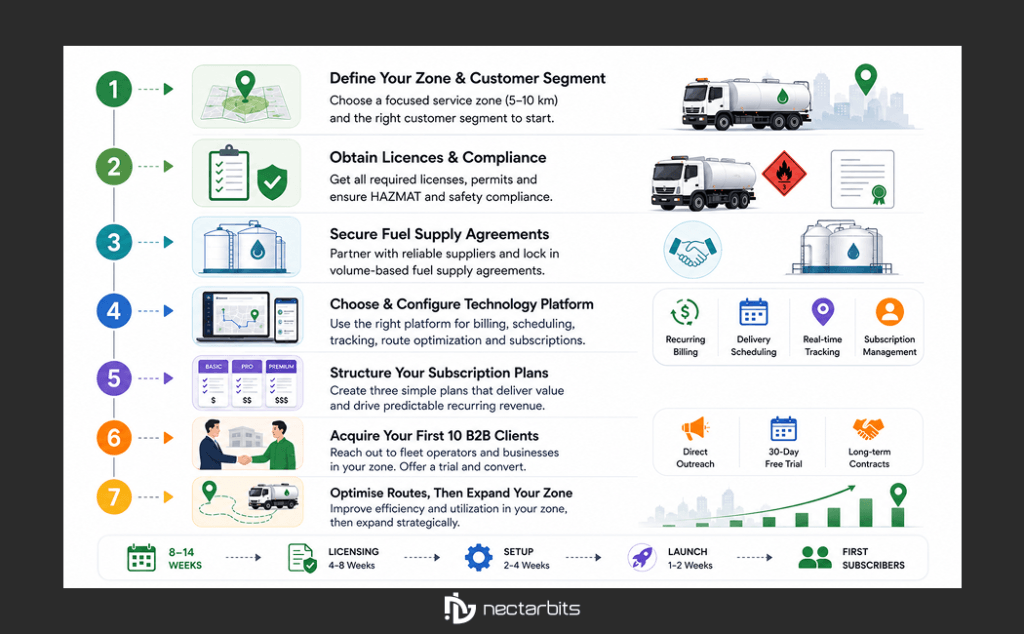
Step 1: Define Your Zone and Customer Segment First
Before licensing, funding, or technology, define your first geographic zone and first customer type. A 5 to 10 kilometre zone with high fleet density is the right starting point. A logistics park on the outskirts of Nairobi, a construction cluster in Abu Dhabi, a commercial strip in Calgary, or an industrial zone outside Johannesburg are all stronger starting zones than trying to serve an entire city from day one. Dominate one zone first. Expand when your trucks are full.
Step 2: Obtain Licences, Permits, and HAZMAT Compliance
Fuel is a regulated commodity in every market. While requirements vary by country, the universal requirements include a fuel distribution or motor fuel dealer licence, a commercial vehicle transport permit, HAZMAT or dangerous goods certification for drivers, and environmental compliance covering spill prevention and storage standards.
In the United States, this includes a DOT Number, state motor fuel dealer licence, and IFTA fuel tax registration for interstate operations. In Canada, provincial transport permits and TDG (Transportation of Dangerous Goods) certification are required. In the UAE, operators require a trading licence from the relevant emirate authority and fuel distribution approval from ADNOC or the respective emirate energy authority. In Kenya, the Energy and Petroleum Regulatory Authority (EPRA) licence is mandatory. In South Africa, a petroleum products retail licence and a dangerous goods vehicle permit under the NRTA are required.
Do not attempt to navigate this without a compliance specialist in your jurisdiction. Penalties are severe and can shut down operations before you reach your first subscriber.
Step 3: Secure Wholesale Fuel Supply Agreements
Your subscription pricing model only works if your fuel procurement cost is stable and predictable. Negotiate with wholesale distributors for a volume-based supply agreement. Most will offer a cost-plus margin on a weekly or monthly pricing cycle. For LPG operators, particularly in the UAE and Kenya where LPG supply chains have faced volatility, establish secondary supplier relationships from day one. Your locked subscription price to customers needs a reliable cost floor below it.
Step 4: Choose and Configure Your Technology Platform
Your subscription model is only as reliable as the software running it. You need a platform that handles recurring billing, automated delivery scheduling, driver routing, real-time tracking, and customer-facing subscription management, all from day one. This is not a spreadsheet-and-phone-call operation at any viable scale.
The choice is build or buy. Before committing to either path, reviewing the detailed breakdown on SaaS vs custom fuel delivery development is genuinely useful; it covers upfront costs, deployment timelines, IP ownership, and the migration path when you eventually outgrow a SaaS foundation. Building a custom platform from scratch for a full-featured subscription fuel delivery operation costs $80,000 to $200,000 and takes 4 to 8 months. A white-label platform delivers the same capability in weeks at a fraction of the cost, with the additional benefit of production-tested reliability. Most operators in 2026 launch on a white-label foundation and invest saved capital into fleet, licensing, and the first 6 months of B2B client acquisition.
Step 5: Structure Your Subscription Plans
Launch with three tiers: a low-cost entry plan to remove the commitment barrier, a mid-tier that is the obvious best value, and a premium tier for high-volume or high-priority customers. Position the middle tier so that 60 to 70% of subscribers land there, that is where your margin is healthiest. Price B2B fleet contracts separately on a cost-plus-service model with custom terms for each client above a certain fleet size. Each tier should map directly to what subscribers experience inside the mobile app development, plan management, delivery scheduling, and consumption history all need to reflect the tier the customer is on, in real time, without manual intervention.
Step 6: Acquire Your First 10 B2B Clients Through Direct Outreach
The fastest path to sustainable MRR is direct B2B outreach, not app store marketing campaigns. Identify 30 to 50 fleet operators in your zone, logistics companies, construction firms, last-mile delivery operators, hotel groups, hospital facilities managers, and make direct contact. Offer a 30-day free trial with no commitment and full service levels.
The conversion rate from free trial to paid monthly contract in B2B fuel subscription is high because the operational value is immediate and measurable. Ten clients at $1,200 per month is $144,000 ARR. That is your operational foundation and your proof of concept for any future funding conversation.
Step 7: Optimize Routes, Then Expand Your Zone
Do not expand to a second zone until your first zone has trucks running above 80 to 85% utilisation. Every subscriber you add inside your existing zone improves unit economics. Every subscriber 40 kilometres outside your zone hurts them. Once your core zone is profitable and operationally stable, replicate the same playbook in the next zone, same zone-first strategy, same direct B2B outreach, same three-tier pricing structure. Expansion is a copy-paste of what already worked.
For operators launching in Canada specifically, fuel delivery app development Canada options that include localised implementation support, covering TDG compliance, provincial permit requirements, and French-language app localisation for Québec operations, can significantly reduce the jurisdictional overhead of a Canadian market entry.
Quick answer: How long does it take to launch a fuel delivery subscription business? With a white-label platform, operators can go from incorporation to first paid subscriber in 8 to 14 weeks. The timeline is usually gated by licensing, typically 4 to 8 weeks depending on jurisdiction, rather than technology. Building a custom platform adds 3 to 5 months. Most successful startups in this space launch on a white-label foundation and invest development resources into differentiation, such as route optimisation, IoT integration, and custom client portals, rather than rebuilding billing and tracking from zero.
Fuel Delivery App With Subscription Billing: What Your Tech Stack Must Include
A subscription model is only as reliable as the software running it. You cannot manage recurring deliveries, billing cycles, and fleet data on spreadsheets and phone calls. The on-demand fuel delivery software platform behind your subscription operation needs to handle several things simultaneously.
Recurring billing engine. Automated invoicing, payment processing, and subscription renewal on a defined cycle. Manual billing for fleet clients is a churn risk; errors and delays erode trust faster than almost anything else. Your billing system must handle plan upgrades, downgrades, pro-rated charges, and renewal reminders without a human in the loop.
AI-powered route optimization. Subscription models generate predictable delivery patterns. AI dispatch systems cluster deliveries geographically, reduce kilometres driven per litre delivered, and keep trucks above optimal utilization. The right routing engine reduces delivery operational waste by up to 15%, which directly improves unit economics as subscription volumes scale.
IoT tank and meter integration. For B2B fleet and LPG clients, smart sensors monitor tank levels in real time and trigger automatic refill orders before the customer notices they are running low. IoT smart meter and tank integration that connects directly with LCR, TCS, and other digital flow meters supports wireless data transmission via cellular or satellite, critical for construction and mining operations in remote regions where connectivity is inconsistent.
Customer and driver apps. Subscribers need real-time delivery tracking, consumption history, digital invoices, and easy schedule management from their phone. On the driver side, smart dispatching software handles optimized routing, shift management, and instant job assignment, the operational layer that keeps your trucks moving efficiently and your delivery SLAs intact.
GPS fleet visibility. Real-time GPS fleet tracking gives your operations team live vehicle locations, geofence alerts when drivers arrive at client sites, and the data trail needed for compliance audits and billing dispute resolution. For enterprise clients especially, this visibility is a prerequisite for trust.
Admin and analytics dashboard. MRR growth, delivery efficiency, fleet consumption trends, driver utilization, and churn signals all need to surface in real time. Advanced reporting tools that surface KPIs- which clients are at churn risk, which routes are underperforming, which drivers are most efficient- allow you to intervene before problems compound, not after.
Quick answer: Should I build a custom fuel delivery app or use a white-label platform? For most operators launching in 2026, a white-label platform is the faster and more capital-efficient path. Custom development costs $80,000 to $200,000+ and takes 4 to 8 months. A white-label platform delivers the same capability in weeks. The saved capital is better invested in fleet equipment, licensing, and B2B client acquisition- the things that actually drive early MRR growth.
Real Companies Proving This Model Works
NextNRG / EzFill (USA)
The most data-rich proof point in the industry. By building long-term fleet contracts and commercial agreements with enterprise clients, including a major global e-commerce company, EzFill grew from $27.7 million in 2024 to $81.8 million in full-year 2025 revenue, a 195% year-over-year increase. By May 2026, the company was generating $9.3 million in a single month, up 41% year over year. That trajectory is not achievable on one-off orders. It is the direct result of building contracted, recurring fleet relationships at scale.
Booster Fuels (USA)
Booster operates a B2B fleet-first model across more than 20 US cities. Corporate clients including PayPal, Facebook, and Pepsi subscribe to regular parking-lot refuelling services. Over 2 million deliveries completed. The model’s durability comes from deep data integration with fleet management platforms; once a year’s worth of fleet analytics lives inside Booster’s system, switching to a competitor requires rebuilding all of that operational intelligence from zero. That is not a barrier customers choose to cross.
Read more: How Booster Fuels Built a Fleet-First Fuel Delivery Business Model
CAFU (UAE)
CAFU runs both a monthly subscription plan and an on-demand model, a dual approach that maximises customer acquisition while building a recurring revenue base. Beyond fuel, CAFU has expanded into engine oil changes, car washes, and battery services, demonstrating how value-added services in fuel delivery deepen the customer relationship and increase average revenue per user over time. CAFU’s trajectory shows clearly what a mature subscription fuel business looks like in a high-density Gulf market.
Filld (USA/Canada)
Specialises in B2B fleet contracts with enterprise clients who enter scheduled, recurring delivery agreements rather than placing one-off orders. Filld’s model combines subscription fleet fueling software with IoT integration and wholesale pricing benefits passed to clients at volume thresholds, a structure that makes large clients genuinely difficult to displace once operational integration is complete.
Nectarbits: The Platform That Powers the Model
While EzFill, Booster, CAFU, and Filld operate their own fleets, Nectarbits builds the enterprise-grade software infrastructure that makes the subscription model work for operators launching or scaling in this space.
The Nectarbits white-label fuel delivery platform is purpose-built for recurring revenue operations, with a native subscription billing engine, IoT and smart meter integration, AI route optimisation, and real-time fleet analytics built in from the ground up, not retrofitted onto a one-off delivery system.
For a fuel distributor in Texas, a logistics operator in Ontario, an energy startup in Dubai, a petroleum dealer in Nairobi, or a commercial fleet operator in Cape Town, the question in 2026 is not whether to build a subscription model. The question is whether to spend 6 months and $150,000 building the technology infrastructure from scratch, or to launch on a platform that is already production-tested and purpose-built for exactly this use case. Nectarbits is that platform.
Challenges of Running a Subscription Fuel Business (and How to Solve Them)
Challenge: Fuel price volatility eating into margins
Solution: Lock subscription rates for a billing cycle but build in a quarterly price adjustment clause tied to a published fuel index. This protects both sides and keeps customers from feeling blindsided by increases.
Challenge: Customer churn after the first month
Solution: Onboard B2B clients with a data integration; connect their fleet management system to your platform. Once their data lives in your system, switching costs are high. For B2C clients, lock-in comes through habit and value: make the first delivery experience exceptional, offer a loyalty discount at the 3-month mark.
Challenge: Route inefficiency at low subscriber density
Solution: Start in a tight geographic zone and reach 80% truck utilisation before expanding. A $15/month subscriber 40 kilometres away is not profitable. A cluster of 30 subscribers within a 5-kilometre radius is.
Challenge: HAZMAT compliance and licensing
Solution: Build compliance into the product from day one, not as an afterthought. This is where custom software development decisions made early have long-term consequences: digital proof of delivery, certified driver tracking, and regulatory workflows built into the core of the platform protect you from costly penalties and earn trust from B2B enterprise clients who need full audit trails.
How Nectarbits Helps You Build a Subscription Fuel Delivery Business
Building the right fuel delivery subscription platform from scratch is one of the most complex technical challenges in the on-demand space. You need a recurring billing engine, IoT hardware integration, AI dispatch, branded apps for customers and drivers, and a real-time analytics dashboard, all working together reliably from day one.
Nectarbits builds exactly this. The platform is an enterprise-grade, white-label, on-demand fuel delivery software solution designed for fuel distributors, logistics operators, and energy startups launching or scaling their subscription model. Here is what the platform includes:
Customer app (iOS & Android): Branded to your business. Customers manage their subscription plan, track deliveries in real time, view consumption history, and pay automatically, all without a phone call.
Driver app: Optimised routing, offline delivery capability for remote sites, digital proof of delivery with volume confirmation, and shift management. Drivers spend more time delivering and less time navigating.
Admin panel: Full operational visibility, active subscriptions, MRR, delivery efficiency, driver locations, customer churn signals, and fleet analytics in a single dashboard. Every decision you make will be data-backed.
IoT and smart meter integration: Connect directly with LCR, TCS, and other digital flow meters for automated volume readings. For LPG and tank-based clients, sensor-triggered auto-replenishment means your customers never run dry.
AI route optimisation: The predictive routing engine reduces fuel waste in delivery operations by up to 15%, keeping your unit economics healthy as you scale subscription volumes.
Recurring billing and subscription management: Automated invoicing, payment cycles, plan upgrades, and renewal reminders, all built into the platform so your team is never chasing payments manually.
Whether you are launching a B2C monthly plan, a B2B fleet contract programme, or an LPG auto-replenishment subscription, the fuel delivery app development platform is built to handle it. From a single city to multi-region operations, the architecture scales without requiring a rebuild.
Conclusion
The fuel delivery industry is undergoing a structural shift. Operators who continue to rely entirely on one-off on-demand orders will find margins tightening, churn rising, and growth plateauing, in every market. Operators who build a subscription base, predictable revenue, contracted fleet clients, and automated delivery cycles are the ones the data consistently shows scaling fastest.
The subscription-based fuel delivery business model is not a niche experiment. It is the operational foundation that took EzFill from $27 million to $81 million in a single year. It is what gives Booster Fuels and Filld enterprise clients who stay for years. It is what CAFU uses to build customer relationships that extend well beyond the fuel transaction.
The market window is open right now, especially in Kenya, South Africa, and the UAE, where the subscription model is still early-stage and the operator who launches first owns the customer relationship before a competitor even enters the conversation.
The question is not whether your fuel delivery business should adopt a subscription model. The question is how quickly you can build and launch one.
Frequently Asked Questions:
A subscription-based fuel delivery business model is a recurring service structure where customers pay a fixed monthly fee, or commit to a volume-based contract, in exchange for guaranteed, scheduled fuel deliveries. Unlike one-off on-demand orders, subscription plans convert fueling into a managed service that generates predictable Monthly Recurring Revenue (MRR) for the operator and eliminates refuelling hassle for the customer.
Yes, and the data is clear. Companies using subscription-based models report 3 to 5 times higher customer lifetime value compared to transactional models, according to Cashfree. EzFill’s fleet-contract-driven model grew revenue 195% year over year in 2025. The key is reaching sufficient route density before expanding; a cluster of subscription clients within a tight geographic zone is far more profitable than scattered individual orders across a wide area.
On-demand fuel delivery means customers order fuel when they need it, each order is a separate transaction. Subscription fuel delivery means customers sign up for a recurring plan and receive scheduled deliveries automatically, typically at a locked-in price. On-demand serves immediate, unpredictable needs. Subscription serves predictable, recurring needs, and generates far more stable revenue for the operator.
A practical starting point for B2C plans is $9.99 to $49.99 per month depending on delivery frequency and priority level. B2B fleet contracts typically run $800 to $2,000 per month for small-to-mid-sized fleets, rising to $5,000 or more for enterprise clients. The most important rule: lock the per-litre price for the billing cycle with a quarterly adjustment clause tied to a published fuel price index. This protects your margins during volatile periods while giving customers the financial certainty they pay a premium for.
At minimum: a recurring billing engine, branded customer and driver apps, an AI-powered dispatch and route optimisation system, real-time delivery tracking, and an admin analytics dashboard. For B2B and LPG clients, IoT smart meter integration that triggers automatic replenishment orders is also essential. The white-label fuel delivery software platform that powers your subscription service is the product your customers interact with every day, it needs to be reliable, branded, and built to handle recurring logic from the start, not retrofitted onto a one-off delivery system.
Yes, and these markets represent some of the strongest growth opportunities globally. In Kenya and South Africa, large diesel-dependent fleets in logistics, construction, mining, and agriculture operate in markets where reliable fuel supply is a consistent operational challenge. A subscription model with guaranteed delivery and locked pricing solves a genuine pain point. In the UAE, CAFU has already demonstrated the model at scale. The opportunity across East Africa and Southern Africa is significant and largely untapped by subscription-structured operators.