
 Anil Patel
Picture this: a fleet manager in Surat loses four hours every week driving trucks to petrol pumps during peak hours. A construction site in Lucknow runs out of diesel at midnight, halting an entire project. A logistics startup in Ahmedabad watches its margins shrink because drivers spend more time refuelling than delivering.
These are not edge cases. These are daily realities for thousands of Indian businesses, and they are exactly why the on-demand fuel delivery industry in India is exploding right now.
India has just one petrol pump for every 8,000 vehicles in Tier-2 cities. Average queue time at fuel stations hits 12–18 minutes during peak hours. Over 3.2 million roadside fuel emergencies occur in India every year. The market is screaming for a smarter solution, and fuel delivery apps are answering that call.
If you are a startup founder evaluating this space, a fuel station owner ready to go digital, a fleet operator tired of refuelling chaos, or a business looking to hire the right fuel delivery app development company in India, this is the only guide you need.
We cover everything: how fuel delivery apps work, which companies build them best in India, exactly what features you need, what it costs in rupees, how India’s regulatory framework applies, and a step-by-step breakdown of the full development process.
What Is an On-Demand Fuel Delivery App?
An on-demand fuel delivery app lets customers order petrol, diesel, or CNG directly to their location, whether that is a parked vehicle, a construction site, a fleet yard, or a generator bank, through the app and receive delivery within a defined time window.
Think of it as Uber, but instead of a ride, a certified fuel tanker comes to you
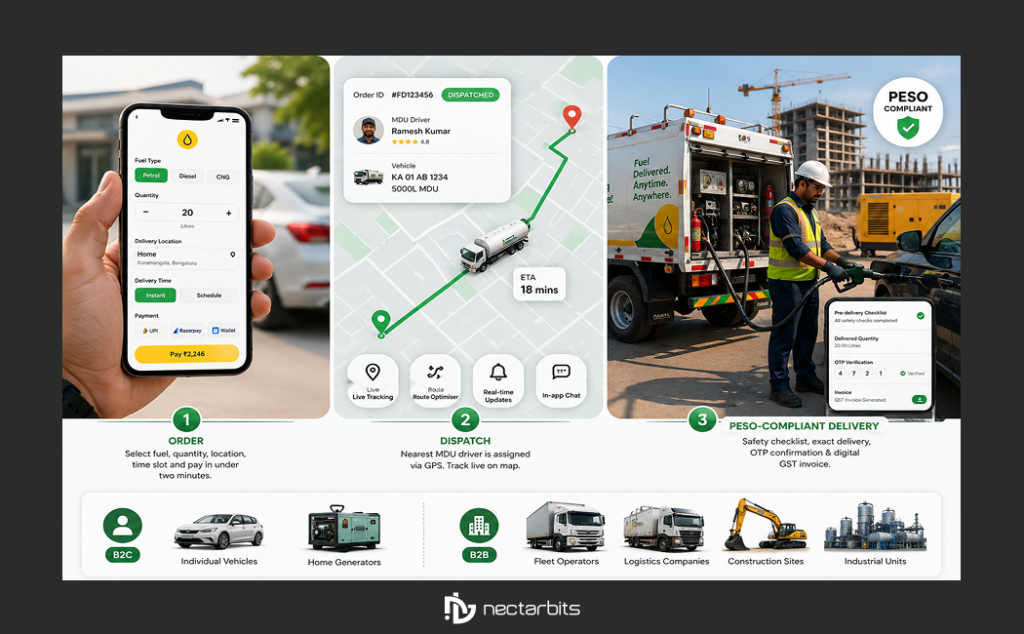
The delivery flow works in three steps:
Step 1 Order: The customer opens the app, selects fuel type (petrol/diesel/CNG), enters the quantity and delivery location, schedules a time slot (instant or pre-scheduled), and pays via UPI, Razorpay, or wallet, all in under two minutes.
Step 2 Dispatch: The system assigns the nearest available Mobile Dispensing Unit (MDU) driver through GPS-based matching. The driver receives the order, navigates via the in-app route optimiser, and the customer tracks delivery in real time on a live map.
Step 3 PESO-Compliant Delivery: The driver arrives, performs a pre-delivery PESO safety checklist inside the app, dispenses the exact quantity ordered, and the customer confirms with an OTP. A digital GST invoice is generated and sent instantly.
This model works for B2C (individual vehicles, home generators) and B2B (fleets, logistics companies, construction sites, industrial units). The B2B segment is where the real money is in India; fleet operators and industrial buyers generate predictable, high-volume, recurring orders that create genuinely scalable businesses.
Why 2026 Is the Best Time to Build a Fuel Delivery App in India
The timing argument for this market has never been stronger. Here is what is happening right now that creates a genuine first-mover window for well-built, well-compliant fuel delivery apps.
The market size is validating the opportunity. India’s on-demand fuel delivery sector is growing at a CAGR of 23.4% through 2030. The global fuel delivery market is projected to reach $11.93 billion by 2035, up from $5.84 billion in 2025 (Source: Future Market Insights). India’s petroleum consumption crossed 210 billion litres in 2024, with urban demand accounting for 68% of that volume. India’s High-Speed Diesel market alone is valued at ₹100 billion, and doorstep delivery could capture 26% of that share over the next five years.
Regulatory clarity is arriving. The Petroleum and Natural Gas Regulatory Board (PNGRB) released its Draft Consumer Protection Regulations in December 2025, the clearest government signal yet that digital fuel delivery is being formalised as a legitimate industry category, not a regulatory grey zone. This removes one of the biggest hesitations that investors and founders had about entering this space.
Market consolidation proves viability. FuelBuddy’s acquisition of MyPetrolPump is a textbook signal that the market is maturing from fragmented early-stage startups into consolidated platforms with institutional backing. When M&A activity begins in a sector, it indicates the business model has been proven.
Tier-2 and Tier-3 cities are massively underserved. Repos Energy’s expansion to 130+ cities across India demonstrates that demand exists well beyond metros. Yet most digital fuel solutions are still metro-centric. The real opportunity, and the real gap, is in cities like Ahmedabad, Surat, Nagpur, Coimbatore, Jaipur, and Lucknow, where fleet operators and MSMEs face daily refuelling chaos with no digital alternative.
65% of Indian users now prefer digital platforms for on-demand vehicle services. The behaviour shift has already happened. The question is not whether India needs fuel delivery apps. It is whether you will build one before someone else captures your city.
Top Fuel Delivery Apps Already Operating in India
Before you build, understand who has already built, and more importantly, where the genuine product gaps still are. Every one of these platforms reveals either a market signal or an opportunity for a better-built app.
FuelBuddy-India’s largest B2B fuel delivery platform
FuelBuddy is the most important benchmark in this market. Founded in 2016 and operating pan-India, FuelBuddy focuses on industrial and enterprise fleet clients, bulk diesel delivery for logistics companies, factories, data centres, and construction operations. Their acquisition of MyPetrolPump in 2021 signalled their intent to consolidate India’s fragmented fuel delivery market into one dominant platform.
For anyone building in this space, FuelBuddy is the case study that proves the B2B fuel delivery model works at scale in India. Their growth trajectory, funding history, and enterprise client base are the clearest validation that this is a genuine market — not just an idea.
Read more: about FuelBuddy’s business model, how they built their platform, and what the fuel delivery startup ecosystem can learn from their growth in this deep dive: FuelBuddy — Fuel Delivery App Deep Dive
Repos Energy-The Tier-2 City Franchise Model
Repos Energy has taken a completely different strategic approach, a franchise model that lets local entrepreneurs become fuel delivery operators under the Repos brand, without Repos needing to own every vehicle or hire every driver. With operations in 130+ cities, Repos Energy is the closest thing India has to a scalable, decentralised fuel delivery network.
Their model is particularly instructive for founders targeting smaller cities: you do not need to build an Uber-scale owned fleet to succeed in Tier-2 India. A platform that enables local operators is often faster to scale and more capital-efficient than a vertically integrated operation.
HPCL Fuel@Call / IndianOil Doorstep Delivery-The PSU Gap
The PSU-backed fuel delivery platforms from HPCL and IndianOil represent enormous distribution reach, but deeply underwhelming execution. HPCL Fuel@Call currently holds a 1.1-star rating on the App Store, with user complaints centred on order fulfilment failures, poor driver tracking, and customer support that does not respond.
This is not a criticism of the concept; it is a direct market signal. When a PSU with nationwide distribution infrastructure cannot deliver a functional app experience, it creates a gap that a well-built private platform can walk straight into. Your competitive advantage is not scale; it is execution, user experience, and operational reliability.
Humsafar India-Industrial Diesel at Volume
Humsafar India operates in Delhi NCR, specialising in diesel bowser deliveries of 3,000 to 6,000 litres, a niche but highly profitable segment serving construction sites, generator-heavy facilities, and industrial buyers. Their model highlights the B2B industrial segment as a distinct vertical within fuel delivery, with different UX requirements, pricing structures, and compliance documentation needs from consumer-facing apps.
What these four platforms tell you collectively: The B2B fleet and industrial segment is proven and profitable. Consumer-facing apps still have major quality gaps, particularly from PSU operators. Tier-2/3 India is demonstrably underserved. And the market is moving fast enough that a well-built app entering today is not too late; it is, in fact, precisely on time.

Top 10 Fuel Delivery App Development Companies in India (2026)
Choosing the right development partner is arguably more important than the idea itself. A poorly built fuel delivery app, with GPS accuracy issues, UPI payment failures, or compliance gaps that expose you to regulatory risk, will cost you customers, reputation, and in the worst case, your operating licence. Here are the ten companies in India with the demonstrated expertise to build this right.
1. Nectarbits Fuel Delivery App Development – Best for: Startups, Fleet Operators & PESO-Compliant MVPs
Nectarbits fuel delivery app development services are built for the Indian market from the ground up, not adapted from generic app development templates. As an Ahmedabad-based on-demand and hyperlocal application development company, Nectarbits brings direct experience in fuel delivery, logistics, and mobility platforms across India’s unique regulatory and payment landscape.
What separates Nectarbits from the typical mobile app shop is precisely what matters most in this vertical: a built-in understanding of India’s PESO compliance framework, MDU certification workflows, and India-native payment integrations (Razorpay, PayU, UPI). These are not features that get added during the final sprint; they are part of the architecture from Day 1.
For startups, Nectarbits structures MVP packages in the ₹8–12 lakh range, typically delivered in 8–10 weeks, sufficient to validate real market demand in your target city before committing to a full enterprise build. For established businesses, the enterprise fuel delivery platforms cover multi-city operations, ERP integrations, B2B fleet management, and custom compliance reporting.
Hourly rate: $25–$49/hr Minimum project size: $5,000+ Location: Ahmedabad, India Best for: India-first PESO-compliant builds, startups, fleet operators, petrol pump digitisation, logistics companies
2. JPLoft Fuel Delivery App Development – Best for: Mid-to-Large Budgets with Documented Track Record
JPLoft fuel delivery app development practice brings over 15 years of mobile application development experience to the table, with a documented portfolio across on-demand logistics and delivery verticals. Their multiple interlocking service pages and published blog content around fuel delivery demonstrate genuine topical investment rather than opportunistic marketing copy.
JPLoft is best suited for clients with budgets above $30,000 who want a company with a long operating history, wide service coverage, and an established reference base they can speak to. Their reputation extends beyond India; references from Wall Street Oasis and financial media give them credibility in investor conversations.
Key strength: 15+ years of operational history, multiple fuel delivery case studies, strong off-page brand authority, and documented client references.
3. Apptunix Fuel Delivery App Development – Best for: Cost-Transparent Builds & Rapid MVP Delivery
Apptunix fuel delivery app development is distinguished by an unusually high degree of cost transparency. Their published breakdowns of development costs, by feature set, team structure, and timeline, are among the most detailed available from any Indian development company. If you are a founder who wants to understand precisely what you are paying for before signing a contract, Apptunix will give you that clarity upfront.
They operate a dedicated on-demand application development practice with fuel delivery explicitly named as a speciality, and their tag page structure shows they have built a genuine topic cluster around this vertical rather than treating it as a one-off project.
Key strength: Deep pre-sales cost documentation, fast MVP delivery cycles, dedicated on-demand logistics team, transparent scoping process.
4. Nimble AppGenie Fuel Delivery App Development – Best for: Consumer-Facing Apps with Strong UI/UX
Nimble AppGenie’s fuel delivery app development excels in cross-platform builds with a strong emphasis on user interface design and consumer experience. If your fuel delivery app is primarily B2C, targeting individual vehicle owners, residential consumers, or retail petrol users, rather than B2B enterprise fleet operators, Nimble AppGenie’s design capability gives them a meaningful edge over more backend-focused competitors.
Their track record in consumer-on-demand service applications, combined with strong Flutter and React Native expertise, makes them a sensible choice where design quality and conversion-optimised user flows are the primary requirement.
Key strength: Cross-platform mobile expertise (Flutter/React Native), consumer app portfolio, strong UI/UX design process, and on-demand service application experience.
5. Hyperlink InfoSystem Fuel Delivery App Development – Best for: Enterprise Clients & Brand Credibility
Hyperlink InfoSystem’s fuel delivery app development carries one of the strongest brand reputations in India’s mobile development market. Consistently ranked in the top tier on Clutch, referenced across 12+ LinkedIn articles and posts, and cited in multiple industry comparisons, their brand recognition matters when you are pitching enterprise clients or presenting to investors who will Google your development partner.
Their team size and parallel delivery infrastructure make them a reliable choice for larger, longer-horizon projects where workstream management and delivery consistency across a complex feature set are important.
Key strength: Clutch top-rated, large delivery team, strong enterprise client references, brand recognition that holds up to investor due diligence.
6. Mindbowser Fuel Delivery App Development – Best for: Compliance-Heavy & Regulated Industry Projects
Mindbowser fuel delivery app development brings experience from some of the most compliance-intensive industries in technology, healthcare, fintech, and regulated logistics. That background translates directly and meaningfully into fuel delivery, where PESO certification, MDU licensing, Petroleum Rules 2002 adherence, and PNGRB compliance are not optional enhancements; they are baseline legal requirements.
Their engineering culture emphasises documentation, compliance architecture, and regulatory audit trails in ways that most general mobile app studios do not. When regulators can inspect your software delivery records, you need a development partner who built compliance into the codebase, not one who bolted it on at the end.
Key strength: Regulated industry track record, compliance-first engineering, thorough documentation practices, audit-ready delivery architecture.
7. Prismetric Fuel Delivery App Development – Best for: Gujarat & West India Clients Seeking Local Partnership
Prismetric fuel delivery app development is based in Ahmedabad, giving them a genuine local advantage for clients in Gujarat and Western India who value regular in-person collaboration with their development partner. Their on-demand app portfolio covers logistics and delivery applications across multiple verticals, and their pricing sits comfortably in the mid-market range, which makes them accessible to growing startups without enterprise budgets.
Key strength: Ahmedabad headquarters, local India presence, on-demand delivery app portfolio, mid-market pricing, accessibility for in-person project reviews.
8. SparxIT Solutions Fuel Delivery App Development – Best for: Budget-Conscious MVPs
SparxIT Solutions’ fuel delivery app development offers competitive pricing without cutting the core capabilities that a functional fuel delivery platform requires. They are a strong choice for founders who need to reach the market with a lean but working MVP and have not yet closed institutional funding. Their logistics application experience covers real-time GPS tracking, live dashboards, driver management, and India payment gateway integrations.
Key strength: Competitive pricing, logistics app track record, efficient MVP delivery approach, and payment gateway integration experience.
9. Octal IT Solution Fuel Delivery App Development – Best for: Feature-Rich White-Label Solutions
Octal IT Solution’s fuel delivery app development has built some of the most comprehensive feature documentation in this vertical; their published breakdowns of customer app, driver app, and admin panel capabilities are detailed enough to serve as a product specification template. They are particularly well-suited if you want a white-label starting point with comprehensive out-of-the-box functionality that you can then brand and configure, rather than building every feature from scratch.
Their stack, AWS, MongoDB, and PostgreSQL, is production-grade and scalable. CBInsights has referenced their platform work, giving them third-party validation beyond self-reported marketing claims.
Key strength: Feature-complete white-label solutions, detailed admin panel capabilities, AWS/MongoDB/PostgreSQL stack, CBInsights-referenced delivery work.
10. Suffescom Solutions Fuel Delivery App Development – Best for: Script-Based Fast Launch & Pre-Revenue Validation
Suffescom Solutions fuel delivery app development specialises in ready-made application scripts and clone solutions built specifically for fuel delivery, enabling entrepreneurs to launch a branded fuel delivery platform in weeks rather than months. If your business model is still in the hypothesis stage and speed-to-market is the absolute priority, Suffescom’s pre-built solution lets you get real orders in hand before committing to a full custom build.
Key strength: Ready-made fuel delivery scripts, fast deployment timelines, low minimum investment, suitable for pre-revenue market validation before committing to custom development.
Trying to decide between hiring an India-based development team versus building with a North American partner? Explore NectarBits’ insights on choosing the right mobile app development company for your business.
Key Features of a Fuel Delivery App in India
A feature list is where many development conversations go wrong: founders ask for everything, developers quote everything, and the MVP becomes a bloated eight-month project before a single order has been placed. Here is a structured breakdown of what you actually need, organised by user type, with India-specific requirements called out clearly.
Customer App: What Users See and Use
The customer app is your brand and your primary retention lever. It needs to feel as frictionless as Swiggy or Urban Company, because that is the UX benchmark your Indian users will measure you against the moment they open it.
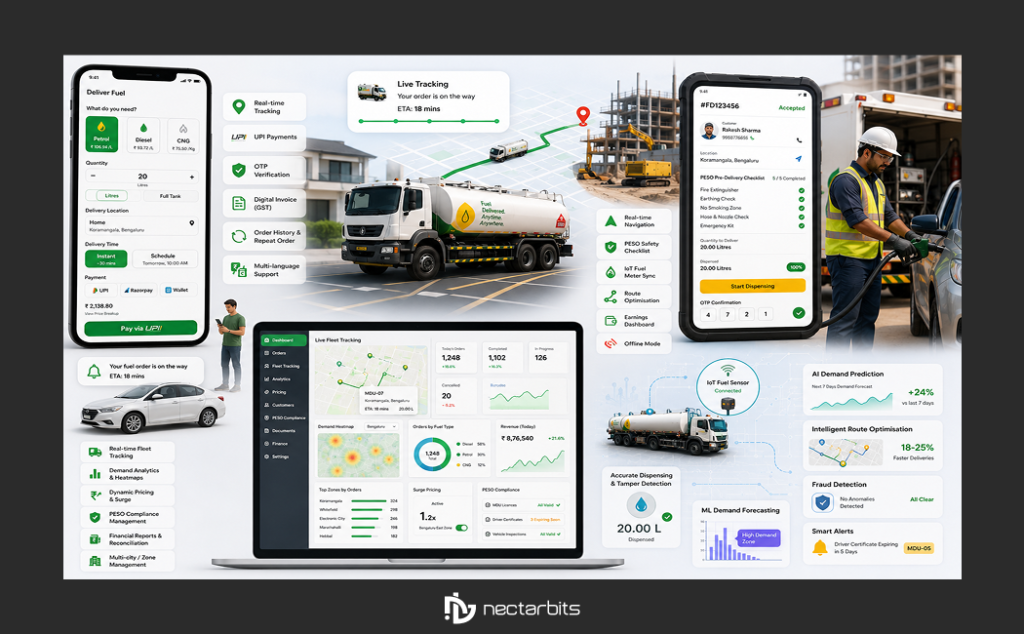
Essential features for India: Real-time GPS order tracking from dispatch through delivery completion. Fuel type and quantity selection, petrol, diesel, CNG, with options in both litres and full-tank estimates. Delivery scheduling covering both instant and pre-scheduled time slots. UPI payment integration alongside Razorpay and PayU, Stripe alone is insufficient for Indian users and will meaningfully reduce conversion rates. OTP-based delivery confirmation to prevent fraud. Digital invoices with correct GST breakdown are sent instantly to the customer’s registered email. Firebase push notifications for order status updates. Full order history with one-tap repeat-order functionality.
Advanced features for scale: AI-powered demand prediction that suggests your customer’s next refuel date based on usage patterns, significantly increasing repeat order frequency. Multi-vehicle management for fleet owners managing multiple assets. Loyalty points and subscription plans for high-frequency users. Regional language support, Hindi and Gujarati at minimum for your core India audience, with Tamil, Marathi, and Telugu for broader national coverage.
Driver App: The Operational and Compliance Backbone
Your driver app is where PESO compliance lives in digital form. It is not just a navigation tool; it is the compliance documentation system that proves your operation is legal at every single delivery.
Essential features: Order acceptance and real-time navigation via Google Maps India API, not a generic global maps integration, because India’s Tier-2 city road coverage is superior on Google’s India-specific dataset. Pre-delivery PESO safety checklist that must be completed and logged digitally before any dispensing begins. Quantity dispensing confirmation with IoT sensor integration for enterprise deployments. Earnings dashboard showing daily, weekly, and monthly figures. In-app route optimisation. Offline mode is non-negotiable for Tier-2 and Tier-3 city operations where connectivity drops regularly.
Admin Panel: Where Your Business Is Actually Run
Essential features: Real-time fleet tracking dashboard showing every driver and every delivery in motion simultaneously. Demand analytics and order management with zone-level visibility. Dynamic pricing controls, including surge pricing capability for peak demand periods. PESO compliance document management, MDU licence tracking, driver certification expiry alerts, and vehicle inspection scheduling. Customer CRM integration. Financial reporting with full UPI and Razorpay reconciliation. Multi-city zone management for businesses operating across multiple cities or states.
AI & IoT Features: The 2026 Competitive Edge
The companies building serious fuel delivery platforms in 2026 are incorporating intelligence into their core stack, not treating it as a future enhancement. IoT fuel sensors on delivery vehicles enable precise dispensing records and tamper detection, critical for enterprise clients who audit every litre dispensed. Machine learning demand forecasting helps operators pre-position trucks ahead of demand spikes, reducing wait times and increasing order capacity during peak windows.
AI-powered route optimisation reduces average delivery time by 18–25% in dense urban environments, a result that depends heavily on how automated dispatching software is structured underneath. Automated fraud detection flags unusual order patterns or payment anomalies before they become operational problems.
Fuel Delivery App Development Cost in India – 2026 ₹ & $ Breakdown
Let us talk about numbers in the currency that actually matters for Indian founders. Every competitor in this space quotes USD. Here is the complete cost breakdown in rupees.
| App Tier | Cost in ₹ | Cost in USD | Timeline | What Is Included |
| MVP / Startup | ₹8 – 12 lakh | $10,000 – $15,000 | 6–10 weeks | Customer app + driver app + admin panel, GPS tracking, UPI/Razorpay payment, basic order analytics, PESO checklist |
| Mid-Level | ₹20 – 35 lakh | $25,000 – $45,000 | 3–4 months | Everything above + AI route optimisation, multi-city zone management, advanced analytics, full PESO compliance module, IoT sensor hooks |
| Enterprise | ₹40 lakh+ | $50,000+ | 5–7 months | Everything above + ERP integration, multi-language support, ML demand forecasting, IoT hardware integration, dedicated SLA support |
What Drives Cost Up or Down in India
India team vs international team: An experienced India-based development team (Ahmedabad, Pune, Bangalore) delivering at $25–49/hr produces the same technical quality as a Western team at $100–150/hr. For a ₹12 lakh MVP, this rate difference versus a US or UK development shop represents a saving of ₹25–35 lakh on the same scope.
Cross-platform versus native development: Building with Flutter or React Native for both iOS and Android costs 30–40% less than maintaining two separate native codebases. For the vast majority of Indian fuel delivery apps, cross-platform app development is the correct architectural decision; the performance difference for a delivery tracking app is negligible, and the cost savings are substantial.
India-native payment gateway integration: Razorpay and PayU integrations are straightforward for development teams with India experience. If you additionally need international payment support or multi-currency billing, budget an additional ₹1–2 lakh for the extra integration and testing work.
PESO compliance module: A properly built PESO compliance workflow, digital delivery checklists, MDU certification tracking, automated documentation generation, licence expiry alerts, adds ₹1.5–4 lakh to any project, depending on depth. This is not an optional feature. It is the legal operating foundation of your business in digital form.
Post-launch maintenance: Budget 15–20% of your initial development cost per year for ongoing maintenance, OS compatibility updates, security patches, and iterative feature additions. A ₹12 lakh MVP costs approximately ₹1.8–2.4 lakh per year to properly maintain. For a granular breakdown of every cost variable, from feature complexity to platform choice to team location, this fuel delivery app development cost analysis covers each parameter in detail.
Tech Stack for Fuel Delivery App Development in India
The technology decisions you make at the start of a fuel delivery app project determine how well it scales, how cost-efficiently it can be maintained, and how reliably it integrates with India’s payment, maps, and connectivity infrastructure.
| Layer | Recommended Technology | Why It Matters for India |
| Mobile — Cross-platform | Flutter / React Native | Single codebase for iOS + Android, 30–40% cost saving, performs well across India’s fragmented device price range |
| Backend | Node.js / Python (Django) | High concurrency handles real-time GPS tracking at scale; a large developer talent pool across India keeps maintenance costs down |
| Database | PostgreSQL + MongoDB | PostgreSQL for transactional data (orders, payments, compliance records); MongoDB for flexible driver and fleet profile data |
| Maps & Navigation | Google Maps India API / Mapbox | Google Maps India has significantly superior road and location coverage for Tier-2/3 cities versus global alternatives |
| Payments | Razorpay, PayU, Paytm | India-native gateways with native UPI support, RBI compliance, and domestic transaction fee structures — Stripe alone is not sufficient |
| Cloud Hosting | AWS Mumbai Region / GCP Mumbai | India-region hosting keeps latency under 50ms for Indian users; non-India hosting typically adds 80–150ms |
| Push Notifications | Firebase Cloud Messaging | Industry standard, highly reliable across Android (dominant in India’s device market) and iOS |
| Real-time Tracking | Socket.io / WebSockets | Enables live GPS position updates without constant API polling — essential for the tracking experience |
| IoT Protocol | MQTT | Lightweight, connection-efficient protocol for IoT fuel sensor data, performs reliably on weak mobile connections |
The payment gateway point deserves direct emphasis. Many development companies, including several well-known ones, default to Stripe in their standard stack. Stripe works in India technically, but its UPI support, domestic transaction fee structure, and RBI compliance complexity make Razorpay or PayU the clearly superior choice for any India-first fuel delivery business. This is a non-negotiable requirement to raise explicitly with any development partner you evaluate.
Read more: The Best Tech Stack for Fuel Delivery App Development, a deeper breakdown of how each technology layer in a fuel delivery platform affects robustness, scalability, and long-term maintenance costs.
White-Label vs Custom Fuel Delivery App – Which Is Right for You?
This is one of the most common decision points for founders in this space, and the right answer is entirely stage-dependent.
| Decision Factor | White-Label Solution | Custom Development |
| Launch time | 4–6 weeks | 4–6 months |
| Cost | ₹2–5 lakh | ₹8 lakh+ |
| IP ownership | None, you license the software | Full codebase ownership |
| Customisation ceiling | Limited to branding and configuration | Unlimited |
| Scalability | Constrained by the vendor’s architecture | Unlimited by design |
| PESO compliance | Varies significantly by vendor | Built precisely to your spec |
| Competitive differentiation | Low, any competitor can buy the same script | High, the product is uniquely yours |
The decision framework:
- Pre-revenue, testing your hypothesis: Go white-label first. Spend ₹3 lakh, launch in six weeks, generate your first 100 orders, and prove the demand is real in your target city. Then build custom with validated data and, ideally, real revenue.
- Post-validation, scaling to multiple cities: Go custom. Your white-label vendor’s technical constraints will cap your growth at precisely the moment you need to accelerate — and rebuilding on a custom platform later costs more in total than building custom from the start. Understanding the full trade-offs between white-label and custom app development across IP ownership, scalability, and feature flexibility is worth reading before you commit either way.
- Enterprise or B2B fleet-focused from day one: Always custom. Enterprise clients require ERP integrations, custom invoicing formats, PESO compliance documentation, SLA guarantees, and multi-city admin structures that no off-the-shelf clone script can provide or promise.
PESO, PNGRB & Legal Compliance for Fuel Delivery Apps in India
This is the section most development blogs skip entirely, and it is the one that can legally shut down your entire operation if you ignore it or treat it as an afterthought.
Doorstep fuel delivery in India is fully legal, but it is regulated across multiple authorities, and your app must function as the digital paper trail that proves compliance at every single delivery.
The Complete Regulatory Framework
PESO: Petroleum and Explosives Safety Organisation. PESO governs the storage, transportation, and dispensing of all petroleum products in India. Any company operating a fuel delivery business must obtain a Mobile Dispensing Unit (MDU) licence from PESO. This licence certifies that your delivery vehicles carry calibrated dispensing meters, proper containment systems, fire safety equipment, and that your drivers are trained and certified.
How India’s most advanced compliant fuel delivery platform handles this in practice is well illustrated in the Jio-bp Fuel4U operational blueprint. Your app’s driver checklist must mirror PESO’s delivery requirements exactly, and the digital records it generates serve as your legal audit trail in the event of any inspection or incident.
Petroleum Rules, 2002. These rules govern specific requirements for petroleum transport, tank construction specifications, driver qualification standards, route restrictions near populated areas and water sources. Every driver in your fleet must hold a valid Hazardous Material (HazMat) transport licence, and your app should automatically track licence expiry dates and flag renewals before they lapse.
CCOE: Chief Controller of Explosives. CCOE certification is required for all vehicles carrying petroleum products above the defined quantity thresholds. Your fleet management module in the admin panel should maintain CCOE certification records per vehicle and alert your operations team to renewal deadlines automatically.
State-Level Transport Permits Petroleum transport permit requirements vary state by state. Gujarat, Maharashtra, Karnataka, Telangana, and other states each maintain specific permit frameworks for vehicles carrying petroleum products. Multi-city expansion requires navigating these jurisdictions by jurisdiction; your admin panel’s compliance module should manage this at the state level.
PNGRB Draft Consumer Protection Regulations, December 2025. This is the newest and most significant regulatory development in India’s fuel delivery space. The Petroleum and Natural Gas Regulatory Board’s December 2025 draft regulations explicitly address digital fuel delivery operations for the first time, requiring operators to maintain verifiable digital delivery records, provide consumers with transparent upfront pricing, and establish formal grievance redressal mechanisms within defined timeframes. Any fuel delivery app built or updated in 2026 should be architected with these draft regulations as a design constraint; they are expected to be formalised into binding law within 12–18 months.
What This Means for Your App Architecture
Your fuel delivery app is not simply a marketplace connecting buyers and sellers. It is a compliance management system that must document every interaction, every dispensing event, every driver certification, and every vehicle inspection, in a format that a regulator can audit at any point.
The PESO delivery checklist embedded in your driver app, the MDU licence tracker in your admin panel, the automated state permit renewal alerts, and the immutable digital delivery records are not value-added features. They are legal requirements, and the development partner you choose needs to treat them as such from the first line of architecture.
How the Fuel Delivery App Development Process Works – Step by Step
For founders who have not previously commissioned a custom application, understanding the real development process prevents the misaligned expectations that turn good projects into expensive, prolonged ones.
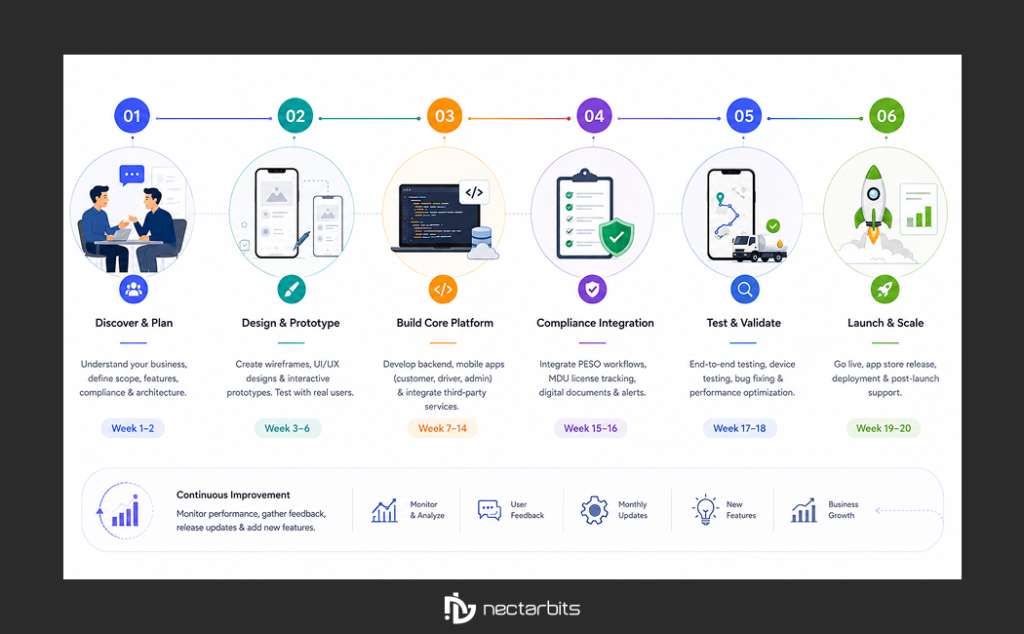
Week 1–2: Discovery & Scoping Your development partner runs structured discovery sessions covering your business model (aggregator vs owned fleet vs franchise), your target cities for launch, your compliance requirements by state, and your realistic go-to-market timeline. The output is a detailed scope document, feature priority matrix, and technical architecture proposal. Do not treat this phase as administrative overhead; it is where every costly misunderstanding gets prevented before it costs money.
Week 3–6: UI/UX Design & Prototyping Wireframes and interactive prototypes for all three applications, customer, driver, and admin. For India specifically, this phase must include UPI payment flow design (which has different UX conventions than card payment flows), Hindi and regional language support architecture, and low-bandwidth performance optimisation for Tier-2/3 city connectivity conditions. Get real users, actual fleet managers, petrol pump operators, or fuel station owners, to test the prototype before production code begins.
Week 7–14: Core Development Backend API development, database architecture, mobile application coding for all three apps, and third-party integrations, Razorpay, Google Maps India API, Firebase, IoT sensor hooks where applicable. For a ₹12 lakh MVP, this phase takes 6–8 weeks with a team of 3–4 developers working in parallel sprints with weekly client review checkpoints.
Week 15–16: PESO Compliance Module Integration. The compliance module, driver delivery checklists, MDU licence tracking, digital documentation generation, and certification expiry alerts are developed, integrated, and tested across both the driver app and admin panel. This is the phase where under-resourced development teams commonly cut corners. Insist on seeing the complete compliance workflow demonstrated end-to-end before accepting it.
Week 17–18: QA, Testing & Bug Resolution End-to-end testing of every user flow, payment scenario, GPS tracking accuracy, compliance checklist completion, and edge case handling. Critically: include testing on low-end Android devices in the ₹8,000–₹15,000 price range. These are the devices your drivers will actually use in the field, not the flagship handsets development teams typically test on.
Week 19–20: Launch & App Store Submission Google Play and App Store submission, production server deployment on AWS Mumbai region for low-latency Indian performance, go-live support, and operational handover with driver and admin onboarding documentation. Your development partner should be available for a minimum of two weeks post-launch to address any production environment issues.
Post-Launch: Maintenance & Iterative Improvement. The best fuel delivery apps are not built once and left static. Plan for monthly update cycles in the first six months; real usage patterns will reveal gaps and opportunities that no amount of pre-launch planning can perfectly anticipate. Allocate 15–20% of the initial development cost per year for ongoing maintenance and feature development.
How Nectarbits Builds Your Fuel Delivery App in India
We have built on-demand delivery applications for the Indian market across fuel, logistics, hyperlocal retail, and fleet management. Here is exactly what our engagement delivers.
What we build: A fully PESO-compliant fuel delivery platform consisting of three integrated applications, a customer app for iOS and Android built on Flutter, a driver app with embedded compliance workflows, and a web-based admin panel, running on a Node.js backend with PostgreSQL, Google Maps India API, Razorpay and PayU payment integration, and deployed on AWS Mumbai region for sub-50ms latency across India.
Who we build for:
- Fuel delivery startups: MVP delivered in 8–10 weeks at ₹8–12 lakh, PESO-compliant and production-ready from launch day
- Fuel station and petrol pump owners: white-label digital platform to expand delivery reach without building a fleet from scratch, live in 4–6 weeks
- Oil and gas retailers and distributors: custom multi-city enterprise platforms with ERP integration, consolidated invoicing, and compliance reporting
- Fleet operators and logistics companies: B2B fleet fuelling platforms with driver management, fuel consumption analytics, automated reorder triggers, and GST-compliant invoicing
- Existing fuel delivery businesses: technology modernisation and migration from legacy or manual systems to scalable digital infrastructure
Our development timeline for a standard MVP:
| Phase | Timeline | Deliverable |
| Discovery & Scoping | Week 1–2 | Scope doc, feature matrix, compliance requirements map |
| UI/UX Design & Prototype | Week 3–5 | Interactive prototype, India-first UX design, client sign-off |
| Core Development | Week 6–12 | All three apps, backend, and third-party integrations |
| PESO Compliance Module | Week 13–14 | Compliance workflows, licence tracking, documentation |
| QA & Testing | Week 15–16 | Device testing, payment flows, GPS accuracy, compliance |
| Launch & Submission | Week 17–18 | App Store deployment, AWS go-live, handover |
| Post-Launch Support | Ongoing | Monthly updates, OS compatibility, feature additions |
Engagement details: $25–$49/hr | Minimum project $5,000+ | Clutch rated | Based in Ahmedabad, India
Learn more about our on-demand delivery app development services across fuel, logistics, grocery, and hyperlocal verticals: On-Demand App Development — Nectarbits
Conclusion — Choosing the Right Fuel Delivery App Development Partner in India
The Indian fuel delivery market is not a future opportunity; you are too early to. It is a present one, with validated demand across Tier-1 and Tier-2 India, regulatory clarity arriving through PNGRB’s December 2025 draft rules, and proven platforms like FuelBuddy and Repos Energy demonstrating that the business model works at scale.
Choosing the right fuel delivery app development company in India comes down to four criteria that no amount of portfolio screenshots or awards logos can substitute for: genuine, working knowledge of India’s PESO and PNGRB compliance framework; transparent pricing in rupees rather than vague USD ranges that mean nothing to an Indian founder; India-native payment stack expertise, Razorpay, PayU, and UPI, not just Stripe; and a demonstrated track record with on-demand logistics applications specifically, not just mobile apps in general.
The companies listed in this guide meet those criteria across different budget ranges and specialisations. Match the partner to your stage: white-label for validation, custom for scaling, enterprise for fleet and industrial, and resist the urge to over-engineer your first version.
The Indian fuel delivery market will not wait. Build smart, build compliant, and build now.
FAQs:
A fuel delivery app MVP in India costs between ₹8–12 lakh ($10,000–$15,000) and typically takes 6–10 weeks to build with an experienced India-based team. A mid-level app with driver management, multi-city support, advanced analytics, and a full PESO compliance module ranges from ₹20–35 lakh ($25,000–$45,000). An enterprise platform with AI route optimisation, IoT sensor integration, and ERP connectivity exceeds ₹40 lakh ($50,000+). All three tiers include the customer app, driver app, and admin panel — these are not optional components.
Yes, doorstep fuel delivery is fully legal in India. Operators must obtain a Mobile Dispensing Unit (MDU) licence from PESO, comply with Petroleum Rules 2002, ensure all delivery vehicles carry PESO-certified dispensing equipment, and employ trained HazMat-licensed drivers. The PNGRB’s Draft Consumer Protection Regulations, released in December 2025, further formalise digital fuel delivery operations and are expected to become binding law within 12–18 months.
An MVP covering order placement, GPS tracking, UPI payment, driver app, and admin panel takes 6–10 weeks with an experienced India-based development team. A full-featured app with AI routing, PESO compliance module, IoT integration, and multi-language support takes 4–6 months. Enterprise-grade platforms for multi-city B2B operations typically require 5–7 months from initial discovery to production launch.
Flutter or React Native for cross-platform mobile (30–40% cost saving over native), Node.js or Python/Django for backend, PostgreSQL and MongoDB for database, Google Maps India API for navigation, Razorpay and PayU for India-native UPI-compatible payments, AWS Mumbai region for low-latency cloud hosting, Firebase for push notifications, and MQTT protocol for any IoT fuel sensor integrations. This stack is proven across production on-demand delivery platforms in the Indian market.
The leading fuel delivery platforms in India are FuelBuddy (B2B diesel, pan-India, acquired MyPetrolPump, Repos Energy (130+ cities, franchise model), HPCL Fuel@Call and IndianOil’s doorstep delivery platform (PSU-backed, significant UX gaps), and Humsafar India (Delhi NCR, industrial diesel bowsers). FuelBuddy dominates the enterprise fleet segment. Repos Energy leads in Tier-2 city expansion.
A white-label fuel delivery app is a pre-built solution you rebrand and configure — launches in 4–6 weeks for ₹2–5 lakh, but you own no IP and are constrained by the vendor’s feature roadmap. A custom app is built from scratch in 4–6 months for ₹8 lakh+, giving you full IP ownership, unlimited scalability, and an architecture built precisely around your business model and India compliance requirements. Pre-revenue startups should start white-label; businesses with proven traction should build custom.
The most common models: per-delivery commission (2–5% of order value) for aggregator platforms; subscription plans for fleet operators (fixed monthly fee with volume caps); per-litre fuel markup on top of market rate; surge pricing during peak demand periods; and B2B enterprise contracts with logistics companies on monthly retainer terms. In India, the B2B fleet-focused model generates the most predictable revenue — consumer B2C delivery has higher churn and lower order frequency, making it a harder standalone business without a strong fleet or industrial anchor.
The best company depends on your stage and requirements. For startups and fleet operators wanting a PESO-compliant build with transparent ₹ pricing and India-native integrations, Nectarbits is the recommended first call. For large enterprise budgets with a preference for a company with a long operating history, JPLoft or Hyperlink InfoSystem are strong options. For cost-transparent mid-market builds, Apptunix delivers well. Evaluate any partner on: India compliance knowledge, Razorpay/PayU integration experience, on-demand logistics portfolio, and verifiable reviews on Clutch.co or GoodFirms.