
 Anil Patel
Drivers in the UAE spend an average of 30 minutes per petrol station visit, queuing under blazing heat, wasting time they simply don’t have. CAFU looked at that frustration and built something the world had never seen before: a mobile platform that brings the fuel station directly to your vehicle, wherever it is parked.
That idea became the Middle East’s first on-demand fuel delivery service, a company that has served nearly one million customers, delivered over 200 million litres of fuel, and is now expanding across continents. For founders exploring on-demand fuel delivery app development, CAFU is the clearest case study in the world.
But here’s what most blogs don’t tell you: the app is the easy part. The business model, the regulatory compliance, the operational infrastructure, and the technology architecture behind CAFU are what it really takes. And if you’re a founder in the UAE, South Africa, Canada, Kenya, India, or the USA evaluating this space, this guide is written specifically for you.
What Exactly Is CAFU? Understanding the Company Behind the Blue-Green Trucks
CAFU is not just a fuel delivery app. It is, in the words of its own leadership, a mobile infrastructure company, one that happens to start with fuel and extends to every service a vehicle owner needs.
Founded in 2018 by Rashid Al Ghurair, a third-generation member of one of Dubai’s most influential business families, CAFU launched with a bold premise: the conventional model of going to a physical petrol station is built on infrastructure that is over 100 years old. Petrol stations sit on expensive real estate, are only busy twice a day, and force customers to come to them. CAFU reversed that entirely.
Its mission, as stated by Chief Business Officer Alaa El-Huni: “to provide every service imaginable and convenient for drivers and vehicle owners and operators of vehicles.”
Today, CAFU operates across Dubai, Abu Dhabi, Sharjah, Ajman, Umm Al Quwain, Oman, Egypt, and Canada, and is actively exploring Saudi Arabia and further global markets.
Key company facts at a glance:
- Founded: 2018, Dubai, UAE
- Founder: Rashid Al Ghurair
- Funding raised: $100M+ (SoftBank Vision Fund, Mubadala Investment Company, STV)
- Customers served: Nearly 1 million
- Fuel delivered: Over 200 million litres
- Tech infrastructure: Built on AWS microservices architecture (Amazon EKS, Amazon RDS, Amazon Redshift)
- Engineering productivity improvement after tech overhaul: 100%+
- Infrastructure cost reduction post-AWS migration: 50%+
In December 2025, Amazon UAE partnered with CAFU to offer Prime members a 12-month free fuel-delivery subscription, signalling how central this service has become to daily urban life in the UAE.
Every Service CAFU Offers to Its Customers Today
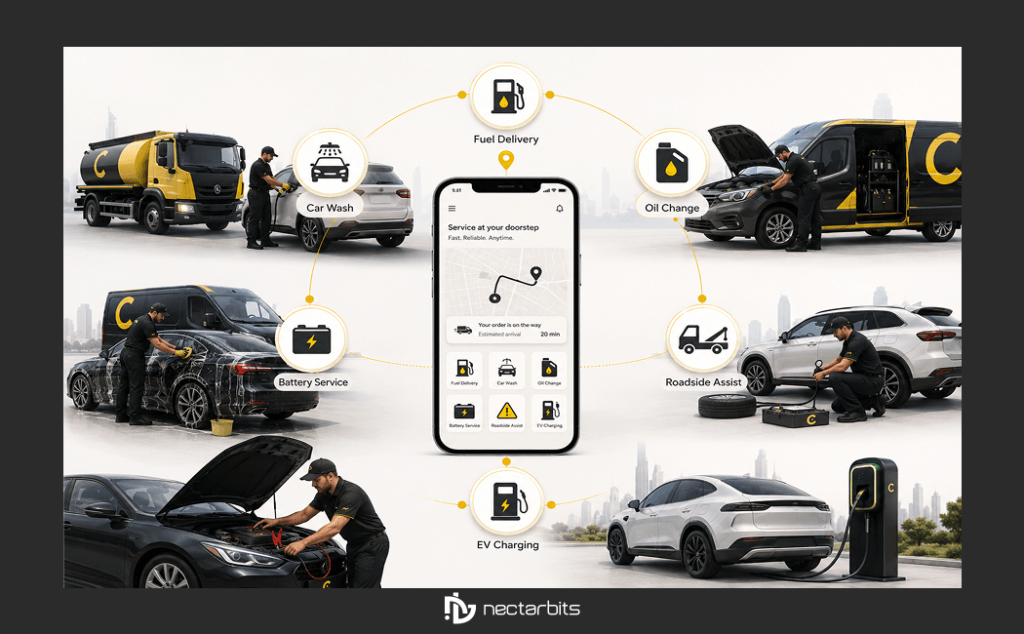
Most articles describe CAFU as a “fuel delivery app.” That significantly undersells the platform. CAFU has evolved into a complete on-demand vehicle services platform. Here is everything it offers:
Core Fuel Delivery Services
On-demand petrol delivery (Super 95, Super 98), diesel delivery, scheduled fuel delivery, overnight delivery (12 am–6 am), motorcycle fuel delivery, boat and jet ski refuelling at select Dubai marinas, and generator fuel delivery.
Vehicle Maintenance Services
Engine oil change (in partnership with Mobil), mobile car wash (waterless and full wash), battery replacement and emergency charging, tyre change and inflation, and a 10-point vehicle health check.
Emergency and Roadside Services
Emergency fuel delivery for vehicles that have run dry, roadside assistance and rescue, and emergency battery jump-start.
Future and Next-Generation Services
EV mobile charging, currently piloted in Montreal, Canada, and hydrogen energy delivery as part of CAFU’s long-term mobility vision. The model mirrors the broader market’s trajectory, as detailed in this forward-looking analysis of the future of on-demand fuel and energy apps.
STRATEGIC INSIGHT
This full-service evolution is deliberate. CAFU’s strategy is to become the single platform for everything a vehicle owner needs, eliminating the need to visit any fixed location for car maintenance. As CTO Aadam Zaidi put it: “The purpose of you owning your vehicle is to take you places, not to worry about where you need to take the vehicle.”
How the On-Demand Fuel Delivery App Actually Works– Step by Step
Understanding the user experience is important, but understanding what powers it is essential for anyone considering building something similar.
From the customer’s perspective, it’s beautifully simple: download the app and register with vehicle details → pin your location on the map → select fuel type and quantity → choose instant or scheduled delivery → leave the fuel cap unlocked and go about your day → a certified CAFU pilot arrives and refuels contactlessly → receive a digital receipt with automatic payment.
Behind the scenes, three interconnected technology panels run the entire operation:
Customer App
Real-time location pinning, fuel type and service selection, in-app payment (credit card, Apple Pay, digital wallets), live GPS tracking of the pilot, push notifications, order history, loyalty rewards, and subscription management.
Driver (Pilot) App
AI-optimised route assignment, GPS navigation, order details and safety checklists, delivery confirmation, digital receipts, and compliance logging.
Admin Dashboard
Fleet management, zone heat maps, demand forecasting, driver performance monitoring, inventory tracking, customer analytics, B2B client billing, and real-time operations oversight.
TECHNOLOGY INSIGHT
CAFU’s pilots are fully HAZMAT-certified and trained in first aid, emergency spill response, and fire extinguisher use. Their trucks use IoT-enabled flowmeters of the same grade used by multinational oil and gas companies. When their monolithic stack caused 5-second load times, CAFU rebuilt everything on AWS using Amazon EKS microservices, achieving 100%+ engineering productivity improvement, 50%+ endpoint latency reduction, and 50%+ infrastructure cost reduction.
For a deeper look at what powers platforms like this, see our guide on the best tech stack for fuel delivery app development.
CAFU Pricing Strategy: From Free Delivery to Sustainable Growth
The Free Delivery Era (2020–2025): A Growth Subsidy, Not a Revenue Model
From July 2020 through April 2025, for nearly five years, CAFU offered completely free fuel delivery. This was a deliberate growth subsidy, funded by Al Ghurair family capital and investor backing, designed to build deep customer habits, eliminate competitor entry windows, and dominate market share before anyone else could establish themselves.
Most blogs describe CAFU as a company that “charges for delivery.” What they miss is the five-year period when it didn’t — and what the decision to reintroduce fees in 2025 reveals about the true unit economics of citywide 24/7 fuel logistics. Understanding this distinction is critical when planning how to start an on-demand fuel delivery business in your own region.
The 2025 Business Model Shift: What It Tells Founders
In April 2025, CAFU reintroduced delivery charges with a tiered pricing structure:
| Service Level | Delivery Time | Fee per Order |
| Priority Delivery | Within 20 minutes | AED 20 |
| Standard Delivery | 30 minutes – 2 hours | AED 16 |
| Overnight Delivery | 12 am – 6 am | AED 12 |
| Monthly Subscription | Unlimited deliveries | AED 26/month |
The message CAFU sent to clients was direct: “Keeping a service like this running, citywide 24/7, takes a lot behind the scenes.”
For founders, this is the most important signal in the entire CAFU story. The real cost of operating a fuel delivery network — dead mileage, HAZMAT-certified drivers, custom fuel trucks, safety compliance, insurance, IoT maintenance, and 24/7 dispatch — is substantial. Build your fee model honestly from day one.
How CAFU Makes Money: All 7 Revenue Streams Explained
CAFU’s profitability is not built on a single income source. It is a carefully layered revenue architecture that has been refined over seven years of operation.
1. Tiered Delivery Fees
Per-order fees range from AED 12 to AED 20, depending on service level, plus AED 26/month for subscription members. The subscription model is particularly valuable; it locks in recurring revenue, reduces churn, and gives CAFU predictable operational planning.
2. Fuel Price Margin
CAFU purchases fuel in bulk at wholesale prices from certified suppliers, then delivers it at prices competitive with local petrol stations. In the UAE, fuel prices are regulated by the Supreme Energy Council, which means CAFU competes on service, not price. As El-Huni explained: “It is mostly a volume game. The more petrol CAFU purchases, the lower the price.” Margins are thin per litre but significant at scale.
3. B2B Fleet Contracts–The Most Scalable Revenue Engine
This is the revenue stream that most blogs mention briefly, and none explain properly. CAFU holds corporate fleet contracts with businesses that operate large vehicle networks. The Ekar partnership is the clearest example: CAFU’s AI automatically triggers a refuel when an Ekar car-share vehicle drops to 25% fuel capacity, no human order required on the client’s side.
For fleet operators, this eliminates driver downtime at petrol stations, prevents fuel fraud, and centralises billing and reporting. For CAFU, it means high-volume orders with low acquisition cost, long-term contracts, and very low churn. On the B2B side, a single CAFU truck can fill 40 vehicles in one hour (versus 12 on the B2C side), making fleet service dramatically more efficient per operational hour.
If you are planning a mobile fuel delivery app for South Africa, Kenya, or Canada — where construction fleets, mining operations, logistics companies, and corporate vehicle pools run large networks, B2B fleet contracts are your fastest and most defensible path to revenue.
4. Value-Added Vehicle Services
Car wash, oil changes, battery replacement, tyre services, emergency rescue, each adds per-visit revenue and increases customer lifetime value. These services transform a fuel delivery transaction into an ongoing vehicle care relationship.
5. In-App Advertising and Brand Partnerships
CAFU’s user base, high-income vehicle owners and fleet managers, is valuable to automotive brands, insurance companies, tyre manufacturers, and car service businesses. In-app advertising and bundled promotional partnerships generate incremental revenue without adding operational cost.
6. Data Monetisation
CAFU collects rich data on vehicle behaviour, fuel consumption patterns, peak demand zones, and delivery logistics. Aggregated and anonymised, this data is commercially valuable to automotive manufacturers, urban planners, fuel suppliers, and logistics companies. As the platform matures, this becomes an increasingly important margin-accretive revenue layer.
7. EV Charging and Alternative Energy
CAFU’s Canada pilot of mobile EV charging in Montreal is not a side project; it is the company’s strategic bet on where mobility is heading. The logic, as El-Huni articulated, is compelling: “If vehicles are smart, connected to the internet and IoT-enabled, why are we using a fixed infrastructure model as opposed to a mobile, dynamic model that can go to where the asset is?” EV charging infrastructure built on fixed locations becomes obsolete as battery technology evolves. CAFU’s mobile model is inherently future-proof.
CAFU Fuel Delivery App Model: The Business Canvas
Here is the CAFU fuel delivery app model through the Business Model Canvas framework, the strategic foundation that any CAFU fuel delivery app development project must be built on.
Value Proposition: Eliminate the need to visit a petrol station — ever. Fuel, maintenance, and emergency services come to you, 24/7, at home, office, or anywhere your vehicle is parked.
Customer Segments: Urban vehicle owners (B2C); corporate and commercial fleet operators (B2B); logistics and delivery companies; car-share and rental operators; hospitality and tourism vehicles; boat and marine owners.
Key Channels: iOS and Android mobile apps; direct B2B corporate sales; loyalty programme; Amazon Prime partnership (UAE).
Revenue Streams: Delivery fees, fuel margin, B2B fleet contracts, value-added services, subscriptions, in-app advertising, data monetisation, EV charging.
Key Resources: Proprietary routing algorithms, HAZMAT-certified pilot fleet, certified fuel inventory, IoT-equipped tanker trucks, AWS microservices platform, regulatory approvals across multiple markets.
Key Partnerships: Fuel suppliers (wholesale procurement), Ekar (B2B fleet auto-refuel), Mobil (oil changes), IVI Quebec (EV charging R&D), Amazon UAE (Prime membership), AWS (cloud infrastructure).
Cost Structure: Fuel procurement, custom tanker fleet capital and maintenance, driver wages and certification, insurance, technology platform, regulatory compliance, customer acquisition, and 24/7 dispatch operations.
The Regulatory Moat: Why CAFU Is Hard to Replicate
Every competitor blog lists app features and cost estimates. Almost none explain the most important reason CAFU is difficult to replicate, and it has nothing to do with the app.
Fuel is a hazardous material. Moving it through urban streets requires a level of regulatory compliance that functions as a genuine competitive moat. Before operating, a CAFU-like business needs:
- Fire marshal and civil defence approvals
- Transport authority permits for hazardous goods vehicles
- Full HAZMAT driver certification (not a quick process)
- National fuel quality compliance (ESMA in the UAE; equivalent bodies elsewhere)
- Environmental agency clearances for spill prevention and emergency protocols
- Vehicle-specific insurance frameworks for fuel transport
- Regulatory approval for any new service area or market entry
El-Huni confirmed this directly: “We’re operating in areas that did not exist before we launch, which means we have to work closely with regulators, which takes time.”
In South Africa and Kenya, where the on-demand fuel space is still early, the founder who earns regulatory clearance first builds a moat that competitors cannot cross quickly. In Canada and the USA, compliance requirements are even more detailed, but the B2B fleet market that operates within that framework is enormous and highly profitable.
When selecting a fuel delivery app development partner, regulatory workflow design must be part of the conversation from the first meeting, not an afterthought after the app is built.
How AI and IoT Power CAFU’s Operations, and Why Your Build Needs Both
CAFU is not a logistics company that added an app. It is an AI and IoT-powered platform that happens to operate physical fuel trucks. The distinction matters enormously for anyone planning a comparable build.
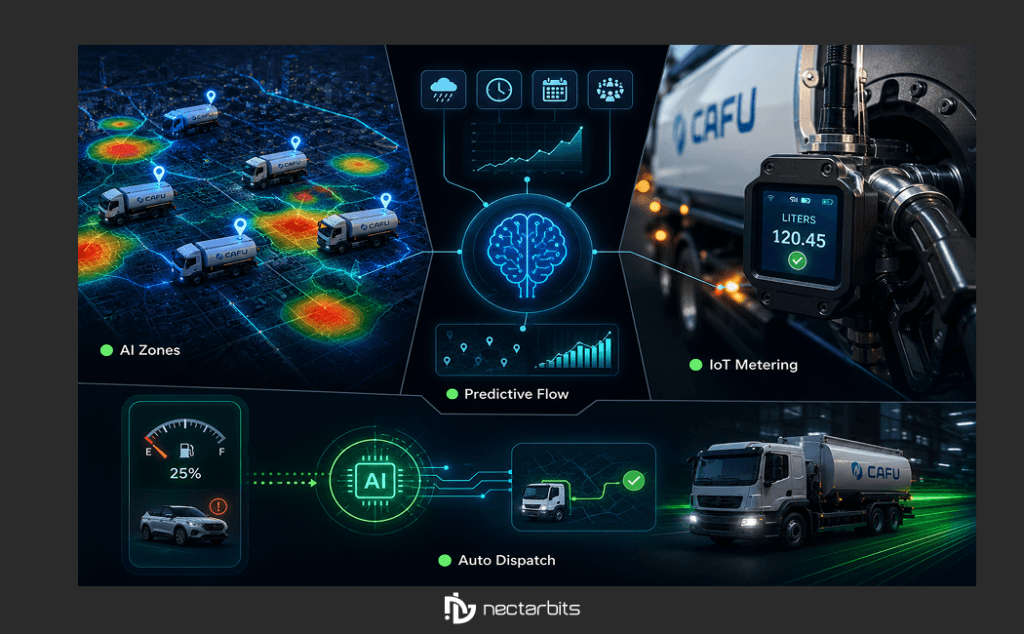
AI Heat Mapping and Zone Management
CAFU uses proprietary AI algorithms to identify the busiest areas of a city and pre-position its fleet accordingly. Unlike taxis that roam and hope for a customer, CAFU’s trucks focus on specific demand zones. This dramatically reduces dead mileage — the single biggest profitability killer in any delivery business.
AI-Triggered B2B Fleet Refuelling
When an Ekar partner vehicle drops to 25% fuel, CAFU’s system automatically dispatches a pilot. The client does not place an order. This is autonomous fleet management — a genuine technology differentiator that eliminates the need for human dispatch entirely on the B2B side. This same principle applies whether you’re building a fuel platform or scaling a fleet management system for a trucking operation.
IoT Smart Flowmeters
Every CAFU truck carries precision IoT flowmeters — the same grade used by multinational oil and gas companies. Every delivery is measured and confirmed to the litre, eliminating disputes and building customer trust at scale.
Predictive Demand Forecasting
Historical order data, time of day, weather patterns, and city events feed CAFU’s forecasting models. Trucks are positioned before demand spikes — not in response to them. Modern Fuel Delivery Dispatch Software combines this forecasting layer with automated driver assignment and real-time route optimisation.
AWS Microservices Architecture
When CAFU’s monolithic stack couldn’t scale, causing 5-second load times and blocking feature launches, it rebuilt everything on AWS using Amazon EKS, Amazon RDS per microservice, and Amazon Redshift for analytics. The rebuild enabled 100%+ improvement in engineering productivity and 99.99% database availability.
FOR ENTREPRENEURS BUILDING IN THE USA, SOUTH AFRICA, OR KENYA
Incorporating AI routing and IoT device integration from the architecture phase is what separates a sustainable platform from a short-lived startup. These aren’t premium add-ons — they are foundational to unit economics.
Is This Market Right for Your Region? A Founder’s Reality Check
CAFU’s model worked in the UAE because of a rare combination of conditions: deregulated fuel pricing (enabling delivery margins), extremely high car ownership (3.4M vehicles), a population accustomed to premium on-demand services, brutal summer heat, and the capital and family backing to subsidise free delivery for five years.
Not every market has those conditions, but every market has some conditions that favour a version of this model. Here’s how to read your geography:
UAE and Gulf (ex-subsidised markets): Consumer-first fuel delivery is proven here. If you’re entering the UAE market now, differentiation through superior tech, better B2B fleet services, or underserved emirates (Northern UAE, for instance) is your path.
South Africa and Kenya: Fuel is less regulated and logistics infrastructure is uneven — but those are the exact conditions where on-demand B2B fuel delivery for construction sites, mining operations, agricultural equipment fleets, and logistics companies thrives. FuelBuddy’s September 2025 expansion into Zimbabwe and Zambia confirms Africa’s trajectory. The window for a first-mover in your specific market is still open.
Canada: CAFU is already here with its EV charging pilot in Montreal. The B2B fleet and corporate campus fuelling market is substantial and underserved by technology-enabled operators. A compliance-ready platform built by a mobile app development company in Canada has genuine competitive space, particularly in provinces targeting EV adoption.
USA: Consumer-first attempts (Fuelster, Filld) struggled with thin margins and high customer acquisition costs. B2B-first — logistics depots, corporate campuses, government fleets, construction sites, is where durable revenue lives.
India: Rapid urbanisation, high urban vehicle density, and maturing digital payment infrastructure make the consumer market increasingly viable in tier-1 cities. Government-authorised launches (like Anytime Diesel in Hyderabad) are proof points that regulatory clearance is achievable. The market is moving, and early movers will define the category.
What It Takes to Build the Right Team for Your Fuel Delivery App–And Why Nectarbits Is Built for This
Given everything above, the regulatory complexity, the operational logistics, the AI and IoT requirements, the multi-panel architecture, the need to serve B2C and B2B simultaneously, the most consequential decision you will make is choosing who builds your platform.
A capable fuel delivery app development team needs to understand far more than mobile app features. They need to architect a system that handles real-time logistics, compliance workflows, IoT device integration, AI-driven route optimisation, multi-stakeholder panels, automated fleet management triggers, and scalable payment infrastructure across multiple markets and currencies.
This is not a project for a generalist development shop.
At Nectarbits, we are built specifically for this kind of challenge. Our team has delivered on-demand platforms for clients across the UAE, South Africa, Canada, India, Kenya, and the USA, markets we understand not just technically, but operationally and commercially.
Here is what working with Nectarbits on a fuel delivery platform looks like:
Business Model First: before a single line of code is written, we work with you on your revenue model, target customer segment (B2C, B2B, or hybrid), regulatory roadmap for your specific market, and unit economics. The most expensive mistake in on-demand app development is building the wrong product with the wrong model. We prevent that.
Architecture That Scales: We build on a microservices architecture so that adding new services (car wash, oil changes, EV charging) doesn’t require rebuilding your platform. We have delivered custom software development solutions that have scaled from MVP to thousands of daily transactions without an architectural overhaul.
AI and IoT Integration: from AI-driven route optimisation and demand heat mapping to IoT flowmeter integration and automated B2B fleet triggers, we design and build the intelligence layer that makes your operation efficient enough to be profitable.
Compliance-Ready Design: We design workflows with your target market’s regulatory requirements built in, whether that’s HAZMAT logging in the UAE, hazardous goods transport permits in South Africa, or environmental compliance documentation in Canada.
Full Development Team or Dedicated Specialists: whether you need a complete end-to-end build or want to hire dedicated developers to augment your existing team, Nectarbits can structure the engagement to suit your timeline and budget.
Markets We Serve: UAE, South Africa, Kenya, Canada, USA, India, and expanding. Our Canadian team operates through Nectarbits and specialises in North American regulatory and market requirements.
The Real Challenges of Building a Fuel Delivery App Like CAFU
The title of this guide promised to tell you what it really takes. Here it is, without the sales pitch.
Dead Mileage is the profitability killer that no competitor blog explains properly. A fuel truck driving across a city without completing a delivery earns zero revenue but costs the driver time, fuel, depreciation, and insurance on every kilometre. CAFU’s AI heat mapping and zone positioning system exists entirely to solve this problem. If your build doesn’t address dead mileage from day one, your unit economics will not work.
Fuel Price Volatility is unpredictable. Unlike food delivery, where ingredient costs shift slowly, fuel prices can move significantly within days. Your pricing model needs to account for this volatility without creating constant friction with customers who expect consistent pricing.
Fleet Capital Costs are higher than most founders’ budgets. Custom fuel trucks with IoT flowmeters, safety equipment, GPS tracking, compliance instrumentation, and appropriate insurance do not come cheap. Underestimating fleet cost is one of the most common reasons early-stage fuel delivery startups fail to reach profitability.
Driver Certification Lead Times are real and non-negotiable. HAZMAT certification is not a two-day course. In most markets, it involves multiple certifications, background checks, and practical assessments. Factor this into your operational timeline before your app launches.
Regulatory Approval Delays are almost always longer than founders expect. In some markets, permitting for hazardous goods transport takes 3–6 months. Build your compliance roadmap before you build your app, not after. Market-Specific Economics vary dramatically. Saudi Arabia’s subsidised fuel prices (roughly SAR 0.67–1.05 per litre) leave almost no margin for a consumer delivery business built on price differential. Kuwait, Bahrain, and parts of Oman face similar constraints. Know your market’s fuel pricing regime before you model your revenue.

The Bottom Line: CAFU’s Success Is Replicable With the Right Foundation
CAFU didn’t win because it had the best-looking app. It won because it combined the right market conditions, earned regulatory compliance before competitors, built an operational infrastructure that the technology could rely on, and then put an elegant, intelligent platform on top of all of it.
The ambition, as Al Ghurair stated clearly, was never to be acquired by a global player. It was to become that global player. The EV charging pilot in Montreal, the Amazon Prime partnership in the UAE, the ongoing expansion — these are the moves of a company that built a genuine platform, not just a feature.
For founders in South Africa, Kenya, Canada, India, and the USA, the opportunity is real. You don’t need to replicate CAFU’s exact path. You need to understand its principles, B2B fleet contracts as your revenue foundation, regulatory compliance as your competitive moat, AI and IoT as your operational differentiator, and apply them intelligently to your market.
If you are seriously evaluating this space, the next step is not wireframes. It is a conversation about your market, your regulatory environment, your target customer, and your revenue model.
Explore more from Nectarbits:
- How to Start an On-Demand Fuel Delivery Business in 2026
- Top On-Demand Fuel Delivery App Startups to Watch
Frequently Asked Questions:
Development costs typically range from $40,000 to $250,000 USD, depending on platform complexity, features, number of panels, AI integration, IoT connectivity, and the development team’s location. A market-ready MVP (customer app, driver app, admin dashboard) with core features typically starts at $50,000–$80,000. Enterprise-grade builds with full AI routing and IoT integration sit at the higher end. Connect with Nectarbits for a market-specific estimate.
Unless you’re operating in the UAE or a similarly structured market, B2B fleet contracts should be your primary revenue focus. B2B delivers higher order volumes, recurring contracts, and dramatically lower customer acquisition costs. CAFU itself fills 40 vehicles per hour on the B2B side versus 12 on B2C, the efficiency difference is significant.
Real-time GPS, in-app payments, push notifications, multi-panel architecture (customer, driver, admin), and route optimisation at a minimum. For scale and profitability: AI demand forecasting, IoT flowmeter integration, automated fleet management triggers, microservices architecture, and business intelligence dashboards. CAFU rebuilt on AWS (Amazon EKS + RDS + Redshift) and achieved 100%+ engineering productivity improvement as a result.
South Africa, Kenya, India, Canada, and the UAE (for B2B fleet services specifically) offer the strongest near-term opportunity. The global on-demand fuel delivery market is projected to grow from $5.06 billion in 2025 to $12 billion by 2035, early movers in underserved markets will define the category.
It depends on your market’s fuel pricing structure, regulatory environment, vehicle ownership density, and digital payment adoption. The Nectarbits team has delivered on-demand fuel platforms across multiple regulatory environments. Get in touch, and we’ll give you an honest assessment of what works for your specific geography.